
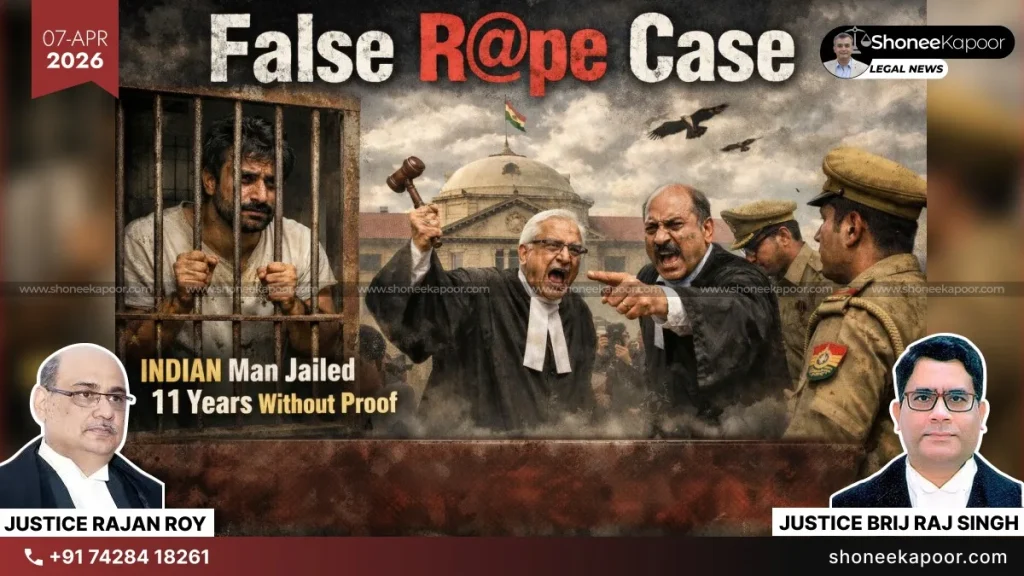
No DNA. No eyewitness. Still 11 years behind bars—how did this conviction even happen? The Allahabad High Court’s findings expose what really went wrong inside the system.
UTTAR PRADESH: The Lucknow Bench of the Allahabad High Court set aside the conviction of a man who had spent 11 years in jail in a 2010 case involving allegations of rape of a 14-year-old girl.
The bench of Justice Rajan Roy and Justice Brij Raj Singh found major gaps in the investigation and clearly stated that the police committed a “serious lapse” by not matching the semen found on the victim with the accused. The trial court had earlier convicted the man in 2018 under Section 376 IPC and sentenced him to life imprisonment along with a fine of ₹50,000.
The High Court made it clear that criminal conviction cannot be based on assumptions or weak evidence, observing that:
“Considering the standard of proof in criminal matters, one cannot, on mere hunch or suspicion, convict a person and hold him guilty of such offence”.
This observation became central to the acquittal, highlighting how strict proof is necessary before taking away a person’s liberty for such serious charges.
As per the prosecution, the incident took place on September 20, 2010, when the accused allegedly lured and raped his minor neighbour. The girl died three days later, after which her father filed an FIR under Sections 376, 302, and 506 IPC. However, during trial, the court found no clear evidence linking the death to the alleged incident, leading to acquittal on murder and intimidation charges, while still convicting for rape.
During appeal, the High Court carefully examined the forensic evidence and noted that although semen was found, there was no scientific proof connecting it to the accused. The court pointed out that:
“…it could be said that she was raped, but, the forensic report is no evidence of fact that the appellant Nirmal Kumar (appellant) raped her, as, no further medical examination etc was undertaken to prove that human semen found on vaginal smear slide was that of Nirmal Kumar (appellant),”.
This gap in investigation directly weakened the prosecution case.
The bench further stressed that failure to conduct DNA matching or proper forensic linkage was a “serious lapse on the part of the investigation“, raising serious concerns about the quality of evidence used to secure conviction in such cases.
The High Court also rejected reliance on statements allegedly made by the victim to her sister and villagers before her death. The State argued that these should be treated as dying declarations under Section 32(1) of the Indian Evidence Act, but the Court disagreed. It clarified that such statements are only relevant when the cause of death is directly linked to the incident, which was not established here.
The Court warned that it would be “too dangerous” to rely on such unverified statements, especially when they were not recorded before a magistrate or police authority. It also noted that there was no eyewitness to support the allegations, and the statements of witnesses did not legally prove the charge.
The bench further observed:
“We fail to understand as to how the statements of P.W.2 (Sumirata), P.W.3 (Ramawati) and P.W.4 (Smt. Nirmala) could be relevant for proving the charge of Section 376 IPC in the facts and evidence before us and how it could be treated as corroborative evidence when the forensic evidence merely points towards sexual intercourse or rape but not that the appellant Nirmal Kumar committed rape…”.
Considering all these gaps, the Court concluded that the conviction was unsafe and allowed the appeal, ordering immediate release of the accused. The case brings attention to how lapses in investigation and absence of scientific proof can lead to long incarceration, raising serious questions about accountability and due process in criminal trials.
Statutory Framework – Explanatory Table
| Provision | Statute | Legal Scope | Application in Present Case |
| Section 376 IPC | Indian Penal Code, 1860 | Penal provision governing offence of rape | Basis of conviction by trial court; reversed on appeal due to lack of conclusive evidence |
| Section 302 IPC | Indian Penal Code, 1860 | Punishment for murder | Charge failed; prosecution unable to establish cause of death |
| Section 506 IPC | Indian Penal Code, 1860 | Criminal intimidation | Charge not proved; acquittal recorded |
| Section 374(2) CrPC | Code of Criminal Procedure, 1973 | Statutory right to appeal against conviction | Appeal preferred by appellant under this provision |
| Section 32(1) Evidence Act | Indian Evidence Act, 1872 | Admissibility of dying declarations | Held inapplicable as cause of death was not established |
| Section 6 Evidence Act | Indian Evidence Act, 1872 | Doctrine of res gestae | Not attracted due to lack of proximity and reliability |
| Section 8 Evidence Act | Indian Evidence Act, 1872 | Relevance of conduct and motive | Not relied upon; deemed inapplicable |
| Section 437-A CrPC | Code of Criminal Procedure, 1973 | Requirement of bail bond post-acquittal | Compliance directed by Court |
| Section 481 BNSS, 2023 | Bharatiya Nagarik Suraksha Sanhita | Successor provision to Section 437-A CrPC | Applied for procedural compliance |
Case Details
- Case Title: Nirmal Kumar vs State of U.P.
- Court: High Court of Judicature at Allahabad, Lucknow Bench
- Case Number: Criminal Appeal No. 407 of 2019
- Bench: Hon’ble Justice Rajan Roy and Hon’ble Justice Brij Raj Singh
- Judgment Reserved On: 05 February 2026
- Judgment Delivered On: 03 April 2026
- Neutral Citation: 2026:AHC-LKO:23345-DB
- Impugned Trial Court Judgment: Dated 05.10.2018 passed by Additional Sessions Judge / Fast Track Court-I, Faizabad
Appearances
- Counsel for Appellant:
- Rama Niwas Pathak
- Sudhir Kumar Pandey
- Syed Raza Mehdi
- Counsel for Respondent (State):
- Government Advocate
- Vimal Kumar Srivastava, Additional Advocate General
- Raj Deep Singh, A.G.A-I
Key Takeaways
- A man spent 11 years in prison despite zero scientific proof linking him to the crime, exposing how easily liberty can be destroyed.
- Investigation failed at the most basic level—no DNA or semen matching—yet conviction still happened.
- Courts relied on unverified, informal statements instead of legally admissible evidence, showing dangerous bias in practice.
- The burden effectively shifted onto the accused to prove innocence, reversing the fundamental principle of criminal law.
- This case proves that in serious allegations, mere accusation can lead to long-term incarceration, while accountability for wrongful prosecution remains absent.
This Could Change Your Case-Get FREE Legal Advice-Click Here!
Disclaimer: The views and opinions expressed in this article are those of the Indian courts and do not necessarily reflect the official policy or position of “ShoneeKapoor.com” or its affiliates. This article is intended for informational and educational purposes only. The content provided is not legal advice, and viewers should not act upon this information without seeking professional counsel. Viewer discretion is advised.