
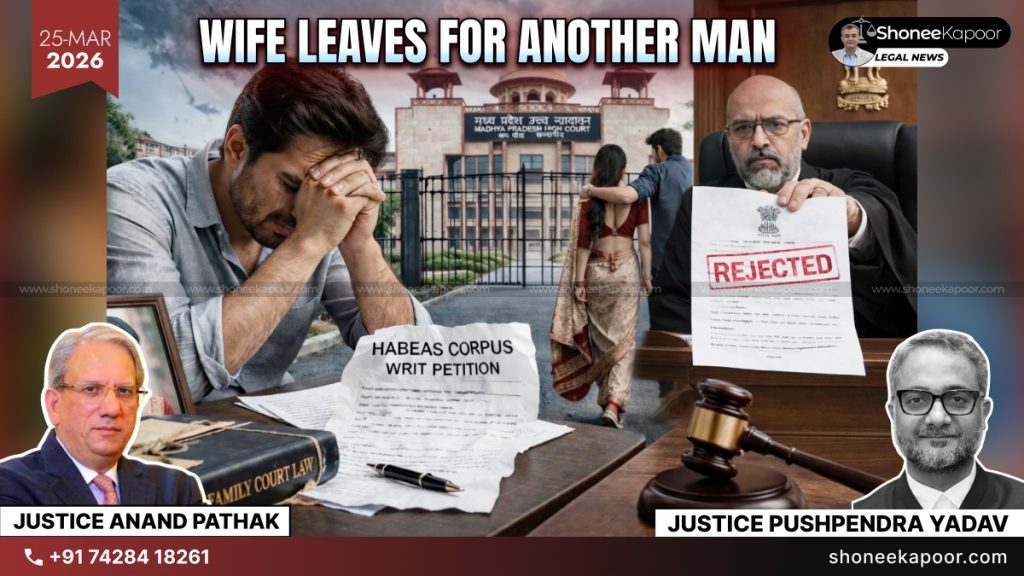
A husband approached court to bring back his pregnant wife—what followed exposes a hard reality of Indian matrimonial law.
When personal choice overrides marriage, what exactly remains enforceable for the husband?
GWALIOR: The Madhya Pradesh High Court at Gwalior, led by Justice Anand Pathak and Justice Pushpendra Yadav, dealt with a habeas corpus petition filed by a man seeking the return of his wife. The husband approached the court claiming that his wife was being illegally confined by another individual and requested that she be brought back to the matrimonial home.
The case took a decisive turn when the woman was presented before the court. She clearly stated that she did not want to return to her husband and was living with another man by her own choice. This statement became the central point of the case and shifted the direction of the proceedings entirely.
The woman informed the court that her marriage with the petitioner had taken place against her will. She explained that her father had fixed the marriage without asking her, and because of that, she never accepted the relationship. She further stated that she had been living with the other man since February 27, 2026, voluntarily and without any pressure.
On the other hand, the husband tried to convince the court by highlighting that his wife was six months pregnant and expressed his willingness to take her back and continue the marriage. Despite this, the wife refused to go with him and stood firm on her decision even in front of the judges.
The court also interacted with the other man involved in the case, who stated that he intended to marry the woman and was ready to accept her unborn child as his own. This further complicated the situation for the husband, as the matter moved beyond simple custody and entered into a complex personal dispute.
After considering all aspects, the court observed that this was essentially a matrimonial dispute and could not be resolved through a habeas corpus petition. The judges made it clear that such petitions are only valid when there is illegal detention, which was not present in this case.
The court clearly recorded that:
“Corpus is major and not in illegal confinement… and she wants to live with respondent No.5 on her own will,…”
Emphasising that her personal liberty could not be interfered with.
At the same time, the court acknowledged the difficult position of the husband and the legal complications arising from the subsisting marriage. It pointed out that the proper legal path for the situation would be either reconciliation or legal dissolution of marriage.
In the end, since there was no illegal confinement, the court held that continuing the petition would serve no purpose and disposed of it. The woman was allowed to go wherever she wished, reinforcing the principle that an adult individual has the right to make personal life choices.
If a husband does something similar, he is immediately exposed to legal consequences, including maintenance liability, but when the same situation arises from the wife’s side, the husband is left with no immediate or effective remedy under the law.
Explanatory Table: Laws And Provisions Involved
| Law / Section | Purpose | How Applied in This Case |
| Habeas Corpus (Article 226 of Constitution of India) | A legal remedy used when a person is illegally detained or confined | Husband filed petition claiming wife was illegally confined |
| Concept of “Illegal Detention” | Court intervenes only if someone is held against their will | Court found no illegal detention as wife stayed voluntarily |
| Personal Liberty (Article 21) | Every adult has right to choose where and with whom to live | Court upheld wife’s right to live with person of her choice |
| Matrimonial Law Principles | Marriage disputes must be resolved through divorce or reconciliation | Court said habeas corpus cannot solve marital disputes |
| Mediation & Counselling | Courts encourage peaceful settlement instead of litigation | Court directed parties to explore mediation |
Case Details
- Case Title: Sandeep v. The State of Madhya Pradesh and Others
- Court: Madhya Pradesh High Court, Gwalior Bench
- Case Number: Writ Petition No. 9500 of 2026
- Neutral Citation: 2026:MPHC-GWL:9936
- Date of Order: 23 March 2026
- Bench: Justice Anand Pathak | Justice Pushpendra Yadav
- Counsels:
- For Petitioner (Husband): Shri Ashok Kumar Ahirwar, and Shri Shriratan Nigam
- For Respondent/State: Shri Deependra Singh Kushwaha (Additional Advocate General)
Key Takeaways
- Habeas corpus cannot be used by a husband to bring his wife back, even when the marriage is legally valid and subsisting.
- An adult woman’s statement alone is enough for the court to close the case, leaving no scope for immediate relief to the husband.
- Even in sensitive situations like pregnancy, the husband’s rights and concerns are not given priority in such proceedings.
- The legal system pushes the husband towards long and time-consuming remedies like divorce or mediation instead of providing urgent relief.
- The outcome highlights a clear imbalance where the husband is left without an effective remedy, despite being legally married.
This Could Change Your Case-Get FREE Legal Advice-Click Here!
Disclaimer: The views and opinions expressed in this article are those of the Indian courts and do not necessarily reflect the official policy or position of “ShoneeKapoor.com” or its affiliates. This article is intended for informational and educational purposes only. The content provided is not legal advice, and viewers should not act upon this information without seeking professional counsel. Viewer discretion is advised.