

“Young boy ultimately bears the consequences”: Madras High Court Flags Harsh Impact of POCSO Cases in Consensual Adolescent Relationships, Quashes 20-Year POCSO Sentence

Written and analysed by Vaibhav Ojha
Head Of Legal CommunicationsA boy sentenced to 20 years under POCSO and 5 years under Section 366 IPC in a consensual teenage relationship case was later acquitted due to faulty age proof.
The bigger question remains — how long will consensual relationships keep turning into criminal cases against young men?
MADURAI: In a recent judgment, Justice N. Mala of the Madras High Court, Madurai Bench, set aside the conviction of a young boy who had earlier been sentenced to 20 years imprisonment under the POCSO Act and 5 years under Section 366 IPC by the Special POCSO Court at Nagercoil.
The case began in 2018 when a teenage girl left her home and went with the boy, who was a friend of her elder brother. The prosecution claimed the girl was 16 years old and alleged that the boy persuaded her to leave home and marry him. A complaint was later filed, and a case was registered under the POCSO Act.
During trial, the prosecution tried to prove the girl’s age using xerox copies of her birth certificate and school transfer certificate. Relying on these documents, the trial court convicted the boy and sentenced him to long imprisonment.
However, the High Court found a major legal flaw. The prosecution had not produced the original documents, even though they were available. The Court held that such secondary evidence cannot be accepted without a proper explanation and clearly stated:
“It is trite that primary evidence is the rule and secondary evidence an exception.”
Since the age of the girl was not legally proved, the foundation of the POCSO case failed. The High Court allowed the appeal, set aside the conviction and acquitted the accused.
While concluding the case, the Court observed that:
“This is a typical case of consensual adolescent sexual relationship ending on a discordant note due to parental differences.”
The Court also noted the impact such cases have on boys, stating:
“In cases involving consensual relationship between adolescents, it is often the young boy, who ultimately bears the consequences.”
It further remarked:
“Under parental pressure, the girl may be compelled to marry another person, following which criminal proceedings are initiated against the boy under the POCSO Act, resulting in his prolonged incarceration.”
The judgment highlights growing concerns about the misuse of strict laws in cases involving teenage relationships, where young boys sometimes face serious criminal charges after families oppose such relationships.
Explanatory Table: Laws And Sections Involved
| Law / Section | Purpose | How Applied in This Case |
| Section 374(2) CrPC | Allows a person convicted by a Sessions Court to file an appeal before the High Court. | The accused filed a criminal appeal before the Madras High Court challenging his conviction and sentence. |
| Section 415(2) BNSS | Provides a procedural framework for criminal appeals under the new criminal procedure law. | Mentioned in the appeal prayer along with the CrPC provisions while seeking to set aside the conviction. |
| Section 366 IPC | Punishes kidnapping or abducting a woman to compel her marriage or force sexual relations. | The trial court convicted the accused under this section, alleging he took the girl away to marry her. |
| Section 5(l) POCSO Act | Defines aggravated penetrative sexual assault on a minor in certain circumstances. | The prosecution charged the accused under this section, claiming sexual assault on a minor girl. |
| Section 6 POCSO Act | Prescribes severe punishment for aggravated penetrative sexual assault. | The trial court sentenced the accused to 20 years’ imprisonment under this provision. |
| Section 65 Indian Evidence Act | Allows secondary evidence, such as copies, only when original documents cannot be produced for valid reasons. | The High Court rejected xerox copies of the birth certificate and transfer certificate because originals were available but not produced. |
| Section 43 POCSO Act | Requires governments to create public awareness about the strict provisions of the POCSO law. | The Court directed authorities to spread awareness about the law and its consequences to prevent misuse. |
Case Details
- Case Title: Mahesh v. State
- Court: Madurai Bench of the Madras High Court
- Case Number: Crl.A.(MD). No.1300 of 2025
- Date of Judgment: 16 February 2026
- Bench: Justice N. Mala
- Crime Number: Crime No.12 of 2018
- Counsels:
- For Appellant: Mr. K. Karnan
- For Respondent: Mr A. Thiruvadikumar, Additional Public Prosecutor
Key Takeaways
- Consensual teenage relationships are increasingly being turned into serious criminal cases when families oppose the relationship, and young boys often end up facing the harshest consequences.
- Strict laws like the POCSO Act were meant to protect children, but they are sometimes used as tools to punish young men involved in mutual adolescent relationships.
- When age or evidence is not properly proven, innocent boys can still spend years in jail before the truth comes out, showing the need for stronger safeguards against wrongful prosecution.
- There is a growing need for legal reforms, such as a Romeo-Juliet type protection, so that genuine teenage relationships are not criminalised.
- The justice system must balance child protection with fairness, ensuring that laws meant for protection are not misused to destroy the lives of young men.
This Could Change Your Case-Get FREE Legal Advice-Click Here!
Disclaimer: The views and opinions expressed in this article are those of the Indian courts and do not necessarily reflect the official policy or position of “ShoneeKapoor.com” or its affiliates. This article is intended for informational and educational purposes only. The content provided is not legal advice, and viewers should not act upon this information without seeking professional counsel. Viewer discretion is advised.
Related Articles
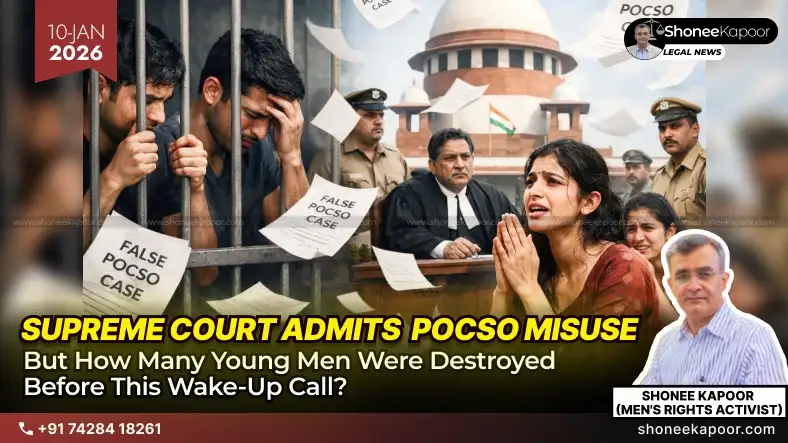
Supreme Court Backs Romeo–Juliet Clause in POCSO, But How Many Young Men Were Destroyed Before This Wake-Up Call?
The Supreme Court of India has openly acknowledged rampant misuse of the POCSO Act against consensual adolescent rela...

Truth on Trial : My RTI Reveals How False Rape Complaints Have Pushed Delhi’s Conviction Rate Down to 4.3%
An RTI-based investigation uncovering the numbers, patterns, and judicial realities behind Delhi’s 4.3% rape convicti...
Share Your Thoughts
Comments are moderated before publication.