
Is India finally moving towards recognising fathers in childcare rights?
Supreme Court signals change, but what does it really mean for working parents?
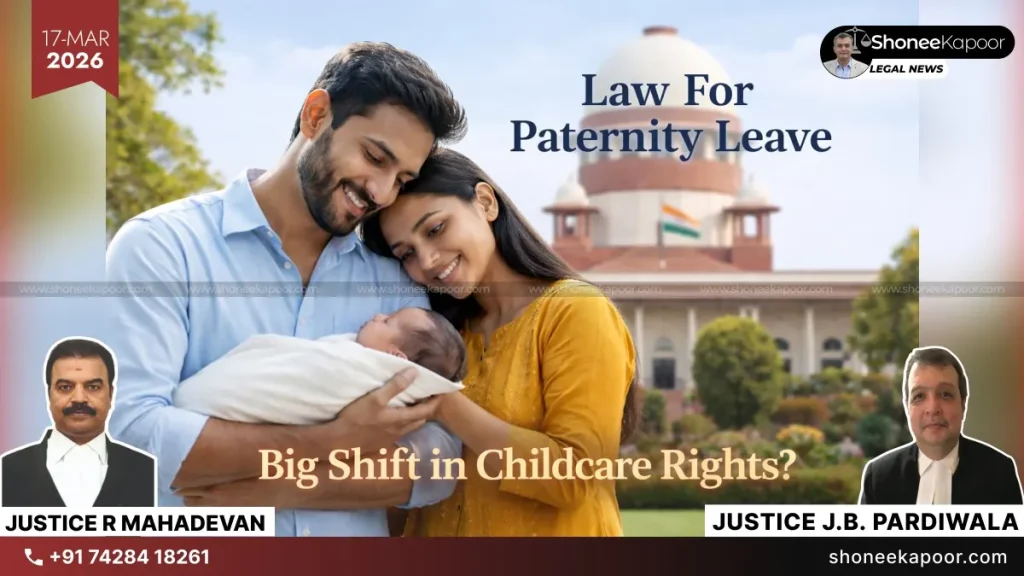
NEW DELHI: The Supreme Court Today (March 17th) urged the Union Government to introduce a law recognising paternity leave as a social security benefit, highlighting the need to balance responsibilities of both parents in early childcare.
The observation came from a bench of Justice JB Pardiwala and Justice R Mahadevan while hearing a case on the validity of maternity leave rules for adoptive mothers under the Social Security Code, 2020.
The Court examined Section 60(4), which allowed 12 weeks of maternity leave to adoptive mothers only if the child was below 3 months of age. The bench found this restriction arbitrary and unconstitutional. It clarified that a woman who legally adopts a child will now be entitled to 12 months of maternity leave, irrespective of the child’s age.
While expanding maternity benefits, the Court also pointed out a gap in the law when it comes to fathers’ rights and responsibilities in childcare.
“On the need of paternity leave, we urge the Union to come up with a provision recognising paternity leave as a social security benefit. We emphasise that the duration of such leave must be determined in a manner that is responsive to the needs of both the parents and the child.”
The Court explained that paternity leave refers to a period of leave given to a father after the birth or adoption of a child so that he can take part in childcare and support the mother during the early stage. It noted that parenting is not a one-sided role and both parents play an important part in a child’s development.
At present, Indian law does not formally recognise paternity leave, even though maternity leave is clearly defined. Women are entitled to up to 26 weeks of paid maternity leave if they have fewer than two surviving children, and 12 weeks if they have two or more children. Up to 8 weeks of this leave can be taken before delivery.
The Court’s remarks indicate a shift towards acknowledging shared parenting, though the legal framework still places primary caregiving responsibility on women, with limited structured support for fathers despite their increasing role in childcare.
Explanatory Table Of Laws & Sections Involved
| Law / Provision | What It Says | Court’s Observation | Practical Impact |
| Social Security Code, 2020 – Section 60(4) | Allowed 12 weeks maternity leave to adoptive mothers only if child is below 3 months | Held unconstitutional and arbitrary | Removes age restriction, expands rights of adoptive mothers |
| Maternity Benefit Framework (India) | Provides 26 weeks paid leave (less than 2 children), 12 weeks (2+ children) | Recognised as existing structured benefit only for women | Highlights imbalance where fathers have no statutory support |
| Concept of Paternity Leave (Not codified in India) | No statutory provision currently | Court urged Union to introduce it as social security benefit | Opens door for formal recognition of fathers in childcare |
| Equality & Social Welfare Principles (Constitutional interpretation) | Laws should be non-discriminatory and welfare-oriented | Court balanced parental roles instead of gender-exclusive view | Signals gradual shift towards shared parenting framework |
Case Details
- Case Title: Hamsaanandini Nanduri v. Union of India
- Case Number: W.P.(C) No. 960/2021
- Bench: Justice JB Pardiwala and Justice R Mahadevan
Key Takeaways
- Court admitted a clear gap—India still has no legal recognition of fathers in childcare through paternity leave.
- System continues to assign responsibility to men without giving them corresponding legal rights or support.
- Maternity benefits are expanded, but fatherhood remains legally invisible in policy structure.
- “Shared parenting” is acknowledged in theory, but laws remain heavily one-sided in execution.
- This imbalance directly affects custody, bonding, and long-term parental roles of fathers.
This Could Change Your Case-Get FREE Legal Advice-Click Here!
Disclaimer: The views and opinions expressed in this article are those of the Indian courts and do not necessarily reflect the official policy or position of “ShoneeKapoor.com” or its affiliates. This article is intended for informational and educational purposes only. The content provided is not legal advice, and viewers should not act upon this information without seeking professional counsel. Viewer discretion is advised.