
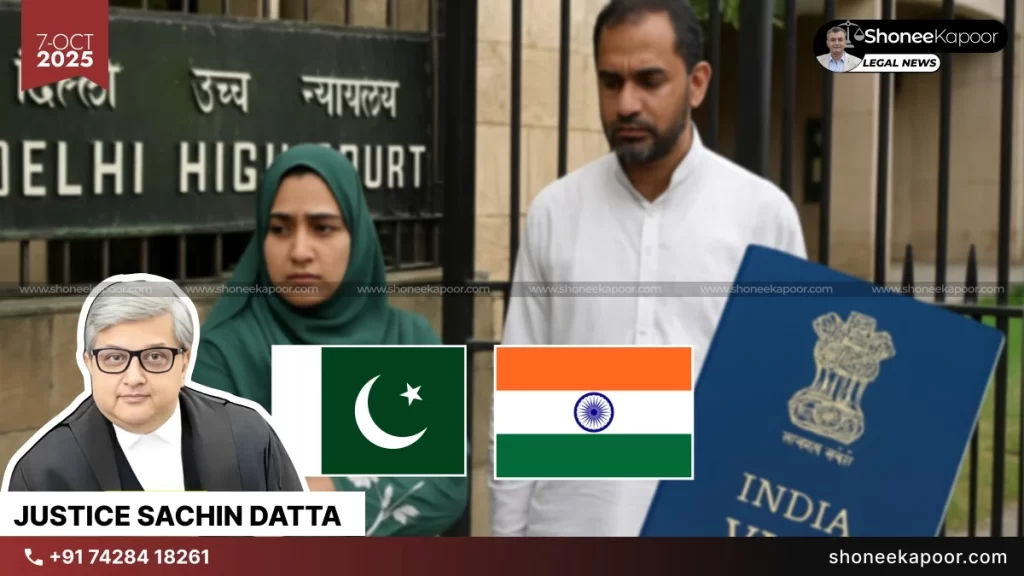
The Delhi High Court has sought the Union government’s reply on a petition by Pakistani national Ruqaiya Obaeed, who wants to live in India with her Delhi-based husband. The court will hear the matter again on November 12, 2025.
NEW DELHI: The Delhi High Court has asked the Union government to give its response in a case filed by Ruqaiya Obaeed, a Pakistani Bride’s who wants permission to stay in India with her husband, Ubada Abdul Barakat Farooqi, who lives in Delhi. The matter came up before Justice Sachin Datta, who heard the case and directed the government to file its reply. The next hearing has been scheduled for November 12, 2025.
According to the petition, Ruqaiya Obaeed married Ubada Abdul Barakat Farooqi in November 2024 in Pakistan. After the marriage, she applied for an Indian visa and came to Delhi in April 2025 to live with her husband. The Foreigners Regional Registration Office (FRRO) of the Delhi Police then issued her a residential permit. Later, she also applied online for a Long-Term Visa (LTV) and submitted all the required documents.
However, before her visa application could be processed, a terror attack in Pahalgam, Jammu and Kashmir, on April 22, 2025, led the Union Home Ministry to suspend all visa services for Pakistani nationals. After this sudden suspension, Obaeed approached the FRRO and requested more time to regularise her stay in India. But her request was turned down. Soon after, the FRRO issued her an Exit Permit on April 28, instructing her to leave India by May 19, 2025, through the Attari–Wagah border.
The petition mentioned a report aired by News18, which said that the government had issued an advisory allowing Pakistani nationals with pending LTV applications to either stay in India or apply again. The petition argued that the officials failed to consider this update.
The plea stated:
“It is submitted that on the basis of the aforementioned news, many of the Pakistani national women who had maintained their families, after a matrimonial knot in India, chose to disregard the order of the respondents and they managed to stay on their respective locations.”
The petition further said that in Rajasthan, especially in Jodhpur, local authorities had allowed other Pakistani women married to Indian men to continue living in India.
It added:
“The petitioners are similarly situated and they seek parity in treatment.”
Ruqaiya Obaeed has asked the court to direct the government to issue her a fresh visit visa or Long-Term Visa, or to allow the Indian High Commission in Islamabad to accept her manual visa application, since online applications are still suspended.
The case was argued by Senior Advocate Sanjeev Sagar, along with Advocates Rajeshwar Singh and Chaitanya Singh, who appeared for the petitioner.
The next hearing will be held on November 12, 2025.
Explanatory Table of All Laws, Sections & Legal Context Related to the Case
| Relevant Law / Policy | Description / Provision | Relevance in This Case |
| The Foreigners Act, 1946 | Empowers the Central Government to regulate the entry, stay, and exit of foreigners in India. Includes power to issue or revoke visas and residence permits. | The FRRO and MHA actions—suspending visas, issuing residential and exit permits—are taken under this Act. |
| The Passport (Entry into India) Act, 1920 | Requires all foreigners entering India to have valid passports and visas. Violations can lead to deportation. | Used to justify the government’s authority to direct Ruqaiya Obaeed to exit India after visa suspension. |
| Visa Manual 2023 (Ministry of Home Affairs Guidelines) | Provides the procedure for issuing different types of visas, including Long-Term Visas (LTVs) for Pakistani nationals married to Indian citizens. | Obaeed’s application for an LTV falls under these guidelines. Her plea argues for equal treatment based on these norms. |
| Long-Term Visa (LTV) Scheme | A facility extended by India to Pakistani nationals married to Indian citizens, allowing stay up to 5 years, renewable periodically. | The core of Obaeed’s plea — she seeks re-issuance or continuation of her LTV under this scheme. |
| Home Ministry Advisory (April 2025, post-Pahalgam attack) | Suspension of visa services for Pakistani nationals due to security reasons. | This advisory caused her visa processing to halt and led to the exit order. |
| Article 14 of the Indian Constitution | Guarantees equality before the law and equal protection of laws. | The plea cites parity with similarly placed Pakistani women in Rajasthan who were allowed to stay. |
| Article 21 of the Indian Constitution | Ensures the right to life and personal liberty, which includes the right to cohabit with a spouse. | Implied argument that forcing Obaeed to leave violates her fundamental right to live with her husband. |
| Case Precedents (Analogous cases from Rajasthan, Jodhpur) | In previous cases, Pakistani wives of Indian men were allowed to stay pending visa approval. | The petitioner seeks “parity in treatment” based on these examples. |
Case Summary
- Case Title: Ruqaiya Obaeed Through Her Husband Ubada Abul Barakat Farooqi vs Union of India & Others
- Petitioner: Ruqaiya Obaeed (Pakistani national)
- Respondents: Union of India & Others
- Petitioner’s Husband: Ubada Abdul Barakat Farooqi (Resident of Delhi, India)
- Bench: Justice Sachin Datta
- Court: Delhi High Court
- Hearing Date: October 6, 2025
- Next Hearing Date: November 12, 2025
- Counsel for Petitioner: Senior Advocate Sanjeev Sagar, Advocates Rajeshwar Singh and Chaitanya Singh
- Relief Sought: Direction to the government to issue a fresh visit visa or Long-Term Visa (LTV), or allow manual submission of visa application at the Indian High Commission in Islamabad
- Key Issue: Denial of visa continuation and issuance of exit permit to a Pakistani woman married to an Indian national after suspension of visa services post-Pahalgam terror attack
- Government Authority Involved: Ministry of Home Affairs (MHA), Foreigners Regional Registration Office (FRRO), Delhi Police
- Important Dates: Marriage: November 2024; Visa travel: April 2025; Exit Permit: April 28, 2025;
- Departure deadline: May 19, 2025
- Place of Incident: Delhi (petition filed), Pahalgam (terror attack leading to visa suspension), Attari–Wagah border (exit route)
- Media Reference Cited: News18 broadcast on government advisory allowing Pakistani nationals with pending LTV applications to remain or reapply

This Could Change Your Case-Get FREE Legal Advice-Click Here!
Disclaimer: The views and opinions expressed in this article are those of the Indian courts and do not necessarily reflect the official policy or position of “ShoneeKapoor.com” or its affiliates. This article is intended for informational and educational purposes only. The content provided is not legal advice, and viewers should not act upon this information without seeking professional counsel. Viewer discretion is advised