
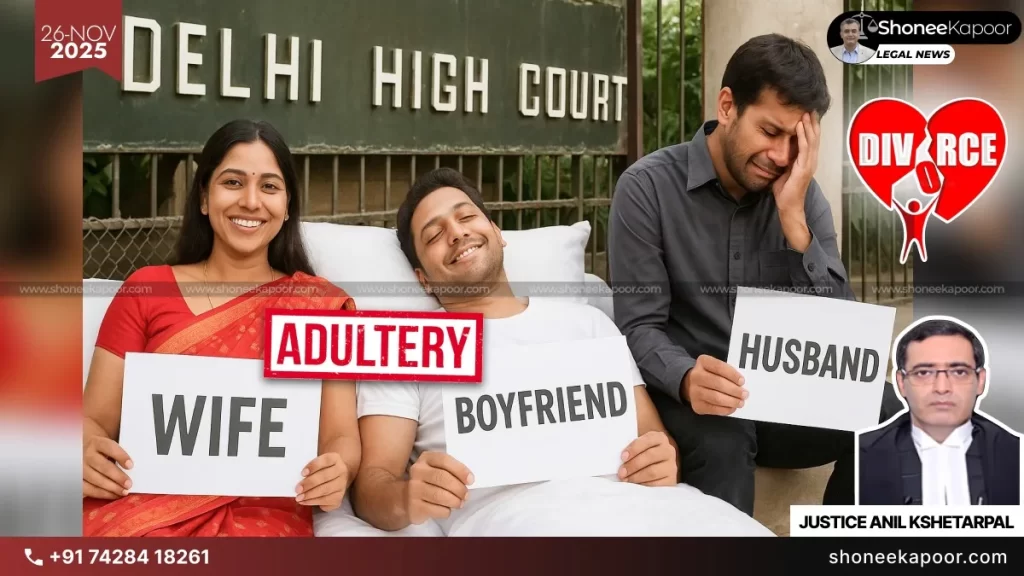
The Delhi High Court upheld a divorce after finding that the Wife’s repeated claim of “not remembering” overnight stays with another man created strong judicial suspicion. The Court held that emotional or secret intimacy outside marriage amounts to mental cruelty.
NEW DELHI: The Delhi High Court has upheld a divorce decree granted to the Husband, after finding that the Wife failed to give clear answers about her prolonged communication and alleged involvement with two men.
The division bench of Justices Anil Kshetarpal and Harish Vaidyanathan Shankar said her repeated use of the phrase “does not recollect” or “does not remember” when asked about staying overnight with one of them naturally created doubt.
The Court observed:
“…the Appellant repeatedly answered that she “does not recollect” or “does not remember”. Far from being categoric denials, the evasive responses, given to direct and specific questions, naturally invite judicial suspicion, for it is implausible that a person of ordinary faculties would fail to recall overnight stays at particular locations in the company of a named individual.”
The Court agreed with the Family Court that the Wife did not produce any contract, invoice, email trail or document to prove her claim that the conversations were only for professional work. On the other hand, the Husband had produced call records and email material.
The judgment noted that one of the email sets (marked before the Family Court) contained improper content and did not match normal business communication. This further damaged her defence.
In a detailed observation, the High Court said:
“In our considered view, infidelity need not always be proved through direct or ocular evidence. Continuous conduct that perpetuates a situation wherein more than a mere reasonable apprehension of unfaithfulness or moral betrayal persists, coupled with the failure of the spouse who is alleged to have caused the genesis and continuity of such a condition of the mind, to effectively dissipate or dissuade through their testimony, the existence of such a state of affairs, constitutes mental cruelty within the meaning of Section 13(1)(ia) of the HMA.”
It added an important principle:
“Infidelity, whether physical or emotional, corrodes the very foundation of marriage. It inflicts harm not upon the body but upon the psyche of the aggrieved spouse; a slow, silent, and devastating form of cruelty that destroys mutual trust and companionship. The Court, therefore, must assess not merely the act itself but the underlying attitude and intent reflected in such conduct.”
The Bench explained that emotional secrecy and sustained private contact with another man — especially when hidden from the Husband — causes deep hurt.
It said:
“When one spouse chooses to invest emotional intimacy, secrecy, and sustained communication in another person outside the marriage, while maintaining a façade of propriety, it results in mental anguish, humiliation, and emotional abandonment of the highest order.”
Discussing the Wife’s conduct, the Court held:
“Her evasive testimony, the absence of any credible documentary evidence to substantiate her alleged professional association with Sh. Pradeep Gupta and her inability to negate the overnight stays with him collectively form an unbroken chain of circumstances that points unmistakably to behaviour wholly incompatible with the obligations of fidelity and transparency inherent in a marital relationship.”
She had answered “she does not recollect” when asked whether she stayed with the man in a hotel in Yamuna Nagar and also in a guest house in Noida. According to the Court, no reasonable person forgets such specific events.
The High Court also agreed with the Family Court that the Wife levelled false allegations of forgery against the Husband. During cross-examination, she had herself admitted that the FSL report confirmed her signatures, and she may have signed without reading.
The Court held that making such false allegations also amounts to mental cruelty against the Husband.
The Division Bench concluded that the Family Court was right in granting divorce on the ground of cruelty. The High Court dismissed the Wife’s appeal after finding no legal error.
The judgment ends with the final conclusion:
“The Impugned Judgment and Decree are affirmed, and the Appeal, being entirely devoid of merit, stands dismissed.”

Explanatory Table Of All Laws & Sections Mentioned
| Law / Section | Description in Simple English | How It Was Used in This Case |
| Section 19, Family Courts Act, 1984 | Allows appeals against Family Court judgments. | Wife filed this appeal under this section. |
| Section 28, Hindu Marriage Act, 1955 | Deals with appeals in HMA cases. | Included as appeal provision. |
| Section 13(1)(ia), Hindu Marriage Act | Divorce on ground of cruelty (mental or physical). | Basis for divorce decree upheld by High Court. |
| Section 65B, Indian Evidence Act, 1872 | Certificate needed for electronic evidence (emails, screenshots, records). | Wife argued Respondent’s emails/chats were inadmissible; Court said Family Courts have relaxed rules. |
| Section 14, Family Courts Act, 1984 | Family Courts may accept any evidence if helpful, even if not admissible under Evidence Act. | Used to justify accepting email/phone records. |
| Section 10, Family Courts Act | Gives Family Courts civil court powers & procedure. | Referred to in judgments explaining evidence process. |
| Section 15, Family Courts Act | Allows Family Court to record evidence in summary form. | Discussed to show flexible procedure. |
| Section 16, Family Courts Act | Allows formal evidence by affidavit. | Mentioned by Supreme Court & High Courts in context. |
| Indian Penal Code – General Reference | No specific IPC section, but allegations included forgery, cruelty etc. | Wife falsely alleged forgery; Court held this allegation itself was cruelty. |
| Evidence Act – General Provisions | Usual rules relaxed in family disputes. | Court emphasized flexible admissibility. |
| Judicial Precedents Cited | Multiple Supreme Court and High Court cases interpreting cruelty. | Applied to define “mental cruelty.” |
Case Title
XX vs YY (Delhi High Court)
MAT.APP.(F.C.) 5/2023
- Bench
- Hon’ble Mr. Justice Anil Kshetarpal
- Hon’ble Mr. Justice Harish Vaidyanathan Shankar
- Judgment Reserved On
- 09 October 2025
- Judgment Pronounced On
- 29 October 2025
Counsels
- For the Appellant–Wife
- Mr. Ashish Upadhyay
- Mr. Pardeep Kumar Mishra
- For the Respondent–Husband
- Mr. Prashant Mendiratta
- Mr. Sanchit Sahani
- Ms. Neha Jain
- Mr. Taarak Duggal
- Ms. Sneha Mathew
- Ms. Vaishnavi Saxena
- Ms. Sakshi Jain
- Mr. Chaitanya
Court of First Instance (Appealed From)
Family Court, Central District, Tis Hazari Courts, Delhi
HMA No. 11/2012 (renumbered as 5862025/2016)
Judgment Dated: 19.11.2022
Nature of Appeal
Appeal under:
- Section 19, Family Courts Act, 1984
- Section 28, Hindu Marriage Act, 1955
Final Outcome
Appeal Dismissed — Divorce Decree Upheld (Cruelty under Section 13(1)(ia) HMA).
Key Takeaways
- Courts will not ignore evasive answers—when a spouse repeatedly says “I do not remember” about overnight stays with another man, it creates strong judicial suspicion.
- Emotional infidelity, secrecy, and private intimacy outside marriage are now recognised as mental cruelty even without direct proof.
- A husband is not required to produce impossible “direct evidence” of adultery; the wife’s own conduct, admissions, and contradictions can legally establish cruelty.
- False allegations—like accusing the husband of forgery without proof—are themselves treated as serious mental cruelty against the man.
- Family Courts are allowed to consider phone records, emails, and behavioural patterns even if strict technical rules of evidence are not met—making it harder for wives to hide behind technicalities.
This Could Change Your Case-Get FREE Legal Advice-Click Here!

Disclaimer: The views and opinions expressed in this article are those of the Indian courts and do not necessarily reflect the official policy or position of “ShoneeKapoor.com” or its affiliates. This article is intended for informational and educational purposes only. The content provided is not legal advice, and viewers should not act upon this information without seeking professional counsel. Viewer discretion is advised.