
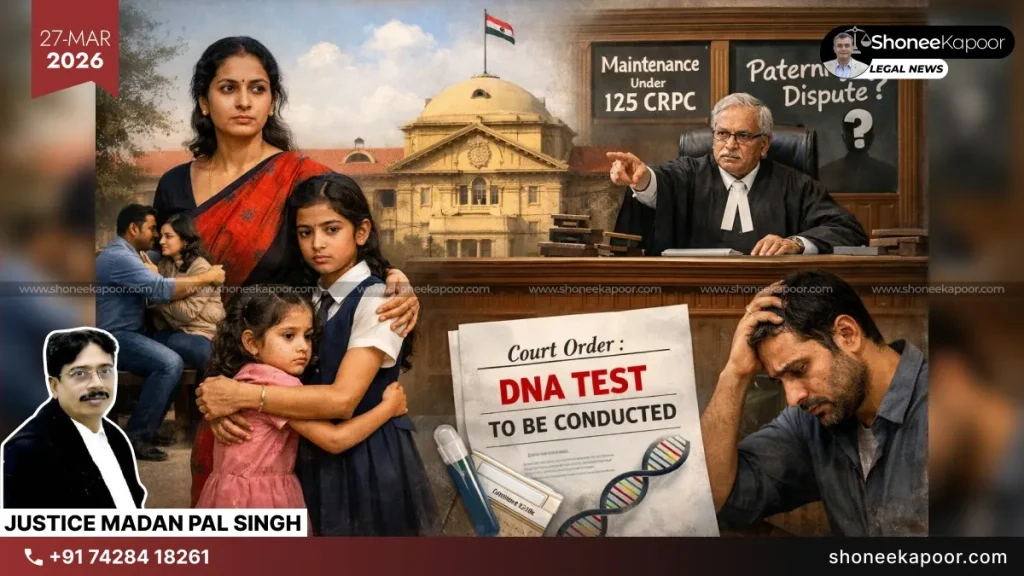
Can a man be forced to pay maintenance when even the court cannot confirm he is the father?Allahabad High Court pauses the liability—and puts biological truth at the center of justice.
PRAYAGRAJ: The Allahabad High Court, in a decision delivered by Justice Madan Pal Singh, has taken a firm stand that a man cannot be compelled to pay maintenance unless his paternity is clearly established. The Court emphasized that where there is genuine doubt about fatherhood, the truth must be determined first before any financial burden is imposed.
The dispute arose when Jawahir Lal Jaiswal approached the High Court against a Family Court order passed under Section 125 CrPC. The lower court had directed him to pay Rs 3,000 per month from the date of application and Rs 6,000 per month from the date of judgment until the minor girl’s marriage. Importantly, his request for a DNA test had been rejected at that stage.
According to the revisionist, his wife had left the matrimonial home in February 2000, and there had been no marital relationship after that. He argued that the child, born years later in 2011, could not be his and was the result of another relationship. On this basis, he challenged the maintenance order, stating that liability cannot be fixed without confirming biological parentage.
When the High Court reviewed the material on record, it noticed serious inconsistencies. The timeline presented did not align with documentary evidence. While it was claimed that the mother stayed with her husband briefly in 2010 and then gave birth in 2011, records indicated a birth as early as 2009. Additionally, later medical documents showed that another child was born in 2017, naming a different man as the father.
During the hearing, it was also acknowledged that the mother had been living with another person after 2011. Despite this, it was still asserted that the first child belonged to the husband. The Court found this claim doubtful and lacking clarity.
In this context, Justice Madan Pal Singh observed that in such situations, “both the father and the daughter have every right to know the biological truth.” The Court further cautioned that if this question remains unanswered, it will continue to trouble both of them throughout their lives and they will not be able to lead their lives properly in society.
The Court pointed out that there was no clear explanation of when the couple last cohabited, how long they stayed together, or when conception took place. These unanswered questions created a serious doubt regarding paternity.
While referring to the ruling in R. Rajendran v. Kamar Nisha, which discourages routine DNA testing, the High Court also relied on Sachin Agarwal v. State of U.P. to underline that such tests can be ordered when required to ensure justice.
On this basis, the High Court concluded that the Family Court had granted maintenance without resolving the most fundamental issue. It therefore set aside the order and directed that a DNA test be conducted first. The Family Court has now been instructed to reconsider the maintenance claim afresh after receiving the test results, within a period of three months.
Explanatory Table: Laws And Provisions Involved
| Law / Section / Case | Purpose | How Applied in This Case |
| Section 125 CrPC | Provides maintenance to wife, child, or parents to prevent destitution | Maintenance was granted by Family Court without resolving paternity; HC set it aside |
| Section 397 CrPC | Provides power of revision to High Court to examine legality of lower court orders | Father filed criminal revision challenging maintenance order |
| Section 401 CrPC | Gives High Court powers to correct errors in revision jurisdiction | HC exercised this power to set aside Family Court order |
| Section 112 Indian Evidence Act | Presumption of legitimacy of a child born during valid marriage | Presumption became doubtful due to long separation and contradictory records |
| Article 21 of Constitution | Protects right to life and personal liberty, including dignity | Court linked right to know biological identity with dignified life |
| R. Rajendran v. Kamar Nisha (2025) | DNA test should not be ordered routinely | HC acknowledged but distinguished due to exceptional facts |
| Sachin Agarwal v. State of U.P. (2024) | DNA test allowed where necessary for justice | Relied upon to justify ordering DNA test in disputed paternity |
Case Details
- Case Title: Jawahir Lal Jaiswal vs State of U.P. & Another
- Court: Allahabad High Court
- Bench: Justice Madan Pal Singh
- Case Type: Criminal Revision Petition
- Impugned Order: March 2025 (Family Court, Sonbhadra)
Key Takeaways
- No man should be forced to pay maintenance just on allegations—when paternity is doubtful, proof must come first.
- Truth of biological fatherhood is not just legal, it impacts dignity and life of both the man and the child.
- Courts cannot rely on vague claims or inconsistent records to impose lifelong financial responsibility.
- DNA testing becomes necessary when facts don’t add up—science must prevail over assumptions.
- Legal protection means ensuring fairness on both sides—liability cannot exist without certainty.
This Could Change Your Case-Get FREE Legal Advice-Click Here!
Disclaimer: The views and opinions expressed in this article are those of the Indian courts and do not necessarily reflect the official policy or position of “ShoneeKapoor.com” or its affiliates. This article is intended for informational and educational purposes only. The content provided is not legal advice, and viewers should not act upon this information without seeking professional counsel. Viewer discretion is advised.