
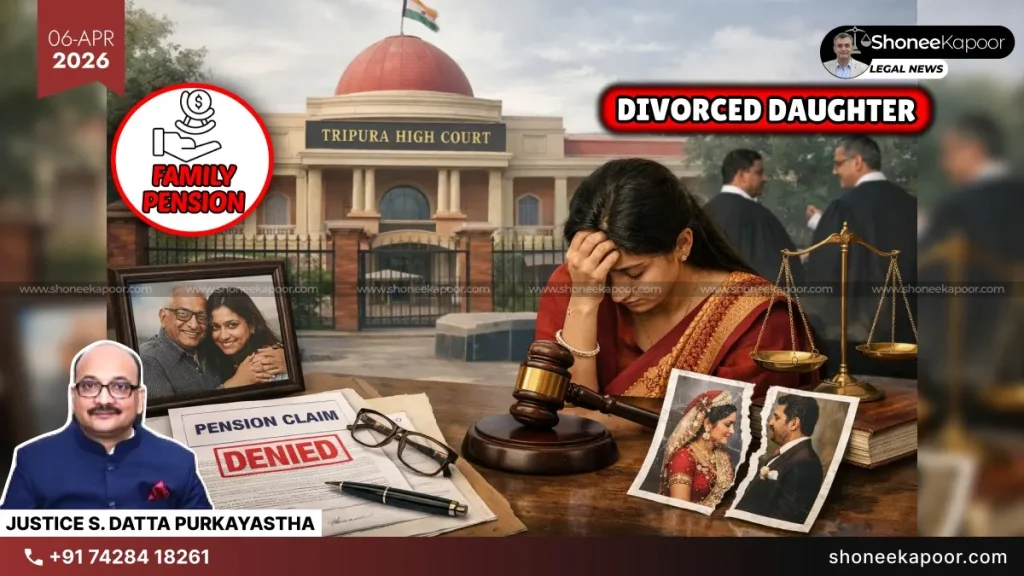
A daughter who became divorced years after her father’s death was denied family pension by the Tripura High Court. The ruling clarifies a strict legal position—eligibility is frozen at the time of death, not changed by later events.
AGARTALA: In a recent judgment, Hon’ble Mr. Justice S. Datta Purkayastha of the High Court of Tripura decided an important case on family pension rights of a divorced daughter.
The case involved a woman whose father was a pensioner in Agartala Municipal Corporation. He died in 2018, and at that time, his daughter was still married. She got divorced later in 2021 and then applied for family pension.
The court examined whether a daughter who becomes divorced after the death of her father can claim pension benefits.
The petitioner argued that she was dependent on her father and had been living separately from her husband for many years. It was also argued that there is no rule saying divorce must happen during the lifetime of the parent.
The court carefully looked at the pension rules and clearly explained the law. It noted that:
“The condition precedent for entitlement to family pension is that the daughter should be a divorced daughter when the original pensioner died, as the right to receive such pension accrues on the death of the original pensioner.”
This means eligibility is fixed on the date of death, not later.
The court also referred to the rule which states:
“Family pension shall be admissible to non-earning unmarried daughter (until her marriage)/widow daughter (until her re-marriage)/divorcee daughter (until restoration of her conjugal life) and disabled children in the event of death of the pensioner and his/her spouse.”
However, the judge clarified that this rule applies only if the person already falls in that category at the relevant time.
The Municipal Corporation argued that since the woman was not divorced when her father died, she was not eligible. The court agreed with this reasoning.
It further emphasized that eligibility cannot arise later, observing that the right must exist at the time of death and cannot be created afterward through events like divorce.
This judgment makes the legal position very clear: pension rights are decided at the time of death, and later changes in marital status do not create new rights.
Explanatory Table: Laws & Provisions Involved
| Law / Provision | Purpose | How Applied in This Case |
| Tripura State Civil Services (Revised Pension) Rules, 2017 – Rule 8 | To provide family pension to eligible dependents like unmarried, widowed, or divorced daughters | Court held that benefit applies only if the daughter is already divorced at the time of the pensioner’s death |
| Article 309 of the Constitution of India | Empowers the State to frame service and pension rules | Basis under which the 2017 Pension Rules were framed and applied by the Court |
| Central Civil Services (Pension) Rules, 1972 | Provides general pension framework adopted by states | Used as background framework; Tripura rules derived from and interpreted alongside it |
| Government Notification dated 28.03.2018 | Introduced amendment allowing divorced daughters to claim pension | Municipal Corporation argued it was not adopted; Court focused instead on eligibility timing |
| Office Memorandum dated 11.09.2013 & 19.07.2017 (Central Govt.) | Clarified cases where divorce proceedings were pending during lifetime of pensioner | Court noted these apply only where divorce process started earlier, not where divorce occurred after death |
| Supreme Court Judgment: All Manipur Pensioners Association vs State of Manipur (2019) | Prevents arbitrary classification among pensioners | Cited by petitioner, but Court distinguished and did not apply it as facts were different |
Case Details
- Case Title: Ujjala Rani Paul vs Agartala Municipal Corporation & Ors.
- Court: High Court of Tripura, Agartala
- Case Number: WP(C) 132 of 2025
- Date of Judgment: 01.04.2026
- Bench: Hon’ble Mr. Justice S. Datta Purkayastha
- Counsels:
- For Petitioner: Mr. P. Roy Barman, Senior Advocate, along with Mr. Samarjit Bhattacharjee, Advocate
- For Respondents: Mr. Arijit Bhaumik, Advocate
Key Takeaways
- Family pension rights get fixed strictly on the date of death of the pensioner, and cannot be altered or expanded based on events that happen later in life.
- Mere dependency on the deceased is not sufficient; the legal status of the claimant at the relevant time plays a decisive role in determining eligibility.
- Changes like divorce, separation, or other personal developments occurring after the death cannot be used to claim financial benefits retrospectively.
- Defined legal timelines act as a safeguard to ensure that welfare provisions are not misused and reach only those who qualify at the right time.
- Uniform and consistent application of rules is essential to prevent selective interpretation and to maintain fairness across all similarly placed individuals.
This Could Change Your Case-Get FREE Legal Advice-Click Here!
Disclaimer: The views and opinions expressed in this article are those of the Indian courts and do not necessarily reflect the official policy or position of “ShoneeKapoor.com” or its affiliates. This article is intended for informational and educational purposes only. The content provided is not legal advice, and viewers should not act upon this information without seeking professional counsel. Viewer discretion is advised.