
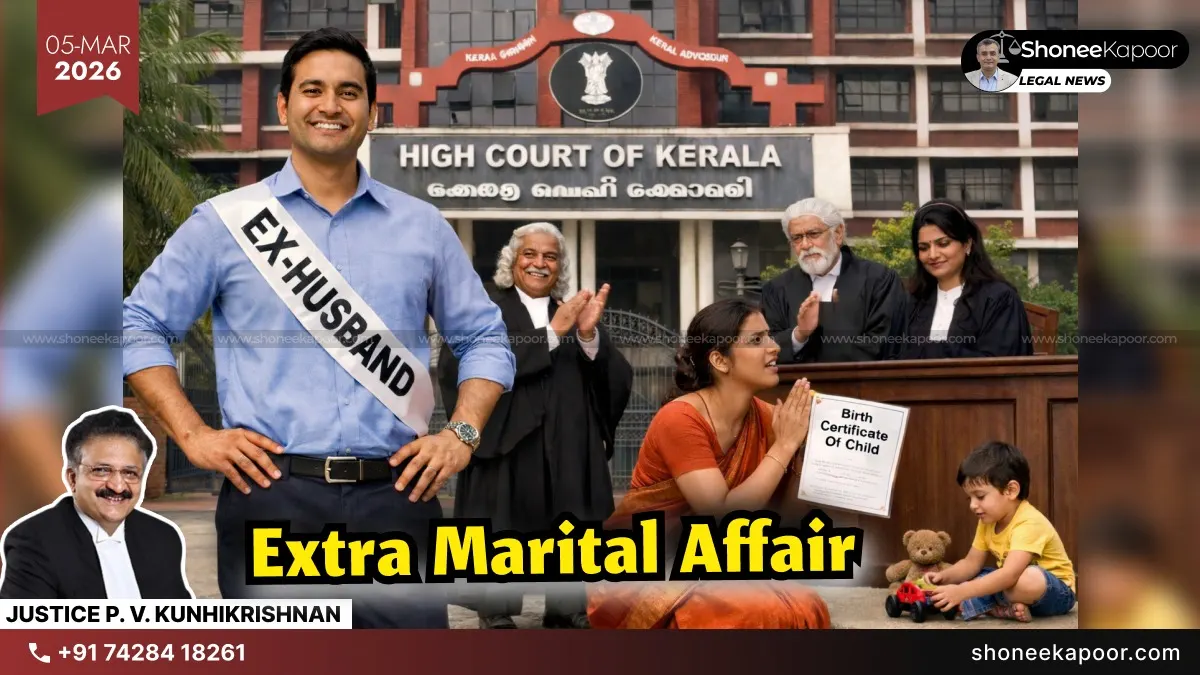
Men Too Have Dignity, Pride And Social Identity: Kerala HC Praised Gentlemanly Attitude Of Ex-Husband Allowing Correction Of Father’s Name In Birth Certificate Of Child Born Out Of Extra-Marital Affair

Curated by NEWS DESK
Editorial DeskCan a father’s name in a birth certificate be corrected years later when a child is born from an extramarital relationship? The Kerala High Court answered this sensitive question while also noting that men too have dignity and social identity.
KOCHI: The Kerala High Court allowed correction of the father’s name in the birth certificate of a minor girl who was born during the marriage of her mother but from an extra-marital relationship with another man. The Court exercised its extraordinary powers under Article 226 of the Constitution while also acknowledging the dignity and social standing of the former husband whose name was earlier recorded as the father.
Justice P.V. Kunhikrishnan was hearing a writ petition filed by the minor child and her biological parents seeking correction of the father’s name in the birth certificate. The request was to replace the name of the mother’s former husband with the name of the biological father.
The mother had married the fourth respondent in 2006 and the couple had a son from the marriage. During the subsistence of that marriage, the mother entered into a relationship with another man and in 2017 gave birth to a girl child. At the time of the child’s birth, the husband believed that the child was his and informed the hospital accordingly. Based on this belief, the hospital authorities recorded his name as the father in the birth register.
Later, marital disputes arose between the couple and in 2023 they obtained a divorce by mutual consent under the Hindu Marriage Act before a Family Court. After the divorce, the woman married the man with whom she had the relationship.
The biological parents then approached the High Court seeking correction of the father’s name in the birth certificate. They claimed that the school authorities had informed them that the child would not be allowed to continue her studies unless the correct father’s name was entered in the birth certificate.
While examining the case, the Court referred to the Registration of Births and Deaths Act, 1969 and the Kerala Registration of Births and Deaths Rules, 1999. These laws state that a registrar can only correct clerical or formal errors in the register. If the issue involves disputed paternity, proper proof such as a DNA test and a court order is required.
The Court also referred to earlier judicial precedents and a government circular dated 16.12.2015 which requires a DNA test report, a notarized agreement, and an order from a competent court before changing the father’s name in birth records.
The Court expressed doubt about the claim made by the petitioners regarding the school authorities insisting on the correction.
The judge remarked:
“The ground mentioned in the writ petition is that the school authorities stated that the child will not be allowed to study unless the father’s name is changed. I cannot believe the petitioners’ statements. How do the school authorities know that the fourth respondent is not the father of the third petitioner, unless the petitioners also made it public to the school authorities?
Moreover, it is difficult to accept the petitioners’ claim that the school authorities insist that the father’s name of the third petitioner is to be changed to allow the child to continue at the school.Therefore, the attitude of petitioners 1 and 2 is to be deprecated, and they are not entitled to any relief from this Court, as this Court is exercising its extraordinary jurisdiction under Article 226 of the Constitution of India. It is a discretionary jurisdiction.”
Despite these observations, the Court noted that the former husband had not opposed the correction of the father’s name. His consent and the future interests of the minor child were important considerations for the Court.
The Court described the situation as difficult for a husband who unknowingly becomes associated with a child born out of an extra-marital relationship.
Justice Kunhikrishnan observed that such situations can affect the dignity and social identity of a man.
“I am of the opinion that, in a situation like this in this case, all should stand behind the men as well, because they too have dignity, pride, self-respect, and social identity. In cultures like ours, where marital fidelity holds strong social value, a husband may feel publicly ridiculed in such a situation, as if his manhood and status have been mocked,” the Court observed.
The judge also described the case as a painful situation for the former husband whose marital life had been affected by the extra-marital relationship of his wife.
The Court appreciated the conduct of the former husband who did not oppose the correction of the birth certificate even after learning the truth about the child’s paternity. The Court referred to his approach as a dignified and responsible one.
“The counsel who appeared for the 4th respondent submitted before this Court that his client has no objection to the correction of the birth certificate as prayed for by petitioners 1 and 2. That is the gentlemanly attitude of the 4th respondent. Moreover, the 3rd petitioner is a minor girl. I do not want her to be in an embarrassing situation when she becomes major, if the father’s name is not correctly mentioned in the birth register.
Therefore, considering the plight of the minor child and the gentlemanly attitude of the 4th respondent, I think the correction can be allowed, invoking the extraordinary jurisdiction of this Court. If this court finds an injustice to a citizen, it can step in to redress it and ensure complete justice. This court must also imagine the minor child’s future,” the Court added.
The Court also criticized the petitioners for not masking the name of the minor child while filing the petition and directed the Registry to mask the names of both the child and the former husband while publishing the judgment. This direction was issued by applying the principle of parens patriae to protect the child’s identity.
Finally, the High Court directed the petitioners to approach the competent authority of the Thrissur Municipal Corporation with an application for correction of the father’s name in the birth register.
“Therefore, considering the plight of the minor child and the gentlemanly attitude of the 4th respondent, I think the correction can be allowed, invoking the extraordinary jurisdiction of this Court. If this court finds an injustice to a citizen, it can step in to redress it and ensure complete justice. This court must also imagine the minor child’s future. Let the name of the 3rd petitioner’s father be correctly mentioned in the birth register before she become major. Let there be a quietus,” the Court added.
The Court ordered that if such an application is received, the municipal authority must make a marginal entry in the register without altering the original entry and sign the correction. Based on this correction, a fresh birth certificate must be issued within 30 days.
Explanatory Table Of Laws And Sections Mentioned In The Case
| Law / Provision | Legal Area | What It Says | Role In This Case |
| Article 226, Constitution of India | Constitutional Law | Gives High Courts power to issue writs to protect legal rights | Used by Kerala High Court to grant relief and allow correction of birth certificate |
| Section 15, Registration of Births and Deaths Act, 1969 | Civil Registration Law | Allows correction or cancellation of entries in birth/death registers through marginal notes without altering original record | Court explained how corrections must legally be made in the register |
| Section 30, Registration of Births and Deaths Act, 1969 | Rule-making power | Allows State Government to frame rules under the Act | Enabled Kerala to frame detailed rules regarding corrections |
| Rule 11, Kerala Registration of Births and Deaths Rules, 1999 | Administrative Procedure | Provides the procedure for correcting clerical or formal errors in birth/death records | Court clarified registrar can correct only limited errors under this rule |
| Section 112, Indian Evidence Act | Presumption of Legitimacy | Presumes a child born during marriage to be legitimate unless strong proof exists | Referenced in earlier precedent regarding paternity disputes |
| Section 13B, Hindu Marriage Act | Family Law | Provides divorce by mutual consent | Used by the couple to dissolve the marriage before the woman remarried |
| Section 57, Kerala Police Act, 2011 | Police Procedure | Related to registration of missing complaints | Applied when the husband filed a missing complaint when the wife left home |
Case Details
- Case Title: XXX & Ors v State of Kerala & Ors
- Court: High Court of Kerala at Ernakulam
- Case Number: W.P.(C) No. 44739 of 2024
- Neutral Citation: 2026:KER:17057
- Bench: Justice P. V. Kunhikrishnan
- Date of Judgment: 23 February 2026
- Nature of Case: Writ Petition under Article 226 seeking correction of father’s name in birth certificate of a minor child.
Counsels
- For Petitioners
- Adv. Happymon Babu
- Adv. Blessy Mary Sebastian
- For Thrissur Municipal Corporation: Adv. Santhosh P. Poduval
- For State of Kerala: Sr. Government Pleader Vidya Kuriakose
- For Former Husband (Additional Respondent 4)
- Adv. Sruthy Saijo
- Adv. Jahra K.
Key Takeaways
- The Kerala High Court recognised that men too have dignity, pride, and social identity, especially when they are publicly associated with a child born from their spouse’s extra-marital relationship.
- The Court described the former husband as an unfortunate man who unknowingly accepted responsibility for a child that was not biologically his.
- Even after discovering the truth, the husband did not object to correcting the birth certificate, which the Court called a gentlemanly attitude.
- The judgment highlights how legal and social consequences of extra-marital relationships often fall heavily on men, including reputational harm and emotional humiliation.
- The Court allowed correction of the birth certificate through municipal authorities using its extraordinary powers under Article 226 to prevent future embarrassment to the child and further injustice to the husband.
This Could Change Your Case-Get FREE Legal Advice-Click Here!
Disclaimer: The views and opinions expressed in this article are those of the Indian courts and do not necessarily reflect the official policy or position of “ShoneeKapoor.com” or its affiliates. This article is intended for informational and educational purposes only. The content provided is not legal advice, and viewers should not act upon this information without seeking professional counsel. Viewer discretion is advised.
Related Articles
Karisma Kapoor – Sunjay Kapur Case Explained: Marriage, Divorce, 498A, Death & the Delhi High Court Property War
From a celebrity wedding to IPC 498A allegations, a Supreme Court-linked divorce settlement, and now a Delhi High Cou...
India vs Canada Divorce: Which Court Has Jurisdiction, and Will India Recognise a Canadian Divorce?
Married in India, living in Canada, or fighting divorce across both countries? Here is the real legal position on jur...
Share Your Thoughts
Comments are moderated before publication.