
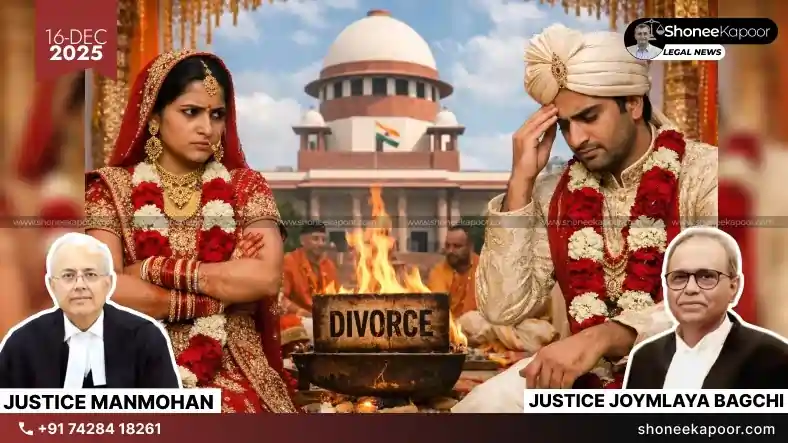
The Supreme Court has dissolved a marriage after 24 years of separation, holding that prolonged litigation and complete breakdown make the marriage meaningless. The Court said keeping such marriages alive only on paper causes cruelty to both sides and serves no purpose.
NEW DELHI: The Supreme Court of India has once again sent a strong message on long-pending matrimonial disputes, clearly stating that courts should not force parties to remain tied in a marriage that exists only on paper due to prolonged litigation.
In a judgment delivered on December 15, the Court dissolved a marriage where the husband and wife had been living separately for nearly 24 years, holding that such prolonged separation itself amounts to cruelty and reflects an irretrievable breakdown of marriage
The Court observed that when spouses have lived apart for decades with no possibility of reconciliation, continuing the legal bond only prolongs suffering. Relying on earlier judgments, the Court reiterated:
“Long period of separation without any hope for reconciliation amounts to cruelty to both the parties.”
The Bench further made an important observation on long-pending matrimonial cases and their social impact, stating:
“This Court is also of the view that pendency of matrimonial litigation for a long duration only leads to perpetuity of marriage on paper. It is in the best interest of parties and the society if ties are severed between parties in cases where litigation has been pending for a considerably long period of time. Consequently, this Court is of the opinion that no useful purpose shall be served by keeping the matrimonial litigation pending in Court without granting relief to the parties.”
In the present case, the marriage was solemnised in the year 2000. The couple separated within a year and had been living apart since November 2001. There were no children from the marriage. The husband first approached the court in 2003 seeking divorce, but the petition was dismissed as premature. A fresh divorce case filed later was allowed by the trial court on the ground of desertion.
However, the High Court reversed the divorce decree, holding that the wife had reasonable cause to live separately and that the husband was attempting to take advantage of his own wrong. This led to the appeal before the Supreme Court.
Setting aside the High Court’s decision, the Supreme Court made it clear that in cases of such prolonged separation, the question of fixing fault becomes irrelevant. The Court held that the very fact that the parties have lived separately for almost their entire adult married life is sufficient to show that the marriage has failed completely.
The Court explained that both spouses had fundamentally different and rigid views about matrimonial life and had refused to adjust with each other for a very long time. On this issue, the Court observed:
“In the case at hand, spouses have strongly held views with regard to the approach towards matrimonial life and they have refused to accommodate each other for a long period of time. Consequently, their conduct amounts to cruelty to each other. This Court is of the view that in matrimonial matters involving two individuals, it is not for the society or for the Court to sit in judgment over which spouses’ approach is correct or not. It is their strongly held views and their refusal to accommodate each other that amounts to cruelty to one another.”
The Supreme Court also referred to its Constitution Bench judgment on the scope of Article 142 of the Constitution, which empowers the Court to do “complete justice” between parties. The Court relied on the settled principle that this constitutional power is not restricted by the fault-based grounds mentioned in matrimonial laws.
Quoting extensively from earlier precedent, the Court reaffirmed:
“An unworkable marriage, which has ceased to be effective, is futile and bound to be a source of greater misery for the parties. The law of divorce built predominantly on assigning fault fails to serve broken marriages. Under the fault theory, guilt has to be proven, and therefore, the courts have to be presented with concrete instances of adverse human behaviour, thereby maligning the institution of marriage.
Public interest demands that the marriage status should, as far as possible, be maintained, but where the marriage has been wrecked beyond the hope of salvage, public interest lies in recognising the real fact. No spouse can be compelled to resume life with a consort, and as such, nothing is gained by keeping the parties tied forever to a marriage which has, in fact, ceased to exist.”
The Court further clarified that even when no statutory ground for divorce is available, it can still dissolve a marriage if it is satisfied that the relationship has completely collapsed. It reiterated:
“We would not read the provisions of the Hindu Marriage Act, their underlying intent, and any fundamental specific issue of public policy, as barring this Court from dissolving a broken and shattered marriage in exercise of the constitutional power under Article 142(1) of the Constitution of India.”
Addressing concerns about the sanctity of marriage, the Court acknowledged that courts should generally try to preserve marriages, but also made it clear that blind preservation serves no purpose when the marriage has lost all substance. The Court held that in the present case, there was “no sanctity left in the marriage” and reconciliation was not realistically possible.
In its concluding observations, the Supreme Court firmly stated that forcing parties to remain legally married after decades of separation only adds to their mental agony and clogs the justice system. Emphasising social interest as well, the Court said once again:
“This Court is also of the view that pendency of matrimonial litigation for a long duration only leads to perpetuity of marriage on paper.”
Invoking its powers under Article 142 of the Constitution, the Supreme Court dissolved the marriage and restored the divorce decree granted by the trial court, finally bringing an end to a litigation that had continued for over two decades.
This judgment reinforces a clear legal position: when a marriage has completely broken down and survives only in court records, the law must step in to bring closure rather than prolong suffering under the name of technicalities or fault-finding.
Explanatory Table: Laws & Sections Applied in This Case
| Law / Provision | Section / Article | Plain Explanation | How Supreme Court Applied It |
| Constitution of India | Article 142(1) | Gives Supreme Court power to do “complete justice” even if no specific law fully covers the situation | Used to dissolve the marriage despite disputes on fault, as the marriage had completely broken down |
| Hindu Marriage Act, 1955 | Section 13(1)(i-b) | Divorce on ground of desertion for a continuous period | Trial Court granted divorce under this section; Supreme Court upheld dissolution considering long separation |
| Hindu Marriage Act, 1955 | Section 13(1)(i-a) | Divorce on ground of cruelty | Supreme Court held that 24 years of separation itself amounts to mental cruelty |
| Hindu Marriage Act, 1955 | Section 23(1) | Bars a party from taking advantage of their own wrong | High Court relied on this, but Supreme Court held it irrelevant in irretrievable breakdown cases |
| Evidence Act (Principles) | Fault-based proof | Requires proving guilt in matrimonial disputes | Supreme Court clarified fault theory should not block relief when marriage is dead in reality |
| Constitutional Jurisprudence | Irretrievable Breakdown Doctrine | Marriage beyond repair should not be legally forced | Applied through Article 142, even though not a statutory ground |
Important Precedents Relied in Judgment
| Case Name | Legal Principle Taken |
| Rakesh Raman v. Kavita (2023) | Long separation means marriage exists only on paper and causes cruelty |
| Shilpa Sailesh v. Varun Sreenivasan (2023) | Article 142 power is not limited by fault-based divorce laws |
| Naveen Kohli v. Neelu Kohli (2006) | Unworkable marriages cause misery and should not be continued |
| Samar Ghosh v. Jaya Ghosh (2007) | Long separation proves matrimonial bond is beyond repair |
| Kumari Rekha v. Shambhu Saran Paswan (2025) | Absence of statutory grounds is not a bar to Article 142 relief |
Case Summary
- Case Title: NB vs AC Civil Appeal No. 5167 of 2012
- Neutral Citation: 2025 INSC 1436
- Court: Supreme Court of India
- Date of Judgment: 15 December 2025
- Bench: Justice Manmohan and Justice Joymalya Bagchi
- Nature of Case: Matrimonial dispute – Divorce on ground of desertion and irretrievable breakdown of marriage
Lower Court History:
- Trial Court dissolved the marriage on the ground of desertion
- High Court set aside the divorce decree
- Supreme Court restored the divorce decree exercising powers under Article 142
Key Takeaways
- A marriage that survives only in court files and not in real life is itself cruelty, especially when a man is dragged into litigation for decades.
- Long separation proves the marriage is dead; forcing a man to remain legally tied serves no social purpose and only prolongs mental, financial, and emotional harassment.
- Fault-finding becomes meaningless after years of separation; men should not be punished endlessly just to satisfy outdated matrimonial theories.
- Article 142 exists to stop legal abuse—when laws fail men, the Constitution steps in to deliver real justice and closure.
- Matrimonial litigation should not be used as a lifelong weapon against men; timely separation is better than endless courtroom suffering.
This Could Change Your Case-Get FREE Legal Advice-Click Here!
Disclaimer: The views and opinions expressed in this article are those of the Indian courts and do not necessarily reflect the official policy or position of “ShoneeKapoor.com” or its affiliates. This article is intended for informational and educational purposes only. The content provided is not legal advice, and viewers should not act upon this information without seeking professional counsel. Viewer discretion is advised.