
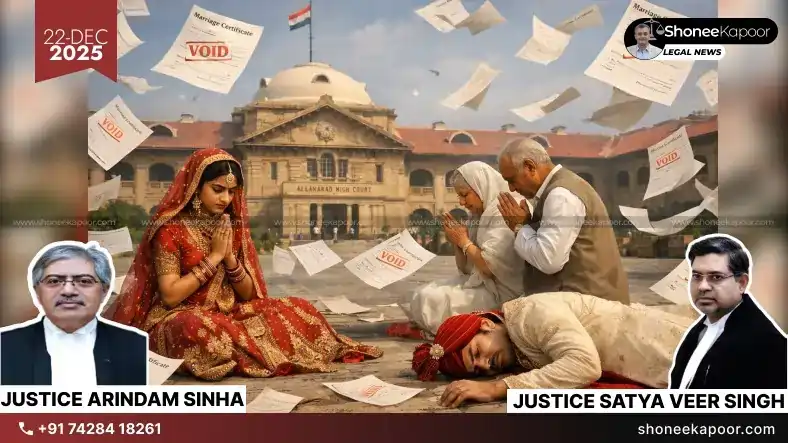
Allahabad High Court ruled that only husband or wife can seek annulment of marriage under Hindu law. In-laws have no legal right to challenge marriage, even on alleged underage ground.
Marriage Is Between Two Adults: The Allahabad High Court has clearly held that a Hindu marriage cannot be declared void at the request of in-laws, even if it is alleged that the bride was underage at the time of marriage.
The Court ruled that under the Hindu Marriage Act, only a spouse to the marriage has the legal right to seek annulment, and not parents or relatives of either side. The Court termed the attempt by the in-laws to invalidate the marriage after the husband’s death as legally untenable and impermissible.
The case arose from a dispute where the parents of a deceased Army personnel challenged a Family Court judgment which had declared a woman to be the legally wedded wife and widow of their son. The soldier had died in an encounter with terrorists on January 14, 2008. The parents claimed that what took place on May 12, 2007 was only an engagement and not a marriage, and further alleged that the woman was below 18 years of age at the time of the ceremony, making the marriage void.
A Division Bench of Justices Arindam Sinha and Satya Veer Singh dismissed the appeal and upheld the Family Court’s findings. The High Court noted that under Section 11 of the Hindu Marriage Act, a marriage can be declared void only if it violates specific conditions mentioned in Section 5 clauses (i), (iv), and (v).
Importantly, the requirement relating to age under Section 5(iii) is deliberately not included as a ground for declaring a marriage void. The Court emphasised that even if there is a violation of the age requirement, the marriage does not automatically become void under the Act.
The Court further clarified that the right to seek nullity of marriage is available only to either party to the marriage. Parents or in-laws do not have the legal standing to file such a plea. Since the husband had already passed away, the in-laws could not step into his shoes to challenge the marriage.
On the procedural side, the High Court strongly criticised the attempt to raise the issue of underage marriage at the appellate stage. It noted that no such plea was taken in the written statement before the Family Court, no issue was framed on this aspect, and no application was filed during the trial seeking framing of an additional issue, even though the appellants claimed that age-related documents had surfaced during evidence. Raising this contention for the first time in appeal was held to be impermissible.
The Bench also relied on earlier proceedings initiated by the mother of the deceased before another High Court, where she had admitted that her son married the woman on May 12, 2007, though she claimed the marriage was never consummated.
The Court reproduced her own admission made in that earlier case, which stated:
“6. It is not in dispute that the son of the petitioner married Sadhnadevi on 12th May, 07 but the marriage has never consummated as according to the custom and usage the marriages are generally consummated after a period of 1 to 3 years of marriage and that too after performing the religious function. Though the marriage did take place on 12th May, 07, it was never consummated and the bridegroom never came at the residence of the petitioner.
It is also required to be mentioned that the petitioner and her husband has performed last ritual ceremony of her son Shri Arve Shanker Yadav and in the last ceremony also Smt. Sadhnadevi never appeared to perform the rituals ceremony as the marriage was never consummated.
Read Also: Video & Audio Evidence Now Directly Admissible Without Certificate Under E-Evidence SystemThe petitioner’s son Shri Arve Shanker was borne on 2-3-1983 at Mehsana in Gujarat and marriage took place on 12th May, 07 and she never came at the residence of the petitioner and she never met even her late husband Shri Arve Shanker Yadav.”
That earlier petition was summarily rejected, with the Court observing:
“We see no substance in the claim made by the petitioner. Petition is summarily rejected.”
The Allahabad High Court also took note of the fact that the woman had received posthumous honours as the widow of the deceased soldier at an investiture ceremony held at Rashtrapati Bhawan in April 2009. While there were subsequent administrative proceedings relating to service benefits, the Court held that such orders could not override a civil court’s determination of marital status after a full-fledged trial.
Upholding the Family Court judgment, the High Court highlighted the detailed and exhaustive evaluation of evidence carried out during trial. This included marriage invitation cards produced by the woman, one of which bore the handwriting of the deceased’s father, oral testimony of witnesses who categorically stated that the marriage ceremony took place on May 12, 2007, and documentary proof showing that the deceased’s father had taken leave from his employment to attend the marriage.
The Court rejected the argument that absence of a ‘vidai’ ceremony disproved the marriage, holding that post-marriage rituals cannot be confused with the actual solemnisation of marriage. It also found no credible evidence to support the claim that the marriage was fixed for a later date, and observed that the alleged future date appeared to be an afterthought.
On the question of jurisdiction, the High Court held that the Family Court was fully competent under the Family Courts Act, 1984, to decide a suit seeking declaration of marital status.
The Court reproduced the Family Court’s finding which stated:
“17. Disposal of Issue No.-3
The point in question is whether this court has jurisdiction to hear the case?
In view of this point, no argument has been presented during the arguments of both the parties. In the case in question, the suit has been filed for declaration of marriage between plaintiff and the opposite party Arbeyshankar (deceased). Under Explanation (b) of Section 7 of the Family Courts Act, 1984, the Court has jurisdiction to entertain any suit or proceeding for declaration of the legality of a marriage or marital status of a person.
Hence, this issue is also decided negatively against the defendants.”
Addressing the underage argument in detail, the High Court examined the statutory scheme and reproduced Section 11 of the Hindu Marriage Act:
“11. Void marriages.-Any marriage solemnised after the commencement of this Act shall be null and void and may, on a petition presented by either party thereto [against the other party], be so declared by a decree of nullity if it contravenes any one of the conditions specified in clauses (i), (iv) and (v) of section 5.”
The Court concluded that since clause (iii) relating to age is not included in Section 11, and since only a spouse can invoke this provision, the plea raised by the in-laws was legally misconceived and deliberately raised at a belated stage.
Finding no perversity, illegality, or jurisdictional error in the Family Court’s judgment dated April 28, 2025, the Allahabad High Court dismissed the appeal and affirmed the declaration recognising the woman as the legally wedded wife and widow of the deceased soldier.
Explanatory Table of Laws & Sections Referred in the Case
| Law / Statute | Section / Provision | Simple Explanation |
| Hindu Marriage Act, 1955 | Section 5(iii) | Prescribes minimum age for marriage; bride must be 18 years old at the time of marriage. Violation does not automatically make marriage void. |
| Hindu Marriage Act, 1955 | Section 11 | Lists grounds for void marriages. Age condition under Section 5(iii) is deliberately excluded; only clauses (i), (iv), and (v) apply. |
| Hindu Marriage Act, 1955 | Section 12 | Deals with voidable marriages. Does not include underage marriage as a ground for annulment. |
| Family Courts Act, 1984 | Section 7 (Explanation b) | Gives Family Court jurisdiction to decide cases related to declaration of marital status or legality of marriage. |
| Family Courts Act, 1984 | Section 13 | Bars automatic right to legal representation but allows Family Court discretion; both sides were represented in this case. |
| Family Courts Act, 1984 | Section 14 | Allows Family Court to receive any evidence that helps resolve the dispute effectively. |
| Family Courts Act, 1984 | Section 15 | Governs manner of recording oral evidence before Family Court. |
| Code of Civil Procedure, 1908 | Order XIV Rule 1 | Issues arise only when a material fact or law is pleaded by one party and denied by the other. |
| Code of Civil Procedure, 1908 | Order XIV Rule 3 | Issues may be framed from pleadings, oral allegations, or contents of documents. |
| Code of Civil Procedure, 1908 | Order VI Rule 17 | Allows amendment of pleadings; after trial starts, amendment allowed only with due diligence. |
| Code of Civil Procedure, 1908 | Order VII Rule 11 | Provides grounds for rejection of plaint; examined and rejected by Family Court. |
| Indian Evidence Act, 1872 | General reference | Evidence assessed through oral testimony and documentary proof during full trial. |
Case Summary
- Case Title: R And Another vs SD
- Court: High Court of Judicature at Allahabad
- Case Number: First Appeal No. 493 of 2025
- Date of Judgment: 28 November 2025
- Bench: Hon’ble Justice Arindam Sinha and Hon’ble Justice Satya Veer Singh
- Counsel for Appellants: Mr. Vinod Kumar Pandey, Advocate
- Counsel for Respondent: Mr. Saurabh Pandey, Advocate
Key Takeaways
- Only husband or wife has the legal right to challenge a marriage under Hindu Marriage Act; parents or in-laws have zero locus, even after the man’s death.
- Allegation of underage bride does NOT make a Hindu marriage void; age is deliberately excluded from Section 11 to prevent misuse after marriage.
- Legal challenges raised after the husband’s death are viewed strictly and courts will not entertain new allegations at appellate stage.
- Marriage validity is decided on evidence of solemnisation, not on post-marriage rituals like vidai or cohabitation.
- Family Courts are the correct forum for deciding marital status, protecting men’s legal certainty from endless collateral attacks by relatives
This Could Change Your Case-Get FREE Legal Advice-Click Here!
Disclaimer: The views and opinions expressed in this article are those of the Indian courts and do not necessarily reflect the official policy or position of “ShoneeKapoor.com” or its affiliates. This article is intended for informational and educational purposes only. The content provided is not legal advice, and viewers should not act upon this information without seeking professional counsel. Viewer discretion is advised.