
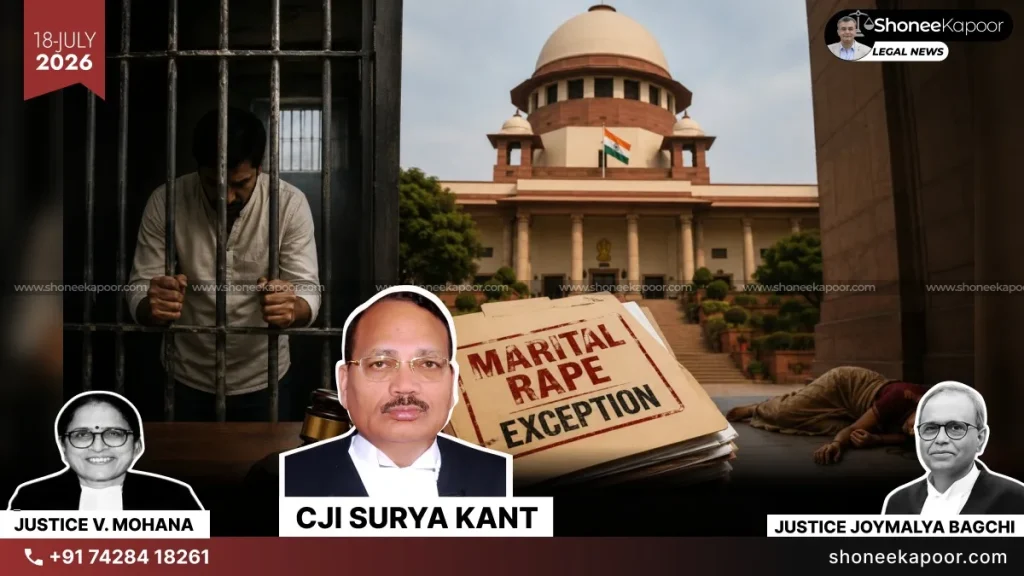
Can the marital rape exception protect a husband even when an alleged forced sexual act causes serious injury or death to his wife? The Supreme Court will now examine whether other criminal charges can still be applied in such cases.
NEW DELHI: The Supreme Court has agreed to examine whether the marital rape exception can protect a husband from criminal prosecution when an alleged forceful and non-consensual sexual act causes bodily injury or death to his wife.
On July 16, 2026, a Bench comprising Chief Justice of India Surya Kant and Justices Joymalya Bagchi and V Mohana issued notice to the Central government on a petition filed by NGO Red Dot Foundation.
The Court connected the petition with the pending cases challenging the constitutional validity of the marital rape exception. It directed that all the connected matters be listed for final hearing on September 9, 2026.
“Issue notice. Tag with SLP (Criminal) Nos. 4063-4064/2022,” the Court ordered.
The new petition raises a question that is slightly different from the main marital rape cases already pending before the Supreme Court.
The main cases seek complete removal of the marital rape exception and ask the Court to declare it unconstitutional. The present petition argues that even if the exception continues, it should not protect a husband from prosecution under other criminal provisions when the alleged act causes hurt, grievous injury or death.
Exception 2 to Section 63 of the Bharatiya Nyaya Sanhita provides that sexual intercourse or sexual acts by a man with his adult wife do not amount to rape. A similar protection was earlier provided under Exception 2 to Section 375 of the Indian Penal Code.
The petitioner has argued that this exception only removes the offence of rape in such circumstances. According to the plea, it should not prevent prosecution for separate offences such as voluntarily causing hurt, grievous hurt, culpable homicide or murder.
Therefore, even where a husband cannot be prosecuted for rape because of the marital exception, he may still face criminal liability if evidence shows that his conduct caused physical injuries or death.
The petition claims that the present interpretation of the exception has created a serious gap in criminal law. It argues that non-consensual sexual conduct within marriage may escape proper criminal consequences even when the alleged incident results in grave physical harm.
Apart from seeking this clarification, the NGO has also challenged the constitutional validity of the marital rape exception itself. It has argued that the exception is based on an old colonial belief that a woman gives permanent consent to sexual relations after marriage.
The plea states that such a legal presumption violates the rights of married women to equality, dignity and bodily autonomy.
It has also referred to the recommendations of the Justice JS Verma Committee, which was constituted after the 2012 Nirbhaya gang rape case. The Committee had recommended the removal of the marital rape exception. However, Parliament retained the exception while amending criminal law in 2013.
The Supreme Court has not yet decided whether the marital rape exception is constitutional or whether husbands can be prosecuted under other penal provisions in such cases. It has only issued notice and agreed to examine the questions raised.
EXPLANATORY TABLE – LAWS AND SECTIONS EXPLAINED
| LAW / PROVISION | WHAT IT PROVIDES | RELEVANCE TO THE CASE |
| Exception 2 to Section 63, Bharatiya Nyaya Sanhita, 2023 | It provides that sexual intercourse or sexual acts by a man with his adult wife do not constitute rape, provided the wife is not below the prescribed age. | The petition questions whether this exception can prevent prosecution when an alleged non-consensual sexual act causes bodily injury, grievous hurt or death. |
| Section 63, Bharatiya Nyaya Sanhita, 2023 | It defines the offence of rape and lists the circumstances in which sexual intercourse or sexual acts are treated as rape. | The marital rape exception is attached to this section. The constitutional validity and scope of that exception are under challenge. |
| Exception 2 to Section 375, Indian Penal Code, 1860 | This was the earlier marital rape exception under the IPC. It excluded sexual intercourse by a man with his wife from the definition of rape, subject to the statutory age condition. | It is the predecessor of Exception 2 to Section 63 BNS and forms part of the legal background of the pending challenge. |
| Section 375, Indian Penal Code, 1860 | It defined rape under the earlier criminal law. | The petitions tagged with the present matter originally challenged the marital rape exception contained in this provision. |
| Criminal provisions relating to hurt | These provisions punish the intentional or voluntary causing of bodily pain, disease or physical injury. | The petitioner argues that even where the rape provision is excluded, a husband should still be prosecuted if the alleged act causes physical injury. |
| Criminal provisions relating to grievous hurt | These provisions apply to serious injuries such as permanent damage, fracture, disfigurement or other legally recognised grave harm. | The plea seeks clarification that the marital rape exception cannot block prosecution for serious bodily injury. |
| Criminal provisions relating to culpable homicide | These provisions punish acts causing death where the required intention or knowledge is established, even where the case may not amount to murder. | The petition argues that criminal liability must continue where an alleged forced sexual act causes the wife’s death. |
| Criminal provisions relating to murder | These provisions punish intentional killing or conduct falling within the statutory definition of murder. | The marital rape exception, according to the petitioner, should not operate as protection against a murder charge merely because the accused and deceased were married. |
| Constitutional right to equality | It protects persons against arbitrary or discriminatory legal treatment. | The petition reportedly argues that the exception treats married women differently and is therefore constitutionally discriminatory. |
| Right to life, dignity and bodily autonomy | Constitutional protection of life and personal liberty includes dignity, privacy and control over one’s body. | The constitutional challenge claims that irrevocable consent cannot be presumed merely because a woman is married. |
| Writ Petition under the Supreme Court’s constitutional jurisdiction | A writ petition may be filed for enforcement of fundamental rights and constitutional review of legislation. | Red Dot Foundation has approached the Supreme Court through Writ Petition (Criminal) No. 217 of 2026. |
| SLP (Criminal) Nos. 4063-4064 of 2022 | These are the already pending connected proceedings concerning the marital rape exception. | The Supreme Court directed that the present writ petition be tagged with these matters. |
CASE DETAILS
- Case Title: Red Dot Foundation v. Union of India & Others
- Case Number: Writ Petition (Criminal) No. 217 of 2026
- Interlocutory Application: IA No. 160477 of 2026 – Ex-Parte Stay
- Court: Supreme Court of India
- Court Number and Section: Court No. 1, Section PIL-W, Item No. 10
- Date of Order: 16 July 2026
BENCH
- Hon’ble the Chief Justice Surya Kant
- Hon’ble Mr. Justice Joymalya Bagchi
- Hon’ble Mrs. Justice V. Mohana
COUNSELS FOR THE PETITIONER
- Ms. N.S. Nappinai, Senior Advocate
- Ms. Sthavi Asthana, Advocate-on-Record
KEY TAKEAWAYS
- Violence must be punished, but marriage alone cannot reverse the presumption of innocence against a husband.
- Any prosecution for injury or death must rest on medical evidence, clear causation and proof—not merely allegations made during matrimonial conflict.
- Expanding criminal liability without strict safeguards may expose husbands to overlapping rape, cruelty, assault and homicide proceedings from the same allegation.
- The marital rape exception does not automatically protect a husband from charges of hurt, grievous hurt, culpable homicide or murder where independent evidence exists.
- The Supreme Court must balance bodily autonomy with due process, ensuring that genuine victims receive justice without turning every accused husband into a presumed criminal.
This Could Change Your Case-Get FREE Legal Advice-Click Here!
Disclaimer: The views and opinions expressed in this article are those of the Indian courts and do not necessarily reflect the official policy or position of “ShoneeKapoor.com” or its affiliates. This article is intended for informational and educational purposes only. The content provided is not legal advice, and viewers should not act upon this information without seeking professional counsel. Viewer discretion is advised.