
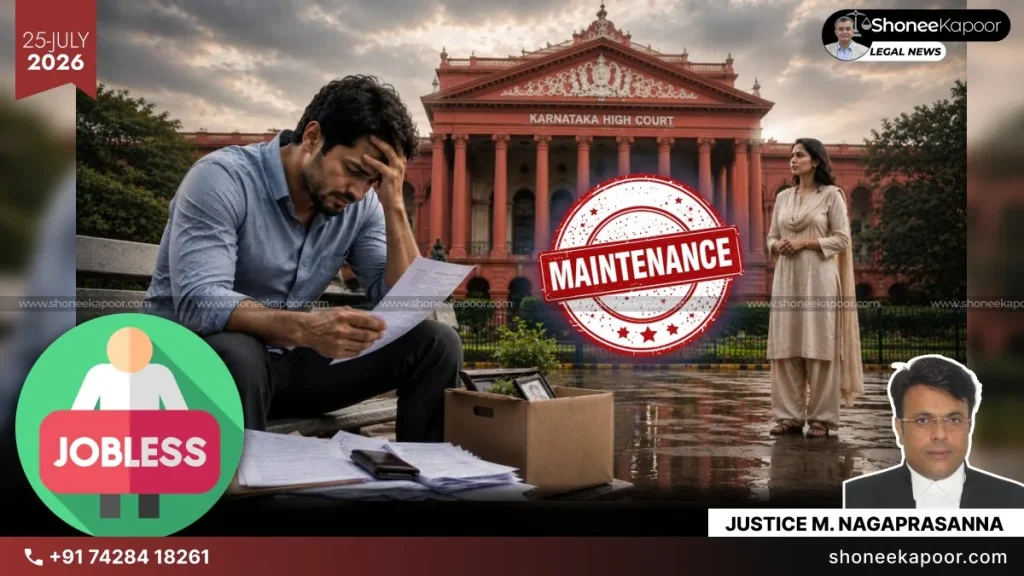
Can a husband be forced to pay maintenance even after losing his job? The Karnataka High Court examined whether unemployment can legally excuse a husband from supporting his wife and child.
BENGALURU:The Karnataka High Court has held that a husband cannot avoid paying maintenance to his wife and child merely by claiming that he is unemployed or earning a low salary.
Justice M. Nagaprasanna dismissed a petition filed by the husband challenging concurrent orders directing him to pay ₹8,000 per month to his wife and ₹8,000 per month to his son. The total monthly maintenance liability was ₹16,000.
The case arose from matrimonial disputes between Harish R. and Sowmya. The parties had married on June 16, 2003. After disputes developed in the marriage, the wife filed a maintenance petition under Section 125 of the Code of Criminal Procedure before the Additional Civil Judge and JMFC at Pandavapura.
On February 3, 2022, the Magistrate partly allowed the maintenance petition and ordered the husband to pay ₹8,000 per month each to his wife and son. The maintenance was awarded from the date of the petition.
The husband challenged the order before the III Additional District and Sessions Judge, Mandya, sitting at Srirangapatna. However, his criminal revision petition was dismissed on November 22, 2022. He then approached the Karnataka High Court under Section 482 CrPC and sought cancellation of both orders.
Before the High Court, the husband argued that he was presently unemployed and did not have sufficient income to pay ₹16,000 every month. He also submitted that his wife was an enrolled advocate and was capable of earning and maintaining herself.
The wife appeared before the Court in person. She stated that although she was enrolled as an advocate, she could not practise because of her health problems. Counsel representing the son also informed the Court that the husband had failed to follow the maintenance order and that the unpaid amount had reportedly reached nearly ₹21 lakh.
The High Court found that the Magistrate and the Revisional Court had already examined the financial position of the parties before fixing the maintenance amount. It therefore found no legal error that required interference.
The Court relied upon the Supreme Court judgment in Anju Garg and Another v. Deepak Kumar Garg, where the responsibility of an able-bodied husband to financially support his wife and minor child was explained.
Quoting the Supreme Court, the Bench observed:
“The husband is required to earn money even by physical labour, if he is an able-bodied, and could not avoid his obligation.”
The Karnataka High Court further held that when a husband has no employment, it is his responsibility to search for a job. When his existing salary is not sufficient, he must make reasonable efforts to find better-paying work. His wife and child cannot simply be left without financial support because of his present employment position.
The husband also relied upon the Supreme Court judgment in Rajnesh v. Neha. However, the High Court rejected this argument after noting that the Revisional Court had already examined the financial circumstances in accordance with the principles governing maintenance proceedings.
The Court also considered the husband’s failure to comply with the maintenance order passed in 2022. Finding no illegality in the orders of the Magistrate and Sessions Court, the High Court dismissed his criminal petition.
As a result, the direction requiring the husband to pay ₹8,000 per month to his wife and ₹8,000 per month to his son remains in force.
The judgment reinforces the legal principle that maintenance is meant to prevent financial hardship and destitution. At the same time, also shows how a husband’s claim of genuine unemployment may receive limited consideration once substantial arrears have accumulated. Courts must protect dependent spouses and children, but maintenance orders should also remain connected with verified income, real earning capacity and the financial circumstances of both parties
EXPLANATORY TABLE OF LAWS AND SECTION
| LAW/SECTION | APPLICATION IN THIS CASE |
| Section 125,Code of Criminal Procedure, 1973 | Allows a Magistrate to order maintenance for a wife, child or parent who cannot maintain themselves when a person having sufficient means neglects or refuses to maintain them. The wife sought maintenance under this provision. |
| Section 482,Code of Criminal Procedure, 1973 | Preserves the inherent powers of the High Court to prevent abuse of court process and secure the ends of justice. The husband approached the High Court under this provision to challenge the maintenance and revision orders. |
| Section 144,Bharatiya Nagarik Suraksha Sanhita, 2023 | The present corresponding maintenance provision after the replacement of the CrPC. It deals with maintenance of wives, children and parents. |
| Anju Garg and Another v. Deepak Kumar Garg2022 SCC OnLine SC 1314 | The Supreme Court held that an able-bodied husband cannot avoid maintenance merely by saying that he has no income. He is expected to earn through legitimate means, including physical labour where necessary. |
| Rajnesh v. Neha and Another(2021) 2 SCC 324 | Provides guidelines regarding maintenance, disclosure of assets and liabilities, determination of income, overlapping proceedings and the date from which maintenance should be awarded. The husband relied upon this judgment, but the argument was rejected. |
CASE DETAILS
| Particular | Details |
| Case Title | Sri Harish R. v. Smt. Sowmya and Another |
| Case Number | Criminal Petition No. 3011 of 2023 |
| Court | High Court of Karnataka at Bengaluru |
| Bench | Hon’ble Mr. Justice M. Nagaprasanna |
| Judgment Date | July 7, 2026 |
| Neutral Citation | 2026:KHC:34049 |
| Petitioner | Sri Harish R. |
| Respondents | Smt. Sowmya and another |
COUNSELS APPEARED
| Party | Counsel |
| Petitioner–Husband | Sri Sudhindra S.A., Advocate |
| Respondent No. 1–Wife | Appeared in person |
| Respondent No. 2–Son | Counsel’s complete name was not available in the linked Udayavani report or the accessible portion of the case summaries |
KEY TAKEAWAYS
- Losing job is no longer enoughfor Husand to avoid a maintenance order if the court believes you are capable of earning.
- The Court held that a husband should find a better-paying job instead of reducing maintenance, raising concerns about unrealistic expectations during unemployment.
- Even when financial hardship is claimed, the burden largely remains on the husband to continue supporting his wife and child.
- This judgment highlights the need for maintenance to be based on actual earning capacity and changing financial circumstances, not assumptions.
- Equal justice requires courts to assess both spouses’ real income and ability to earn, so maintenance remains fair rather than one-sided.
This Could Change Your Case-Get FREE Legal Advice-Click Here!
Disclaimer: The views and opinions expressed in this article are those of the Indian courts and do not necessarily reflect the official policy or position of “ShoneeKapoor.com” or its affiliates. This article is intended for informational and educational purposes only. The content provided is not legal advice, and viewers should not act upon this information without seeking professional counsel. Viewer discretion is advised.