
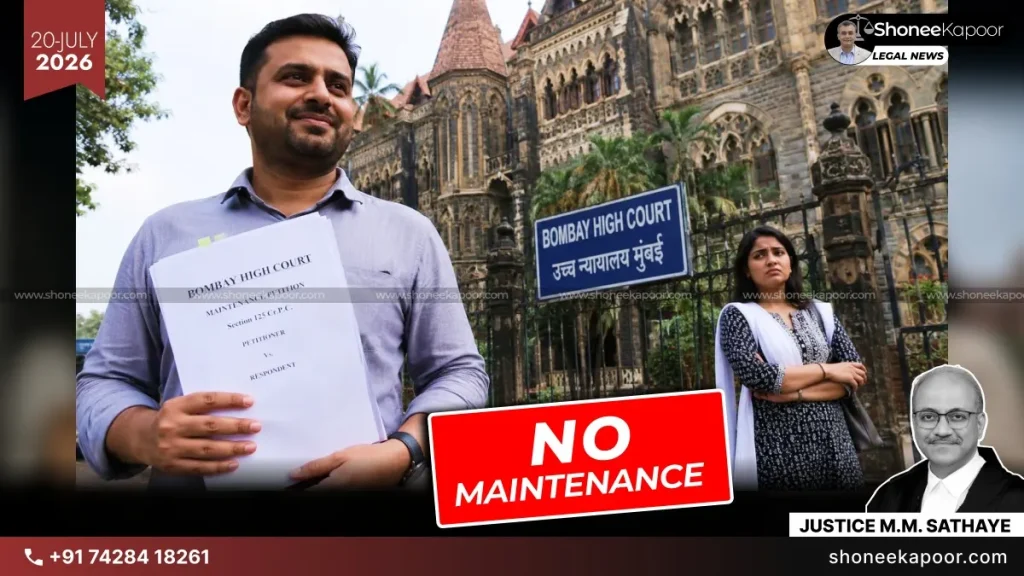
Can a woman conceal her existing marriage, marry another man and later claim maintenance as his legally wedded wife? The Bombay High Court said that beneficial laws cannot protect a person who entered into the relationship through deception.
MUMBAI: The Bombay High Court has refused maintenance to a woman after finding that she had concealed her subsisting first marriage before marrying another man. The Court held that a person who acts deceitfully cannot take advantage of beneficial maintenance provisions arising from her own wrongdoing.
A Single Judge Bench of Justice M.M. Sathaye dismissed the woman’s petition challenging a Sessions Court order that had cancelled her maintenance. However, the maintenance awarded to her minor son was allowed to continue.
According to the case, the woman approached a Magistrate’s Court in 2010 and alleged that the man had physically and mentally harassed her, demanded money and abandoned her and their child shortly after their marriage.
She sought monthly maintenance of ₹15,000 for herself and ₹15,000 for her son, claiming that the man owned agricultural land and earned income from a godown.
The man opposed her claim and informed the Court that she was already married when she entered into the second marriage. He argued that she had neither disclosed her first marriage nor obtained a divorce from her first husband.
The subsequent marriage between the parties had already been declared null and void. The man therefore argued that she could not claim the legal status of his “wife” for obtaining maintenance. He did not dispute his responsibility towards the minor child.
In 2015, the Magistrate directed the man to pay ₹2,000 per month to the woman and ₹1,000 per month to the child. The Sessions Court later cancelled the maintenance granted to the woman but continued the child’s maintenance.
The woman then approached the Bombay High Court, claiming that she was the legally wedded wife and had no independent means to maintain herself.
The High Court acknowledged that maintenance law is a beneficial social-welfare provision. Courts have, in appropriate cases, interpreted the expression “wife” broadly where parties lived together for a sufficiently long period in a relationship resembling marriage. Strict ceremonial proof may not always be required in summary maintenance proceedings.
However, the Court found that these principles could not rescue the woman in the present case.
The parties had lived together for only around four months. More importantly, the woman had entered the relationship after concealing that her first marriage was still legally subsisting.
The Court observed:
“A party cannot be permitted to take advantage of his or her own wrong.”
The High Court held that the woman’s deliberate concealment fundamentally affected her claim. A beneficial provision intended to prevent destitution could not be invoked by suppressing a material fact and subsequently demanding the legal benefits of a marriage that had already been declared void.
The Court therefore upheld the Sessions Court order and dismissed the woman’s petition for maintenance. The child’s maintenance remained unaffected.
The ruling makes an important distinction between a woman who is genuinely deceived into an invalid marriage and a woman who herself conceals an existing marriage. Courts have previously protected women who unknowingly enter relationships with already-married men because the man should not benefit from his own fraud.
But the same equitable protection cannot automatically apply where the claimant herself committed the concealment.
Maintenance law is meant to prevent genuine neglect and financial hardship. It is not a legal reward for hiding an existing spouse, entering another marriage and later shifting the financial burden upon the second man.
At the same time, the judgment correctly protected the child. A dispute regarding the validity of the parents’ marriage does not erase an established parental obligation towards a minor child.
EXPLANATORY TABLE OF IMPORTANT LAWS AND PRINCIPLES
| LAW OR PRINCIPLE | WHAT THE PROVISION MEANS | APPLICATION IN THIS CASE |
| Section 125, CrPC | Allowed a wife, child or parent unable to maintain themselves to seek monthly maintenance. | The proceedings began under this provision before the BNSS came into force. |
| Section 144, BNSS | The current corresponding provision governing maintenance of wives, children and parents. | It now substantially replaces Section 125 CrPC for proceedings governed by the BNSS. |
| Valid Hindu Marriage | Under Section 5 of the Hindu Marriage Act, neither party should have a living spouse when the marriage is solemnised. | The woman’s first marriage was allegedly still subsisting when she married the second man. |
| Void Marriage | Section 11 of the Hindu Marriage Act treats a marriage violating the living-spouse condition as void. | The subsequent marriage had been declared null and void. |
| No Benefit From One’s Own Wrong | A person seeking equitable or beneficial relief cannot rely upon their own fraud or concealment. | The woman could not hide her first marriage and then claim benefits as the second man’s lawful wife. |
| Child’s Independent Right | A child’s entitlement to maintenance is separate from the mother’s entitlement. | The mother’s claim was rejected, but the minor son continued receiving maintenance. |
CASE DETAILS
| PARTICULAR | DETAILS |
| Case Title | J & Anr. v. P & Anr |
| Court | Bombay High Court |
| Bench | Justice M.M. Sathaye |
| Case No. | Writ Petition No 130 of 2023 |
| Date of Judgment | 16 July 2026 |
| Counsel for Petitioners | Sachin Dhakephalkar, Surbhi V. Vadhavkar, Advocates. |
| Counsel for Respondents | Vikas G. Ambetkar, Manisha Tidke, APP, Advocate |
KEY TAKEAWAYS
- A woman cannot conceal her subsisting first marriage and later demand maintenance as the legally wedded wife of another man.
- A short relationship of approximately four months cannot automatically be treated as a long-term relationship resembling marriage.
- Courts must examine who committed the fraud before extending equitable protection.
- Men cannot be made financially liable on the basis of a marital status obtained through concealment.
- Maintenance is meant to prevent destitution, not to allow a claimant to profit from her own wrongdoing.
This Could Change Your Case-Get FREE Legal Advice-Click Here!
Disclaimer: The views and opinions expressed in this article are those of the Indian courts and do not necessarily reflect the official policy or position of “ShoneeKapoor.com” or its affiliates. This article is intended for informational and educational purposes only. The content provided is not legal advice, and viewers should not act upon this information without seeking professional counsel. Viewer discretion is advised.