
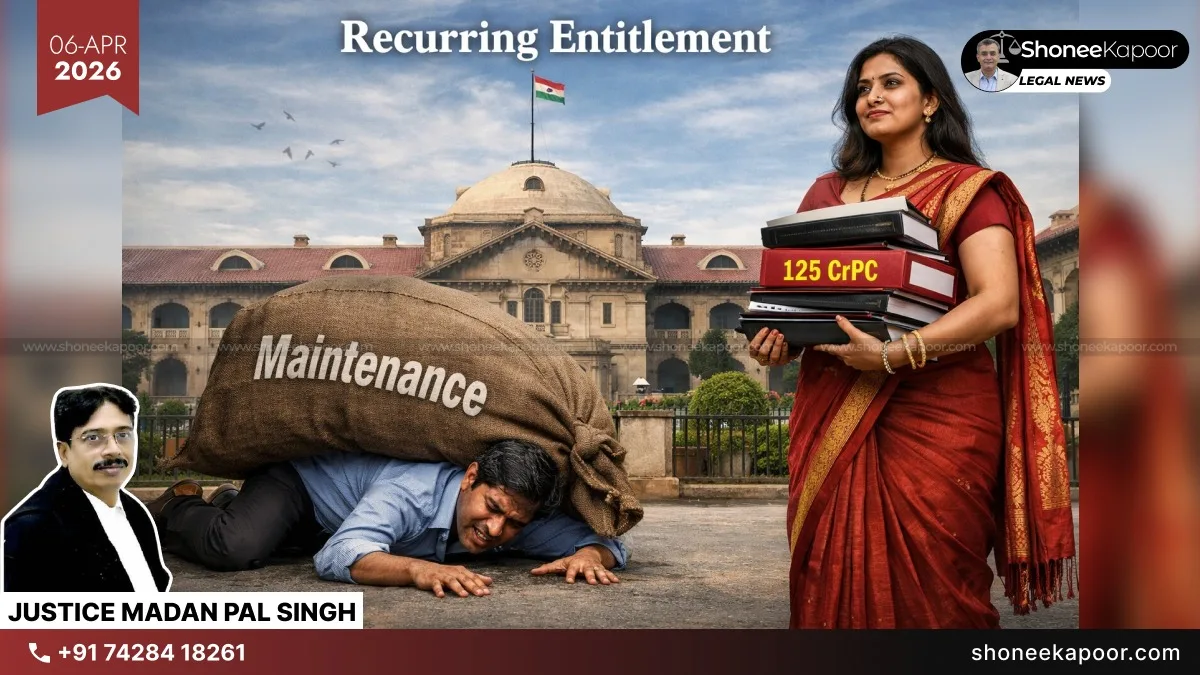
Maintenance Is A Recurring Entitlement. Even After Settlement, Wife Can Reopen Old S. 125 CrPC Plea Against Husband: Allahabad High Court

Written and analysed by Shonee Kapoor
Legal Consultant, Author & Men's Rights ActivistCan a wife restart an old maintenance case after settlement if dispute happens again? Court says yes—but reduced the amount citing husband’s earning capacity.
PRAYAGRAJ: The Allahabad High Court said that maintenance is not a one-time relief but a continuing right, and a wife can revive her earlier case if the husband fails to follow a settlement agreement.
The Court held that:
“The right to maintenance is not a one-time bounty but an ambulatory, recurring entitlement which crystallises afresh upon each breach of obligation.”
This means maintenance keeps arising again and again whenever the obligation is not fulfilled.
The case was heard by Justice Madan Pal Singh on a plea filed by a husband challenging a Family Court order that directed him to pay ₹9,000 per month as maintenance.
The husband argued that both parties had earlier settled their dispute in October 2021 through mediation, where they agreed to live together and withdraw all cases. However, when the wife later alleged that she was assaulted and forced out, he claimed this created a new situation and she should file a fresh case instead of continuing the old one.
The High Court rejected this argument and made it clear that maintenance is a continuous obligation, not something that ends after one settlement. The Court emphasised that forcing repeated fresh cases would unnecessarily burden the system and prolong disputes.
The Court also reiterated that:
“Section 125 of the CrPC is a measure of social legislation that must be construed liberally for the welfare and benefit of the wife and daughter.”
At the same time, the Court examined the husband’s financial condition. The husband claimed he was only a daily wage labourer and could not afford ₹9,000 per month. The wife alleged he ran a brass business but failed to provide proof.
In absence of clear evidence, the Court assumed his earning capacity based on minimum labour income. It calculated ₹700 per day, estimating a monthly income of ₹21,000. Applying the general principle that maintenance may be around 25% of income, the Court fixed the amount at ₹5,250 per month instead of ₹9,000.
Explanatory Table Of Laws & Provisions
| Section 125 CrPC | Provides maintenance to wife, children, parents to prevent destitution | Wife continued earlier maintenance case despite settlement breach; Court upheld her right |
| Section 397 CrPC | Revisional jurisdiction of High Court | Husband filed revision challenging Family Court order |
| Section 401 CrPC | Powers of High Court in revision | High Court modified maintenance amount using revisional powers |
| Section 482 CrPC | Inherent powers of High Court | Earlier proceedings led to mediation settlement between parties |
| Mediation Settlement Agreement (06.10.2021) | Settlement to resolve disputes and withdraw cases | Husband allegedly breached terms; Court allowed wife to revive earlier proceedings |
| Supreme Court precedent: Rajnesh v. Neha (2021) 2 SCC 324 | Guidelines on maintenance calculation | Used to apply 25% income principle |
| Kalyan Dey Chowdhury v. Rita Dey Chowdhury (2017) | Maintenance proportion principle | Reinforced 25% benchmark for maintenance |
| Kulbhushan Kumar v. Raj Kumari (1970) | Maintenance jurisprudence | Basis for determining reasonable maintenance |
Case Details
- Case Title: Murtaza Alias Phool Miya Alias Guddu vs State of U.P. and Another
- Case Number: Criminal Revision No. 5870 of 2025
- Court: High Court of Judicature at Allahabad
- Bench: Hon’ble Justice Madan Pal Singh
- Date of Judgment: March 18, 2026
- Neutral Citation: 2026:AHC:55373
- Counsel for Revisionist (Husband): Rupendra Kumar Mishra
- Counsel for Opposite Party (Wife): Anuj Kumar Gupta
- Counsel for State: Learned AGA
- Lower Court Details: Principal Judge, Family Court, Sambhal at Chandausi. Case No. 156 of 2018
Key Takeaways
- Settlement gives no finality—case can be revived anytime if wife alleges breach.
- Maintenance treated as endless liability, not a one-time legal closure.
- Courts allow continuation of old cases instead of forcing fresh proceedings, tilting process advantage.
- Income can be assumed by court without strict proof, increasing financial burden on men.
- Even after compromise and cohabitation, allegations can reopen full litigation exposure for husband.
This Could Change Your Case-Get FREE Legal Advice-Click Here!
Disclaimer: The views and opinions expressed in this article are those of the Indian courts and do not necessarily reflect the official policy or position of “ShoneeKapoor.com” or its affiliates. This article is intended for informational and educational purposes only. The content provided is not legal advice, and viewers should not act upon this information without seeking professional counsel. Viewer discretion is advised.
Related Articles

Legal Risks Men Face In Modern Relationships In India: 498A, Maintenance, False Promise To Marry, Live-In Cases & DV Act
Modern relationships can expose Indian men to criminal cases, maintenance claims, DV Act proceedings, false promise t...
Legal Mistakes Men Make During Divorce: Costly Errors That Destroy Cases
Costly legal mistakes Indian men make during divorce, maintenance, custody, 498A/BNS cruelty cases and evidence colle...

8 Court Judgments Every Man Should Know in India Before 498A, Maintenance, Custody or Divorce Hits
From arrest protection in 498A (85 BNS) cases to maintenance disclosure, child visitation, DV residence rights and fo...
Relevant Judgements
Can an NRI Husband Be Forced to Pay Maintenance in India? Supreme Court Rules Explained for Overseas Indian Men
Living abroad does not automatically protect an NRI husband from maintenance claims in India.But can Indian courts pa...
Share Your Thoughts
Comments are moderated before publication.