
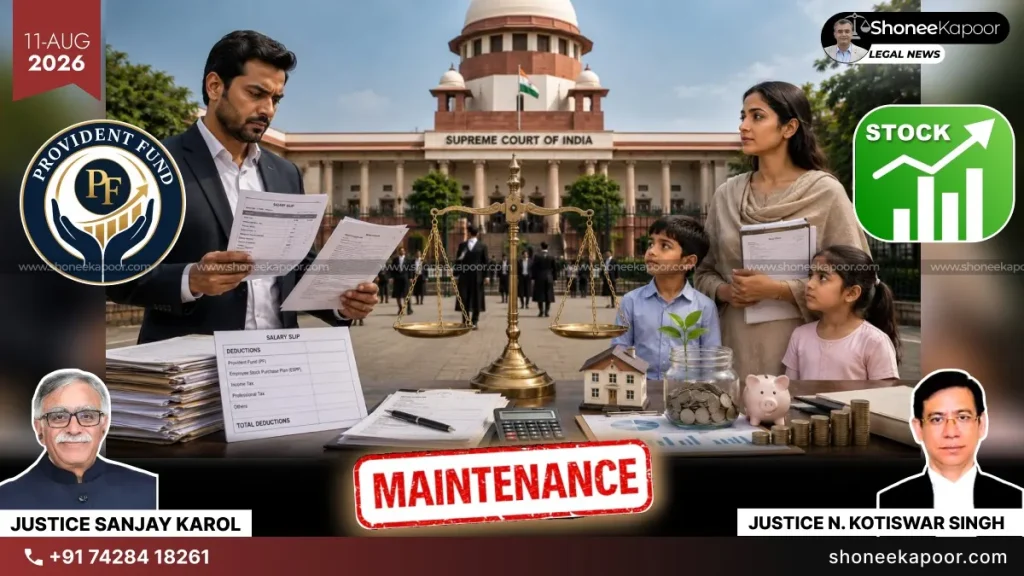
Can a husband reduce his income for maintenance by showing PF and stock-plan deductions from salary? The Supreme Court has now clarified which deductions can actually be counted while fixing maintenance.
NEW DELHI: The Supreme Court of India has held that voluntary salary deductions such as Provident Fund (PF) and Employee Stock Purchase Plans (ESPPs) cannot automatically be treated like compulsory deductions for reducing a husband’s income while calculating maintenance.
The ruling came from a matrimonial dispute involving maintenance for the wife and the couple’s two minor sons. A Bench of Justice Sanjay Karol and Justice N. Kotiswar Singh delivered the decision on August 10, 2026.
The parties married on December 9, 2004, according to Sikh rites in New Delhi and have two sons. After the matrimonial relationship broke down, the wife filed divorce proceedings under Section 13(1)(ia) of the Hindu Marriage Act, 1955, along with applications under Sections 24 and 26 HMA seeking interim maintenance for herself and the children.
In January 2021, the Family Court refused maintenance to the wife after considering her own monthly income, but awarded maintenance for the children. The amount was increased over the years as the litigation continued. In July 2024, the Family Court fixed it at ₹50,000 per child per month.
The wife approached the Delhi High Court seeking further enhancement. During those proceedings, she was diagnosed with aggressive breast cancer. The High Court initially directed the husband to pay ₹20,000 per month as interim maintenance to her and later enhanced the combined maintenance for the two children to ₹1,25,000 per month.
The dispute eventually reached the Supreme Court.
One important issue before the Court was the husband’s actual disposable income. Before the High Court, his salary was stated to be around ₹4 lakh per month, apart from an average annual bonus of approximately ₹6 lakh. His case was that substantial amounts were deducted every month towards income tax, provident fund, professional tax and other deductions, leaving a lower disposable income.
The Supreme Court, however, drew a clear distinction between mandatory statutory deductions and contributions that ultimately remain for the employee’s own benefit.
The Bench observed:
“PFs and ESPPs are not permanent charges”
The Court explained that amounts put into PF and ESPPs ultimately benefit the husband and may become available to him later. They therefore cannot be placed on the same footing as mandatory liabilities such as income tax and professional tax while determining the income available for maintenance.
This finding is important for maintenance litigation because courts frequently have to examine salary slips containing several deductions. The judgment indicates that the label “deduction” alone is not enough. Courts may examine whether the amount is an unavoidable outgoing or is actually a contribution creating an asset or future financial benefit for the earning spouse.
At the same time, the financial burden on the husband was substantial. The proceedings involved maintenance for two children, personal maintenance for the wife, arrears and an undertaking regarding transfer of a vehicle. The judgment therefore also demonstrates why a realistic assessment of the earning spouse’s actual income, genuine compulsory liabilities and voluntary investments becomes important instead of relying only on the final take-home figure shown on a salary slip.
Considering the children’s expenses and the circumstances of the parties, the Supreme Court enhanced child maintenance to ₹1,50,000 per month, meaning ₹75,000 for each child, with effect from January 1, 2025. The Court also increased the wife’s interim personal maintenance to ₹30,000 per month, particularly considering her medical expenses.
The husband was further directed to complete the necessary documents for transferring ownership of the Mahindra XUV500 in accordance with his earlier undertaking, within three months of the Supreme Court order. The civil appeals were accordingly disposed of.
EXPLANATORY TABLE OF LAWS AND LEGAL PROVISIONS
| Law / Section | What It Means | Application In This Case |
| Section 13(1)(ia), Hindu Marriage Act, 1955 | Allows a spouse to seek divorce on the ground of cruelty. | The wife instituted divorce proceedings under this provision. |
| Section 24, Hindu Marriage Act, 1955 | Permits interim maintenance and litigation expenses during matrimonial proceedings where the statutory requirements are satisfied. | The wife sought interim financial support during the pending matrimonial case. |
| Section 26, Hindu Marriage Act, 1955 | Empowers the matrimonial court to pass orders concerning custody, maintenance and education of minor children. | Maintenance for the couple’s two minor sons formed a major part of the dispute. |
| Provident Fund (PF) | A retirement-linked fund receiving contributions connected with employment. | The Supreme Court held that the PF deductions considered in this case could not be treated like permanent compulsory charges merely to reduce income available for maintenance. |
| Employee Stock Purchase Plan (ESPP) | An employee benefit arrangement through which employees may acquire company shares, usually through salary contributions. | The Court treated these contributions as ultimately benefiting the husband rather than as permanent mandatory liabilities. |
| Income Tax / Professional Tax | Statutory taxes payable according to applicable law. | The Supreme Court distinguished such mandatory taxes from PF and ESPP contributions while assessing disposable income. |
| Maintenance Pendente Lite | Financial support granted while matrimonial proceedings remain pending. | Interim maintenance for the wife and maintenance for the children were considered during the long-running matrimonial proceedings. |
CASE DETAILS
| Case Particular | Details |
| Case Title | Harpreet Sawhney v. Puneet Sharma |
| Court | Supreme Court of India |
| Case | Civil Appeals arising out of SLP (C) Nos. 31815-31816 of 2025 |
| Bench | Justice Sanjay Karol and Justice N. Kotiswar Singh |
| Decision Date | August 10, 2026 |
| Impugned Proceedings | MAT.APP.(F.C.) No. 299/2024, Delhi High Court |
| Neutral Citation | 2026 INSC 822 |
COUNSELS APPEARED
| Party | Counsel |
| Harpreet Sawhney | Senior Advocate Priya Hingorani; proceedings in the matter also record Advocate-on-Record Chandra Bhushan Prasad and Advocates including Dr. Shweta Hingorani, S.R. Desai and Naseem Ahmed |
| Puneet Sharma | Advocate-on-Record Tatini Basu; earlier Supreme Court proceedings also record Advocate Esha Thawal |
KEY TAKEAWAYS
- PF and stock deductions won’t automatically reduce a husband’s maintenance liability.
- The Supreme Court separated real compulsory deductions from money that still benefits the husband.
- The husband was ordered to pay ₹1.5 lakh for two children plus ₹30,000 to the wife every month.
- Take-home salary alone will not save you. Courts can examine your real earning capacity.
- For men in maintenance cases, the warning is clear: your savings and investments can also come back to haunt you.
This Could Change Your Case-Get FREE Legal Advice-Click Here!
Disclaimer: The views and opinions expressed in this article are those of the Indian courts and do not necessarily reflect the official policy or position of “ShoneeKapoor.com” or its affiliates. This article is intended for informational and educational purposes only. The content provided is not legal advice, and viewers should not act upon this information without seeking professional counsel. Viewer discretion is advised.