
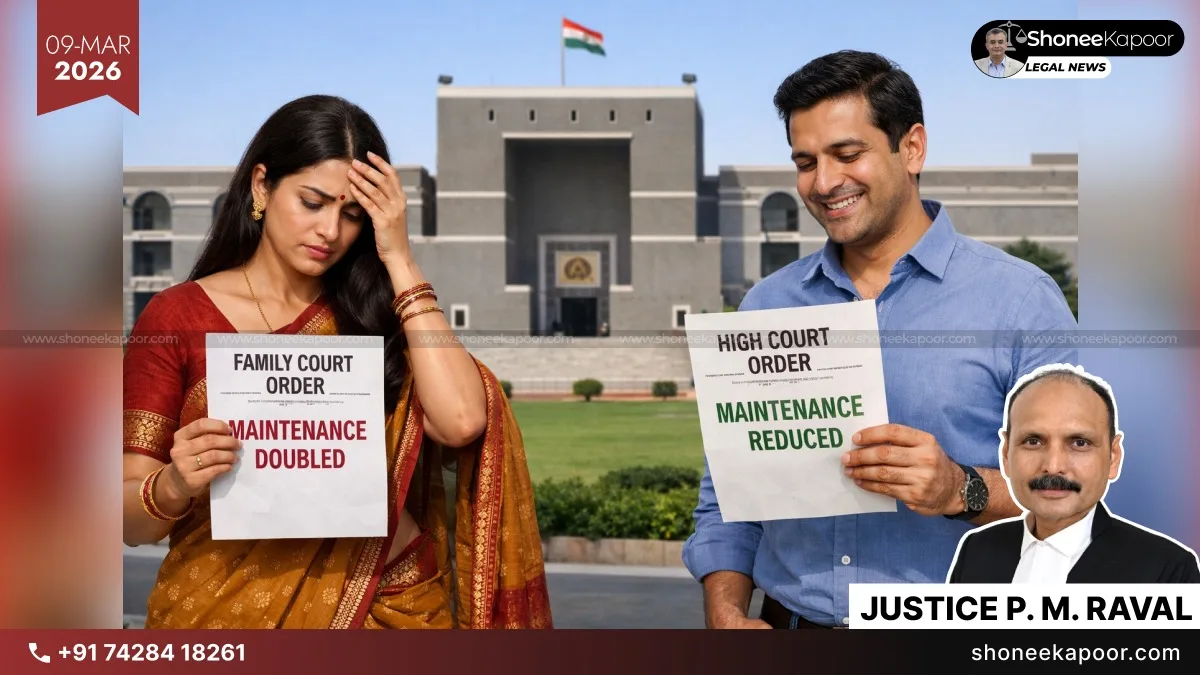
Maintenance Should Not Be Unreasonably High or Encourage Idleness: Gujarat High Court Reduces Excessive Enhancement, Stresses Balance Between Support and Husband’s Capacity

Written and analysed by Shonee Kapoor
Legal Consultant, Author & Men's Rights ActivistThe Gujarat High Court reduced the enhanced maintenance, noting that it should not become excessive or encourage idleness.
When a man with limited income must pay maintenance while also supporting his elderly mother and covering his own basic expenses, how can he maintain that balance without it becoming financial extortion?
AHMEDABAD: Justice P. M. Raval of the Gujarat High Court recently delivered an important ruling in a maintenance dispute, emphasizing that courts must balance the needs of the wife and child with the husband’s real financial capacity. The Court examined whether the Family Court was justified in significantly increasing the amount of Allowance.
The Family Court had increased the monthly maintenance for the wife and child from ₹6,500 to ₹14,000. The husband challenged this order, stating that his monthly income was about ₹25,900 and that he also had the responsibility of supporting his 76-year-old ailing mother. He argued that the increase meant that more than half of his income would go towards maintenance, leaving him with very little to manage his own expenses.
During the hearing, the wife claimed that she was currently unemployed and therefore required higher financial support. The Family Court had relied on factors such as inflation and the passage of time since the earlier Allowance order. However, the High Court examined whether these factors alone justified doubling the maintenance amount.
Referring to a Supreme Court judgment, the Court reiterated an important principle that:
“The Court has to consider the status of the parties, their respective needs, the capacity of the husband to pay having regard to his reasonable expenses for his own Allowances and of those he is obliged under the law and statutory but involuntary payments or deductions. The amount of Allowance fixed for the wife should be such as she can live in reasonable comfort considering her status and the mode of life she was used to when she lived with her husband and also that she does not feel handicapped in the prosecution of her case. At the same time, the amount so fixed cannot be excessive or extortionate”.
The Court also noted that although the wife claimed she was not earning, she was educated up to M.Com., which could be considered while deciding Allowance. At the same time, the Court found that the husband’s income had increased only slightly and there was no evidence that he was living a luxurious lifestyle.
Observing that the Family Court had doubled the Allowance amount without sufficient reasoning, the High Court modified the order to maintain fairness. The Court reduced the Allowance to ₹5,500 per month for the wife and ₹6,500 per month for the child, making the total ₹12,000 per month.
The judgment highlights an important issue in matrimonial cases: while Allowance is necessary for the support of the wife and child, it must remain reasonable and should not place an unrealistic financial burden on the husband.
Explanatory Table: Laws and Sections Involved
| Law / Section | Purpose | How Applied in This Case |
| Section 125, Criminal Procedure Code (CrPC) | Provides a legal remedy for wives, children, and parents to claim maintenance when they cannot maintain themselves. | The original Allowanceorder was granted under this provision by the Family Court in 2019. |
| Section 127, Criminal Procedure Code (CrPC) | Allows modification or enhancement of Allowance when circumstances change, such as income or needs. | The wife filed an application under this section seeking enhancement of Allowance after several years. |
| Revisional Jurisdiction of High Court (CrPC) | Allows High Courts to review lower court orders when there is legal error, arbitrariness, or miscarriage of justice. | The husband approached the High Court challenging the Family Court’s order that doubled the Allowance amount. |
| Supreme Court precedent: Jasbir Kaur Sehgal v. District Judge, Dehradun (AIR 1997 SC 3397) | Establishes principles for determining fair Allowance based on income, status, and needs of parties. | The High Court relied on this precedent to stress that Allowanceshould ensure reasonable comfort but should not be excessive or unrealistic. |
Case Details
- Case Title: Mayurbhai Badvantbhai Dave vs State of Gujarat & Ors.
- Court: Gujarat High Court, Ahmedabad
- Case Number: Criminal Revision Application (For Allowance) No. 181 of 2025
- Connected Case: Criminal Misc. Application (For Stay) No. 1 of 2025
- Bench: Honourable Mr. Justice P. M. Raval
- Neutral Citation: 2026:GUJHC:16305
- Date of Judgment: 03 March 2026
- Counsels:
- For Applicant (Husband): Jaivik Uday Bhatt with Mr. Adnirrudhsinh Kushwaha
- For Respondent Nos. 2 & 3: Mr. A. B. Gateshaniya
- For State: Mr. Rohan Shah, APP
Key Takeaways
- Courts must ensure that Allowance orders are realistic and proportionate to the husband’s actual income, otherwise they can become financially crippling.
- Simply citing inflation or the passage of time cannot justify doubling Allowance without proper reasoning and evidence.
- The earning capacity, education, and potential of the wife are relevant factors that courts must consider while fixing Allowance.
- Allowance law is meant to provide support and dignity, not to impose an excessive or extortionate financial burden on the husband.
- This judgment reinforces the need for balanced matrimonial justice where both the needs of the wife and child and the financial survival of the husband are fairly protected.
This Could Change Your Case-Get FREE Legal Advice-Click Here!
Disclaimer: The views and opinions expressed in this article are those of the Indian courts and do not necessarily reflect the official policy or position of “ShoneeKapoor.com” or its affiliates. This article is intended for informational and educational purposes only. The content provided is not legal advice, and viewers should not act upon this information without seeking professional counsel. Viewer discretion is advised.
Related Articles

Family Courts Refuse My RTI To Reveal Divorce Data: Is Transparency Selective When It Comes to Men?
Family Courts have refused to provide year-wise divorce and alimony statistics under the RTI Act, citing technical gr...

Can an Educated Wife Claim Maintenance from Her Husband? The Legal Reality No One Explains
Indian courts recognise education and earning capacity, yet husbands are still routinely ordered to pay maintenance.I...
Alimony vs Maintenance in India: The Real Legal Difference Every Man Must Know Before Divorce
Alimony and maintenance are not the same, but Indian courts often blur the line, creating lifelong financial pressure...
Relevant Judgements
Can an NRI Husband Be Forced to Pay Maintenance in India? Supreme Court Rules Explained for Overseas Indian Men
Living abroad does not automatically protect an NRI husband from maintenance claims in India.But can Indian courts pa...
Share Your Thoughts
Comments are moderated before publication.