
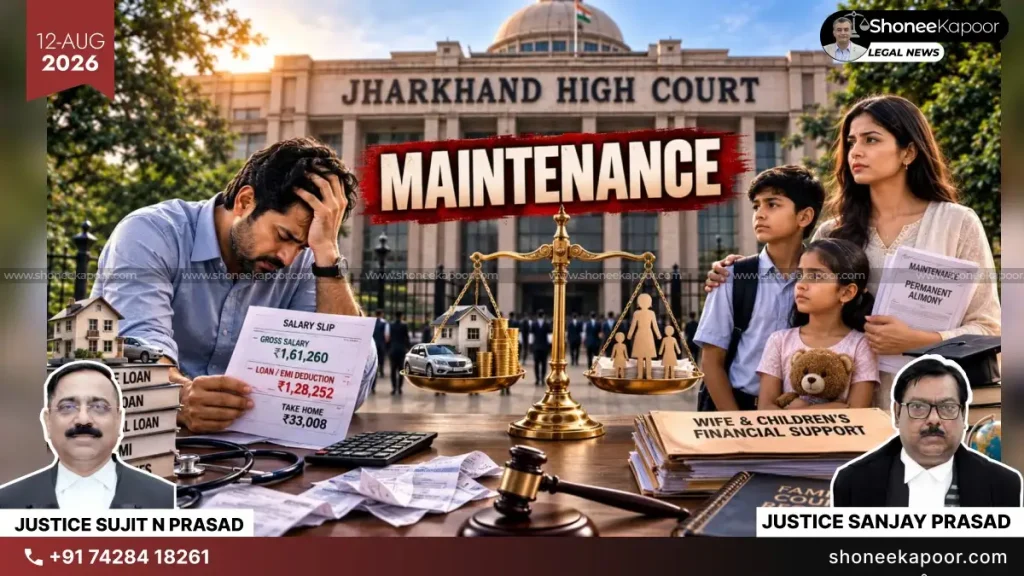
Can a husband reduce maintenance liability by showing heavy loan deductions from his salary? Jharkhand High Court answers why loans taken for future asset creation cannot automatically reduce alimony obligations.
JHARKHAND: The Jharkhand High Court has held that a husband generally cannot reduce his maintenance or permanent alimony obligation by claiming deductions for loans taken to create future assets or wealth.
The Division Bench of Justice Sujit Narayan Prasad and Justice Sanjay Prasad made the observation while deciding a matrimonial appeal filed by a husband who had challenged the dismissal of his divorce petition.
The husband had approached the Court after the Family Court, Garhwa dismissed his divorce petition filed under Section 13(1)(ia) of the Hindu Marriage Act, 1955, as he failed to prove cruelty against his wife.
During the proceedings, both parties initially expressed willingness for reconciliation. The matter was sent for mediation, but the settlement attempt failed. The husband later offered ₹40 lakh as a one-time settlement and also offered to bear expenses related to the education of their children and marriage expenses of the daughter. However, the wife did not accept the offer.
The Court then examined the issue of permanent alimony. Following the Supreme Court guidelines in Rajnesh v. Neha, both parties were directed to submit affidavits regarding their financial status.
The husband, who was working as a contractual doctor at Sadar Hospital, Garhwa, stated that his gross monthly salary was ₹1,61,260. He claimed that after deduction of loan repayments of around ₹1,28,252, his take-home salary was only ₹33,008.
However, the High Court observed that voluntary financial commitments cannot automatically reduce a husband’s responsibility towards maintenance.
The Court held:
“At this juncture, it needs to be referred to herein the settled position of law that the impact of a loan taken by a husband for ‘future wealth construction’ during the pendency of a matrimonial suit or before the matrimonial suit, which consequently reduces his total income due to loan payments, on the amount of alimony payable to his wife is a matter that courts scrutinize carefully. Generally, such voluntary financial commitments are not permitted to diminish the husband’s primary obligation to maintain his wife.”
The Court clarified that while deciding maintenance, judges must examine the purpose and nature of the loan. Loans taken for asset creation, speculative investments, or reducing disposable income cannot be treated like unavoidable expenses when determining alimony.
The Bench also noted that maintenance decisions cannot be based only on the remaining salary after voluntary deductions. The husband’s earning capacity, financial position, liabilities and overall circumstances must be considered.
The Court considered that the wife had no independent income and that the couple had two children, including a son aged 14 years and a daughter aged 12 years.
Ultimately, the High Court fixed ₹90 lakh as permanent financial provision, including ₹40 lakh for the wife and ₹25 lakh each for the son and daughter.
EXPLANATORY TABLE OF LAWS AND SECTION
| Law / Section | What It Means | Relevance in This Case |
| Section 13(1)(ia), Hindu Marriage Act, 1955 | Provides for divorce on the ground of cruelty | Husband sought divorce alleging cruelty, but the Family Court dismissed the petition after finding that cruelty was not proved. |
| Section 25, Hindu Marriage Act, 1955 | Allows courts to grant permanent alimony and maintenance after considering income, property and circumstances | Basis for deciding permanent financial support. |
| Section 19(1), Family Courts Act, 1984 | Provides for an appeal against Family Court orders | Present appeal was filed under this provision. |
CASE DETAILS
| Particulars | Details |
| Case Title | Husband v. Wife |
| Court | High Court of Jharkhand at Ranchi |
| Case Number | First Appeal No. 133 of 2025 |
| Neutral Citation | 2026:JHHC:23530-DB |
| Date of Judgment | 06 August 2026 |
| Appeal Filed Under | Section 19(1) of the Family Courts Act, 1984 |
| Bench | Hon’ble Mr Justice Sujit Narayan Prasad and Hon’ble Mr Justice Sanjay Prasad |
| Petitioner/Appellant | Husband |
| Respondent | Wife |
| Counsel for Appellant/Husband | Mr. Pankaj Srivastava, Advocate; Mr. Ashish Gautam, Advocate |
| Counsel for Respondent/Wife | Mr. Hemant Kumar Shikarwar, Advocate; Mr. Abhishek Kumar, Advocate |
| Original Proceedings | Husband filed divorce petition under Section 13(1)(ia) Hindu Marriage Act, 1955 alleging cruelty. |
| Family Court Case Number | Original Suit No. 78 of 2020 |
KEY TAKEAWAYS
- A husband is not a financial machine. His right to survive with dignity, meet his own expenses and secure his future deserves the same seriousness as any maintenance claim.
- A man’s genuine liabilities cannot be treated as irrelevant. Courts must distinguish between artificial deductions and real financial burdens before deciding what he can actually afford to pay.
- Maintenance cannot become financial punishment for being the earning spouse. The law itself requires a fair balance and warns against amounts that become excessive or unbearable for the person paying.
- Men also have dependants, responsibilities and a future to protect. A husband’s financial capacity should be judged after considering his lawful obligations, not merely by looking at his gross salary.
- Justice for one spouse cannot come by economically crushing the other. Even this judgment recognises that the husband “is also to survive” and has other liabilities and responsibilities.
This Could Change Your Case-Get FREE Legal Advice-Click Here!
Disclaimer: The views and opinions expressed in this article are those of the Indian courts and do not necessarily reflect the official policy or position of “ShoneeKapoor.com” or its affiliates. This article is intended for informational and educational purposes only. The content provided is not legal advice, and viewers should not act upon this information without seeking professional counsel. Viewer discretion is advised.