
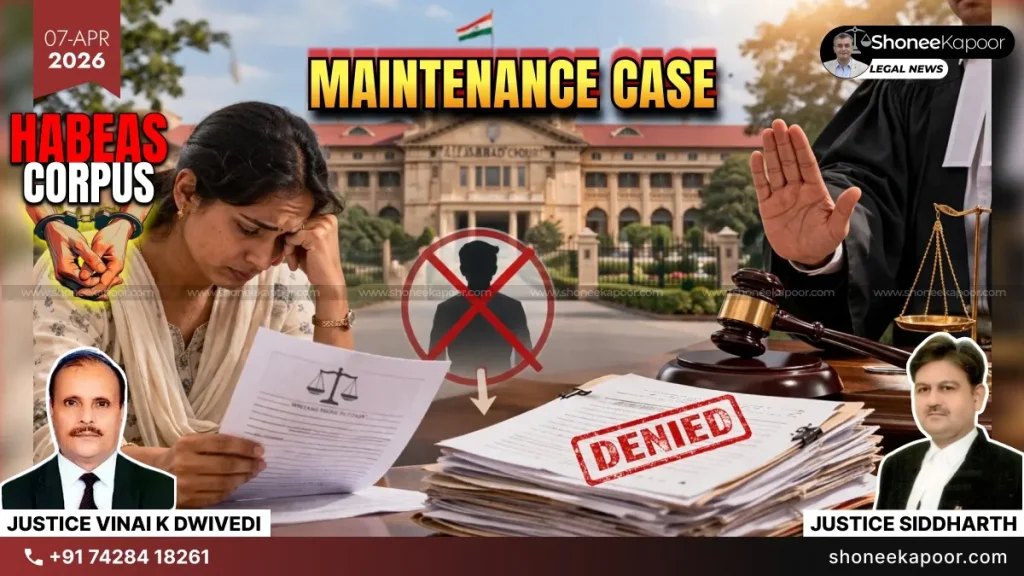
Can constitutional remedies be used to bypass proper legal procedures in maintenance cases?
The Allahabad High Court held that constitutional remedies are not meant to enforce civil obligations like maintenance recovery.
PRAYAGRAJ: In a recent judgment, the Allahabad High Court bench of Justice Siddharth and Justice Vinai Kumar Dwivedi dismissed a habeas corpus petition where a wife sought court intervention to trace her husband, who was avoiding maintenance proceedings.
The case arose out of a matrimonial dispute where the husband had stopped appearing before the Family Court and was allegedly evading legal responsibility. The wife approached the High Court seeking directions to locate and produce him before the court so that pending maintenance dues could be enforced.
After examining the matter, the Court clearly distinguished between cases of illegal detention and situations where a person is deliberately avoiding court proceedings. The judges observed that the extraordinary remedy of habeas corpus cannot be invoked simply because a person is absconding or not complying with court orders.
The Court referred to a previous judgment relied upon by the petitioner, but clarified that such relief is only applicable when a person is under unlawful custody. In the present situation, there was no evidence of illegal confinement, only an attempt to use constitutional remedies to enforce a civil liability.
The bench categorically stated:
“Only because he is evading warrant issued by the Family Court for making payment of maintenance amount to his wife and daughter, the direction in the nature of habeas corpus cannot be issued.”
It further emphasized that the responsibility lies with the Family Court to take appropriate legal steps to secure the presence of the husband and ensure compliance with its orders.
Reinforcing this position, the Court stated:
“The habeas corpus petition cannot be a tool for securing the presence of petitioner in the court proceedings.”
With these observations, the High Court refused to entertain the petition and dismissed it, making it clear that constitutional remedies cannot be stretched to cover situations where proper legal mechanisms already exist.
This judgment sends a strong message that misuse of legal provisions to bypass due process will not be tolerated, and enforcement of maintenance orders must follow the established legal route rather than extraordinary writ jurisdiction.
Explanatory Table: Laws And Provisions Involved
| Law / Provision | Purpose | How It Applied in This Case |
| Habeas Corpus (Article 226 of Constitution) | A legal remedy used when a person is illegally detained or kidnapped, and the court orders production of that person | Court held it cannot be used just because a person is absconding or avoiding court |
| Maintenance Law (CrPC Section 125 / Family Court Orders) | Legal provision requiring a husband to financially support wife and children | Husband was avoiding payment and court proceedings |
| Execution Proceedings (Family Court) | Process used by court to enforce its orders, including recovery of money or securing presence | Court said Family Court must use its own powers instead of invoking habeas corpus |
| Coercive Measures (Warrants, Attachment, etc.) | Legal tools like arrest warrants or property attachment to compel compliance | Court emphasized these should be used to bring the husband before court |
| Contempt of Court | Action taken when someone deliberately disobeys court orders | Petitioner sought action, but High Court did not entertain it in this petition |
Case Details
- Case Title: Smt. Sangita Yadav vs State of Uttar Pradesh and 3 Others
- Case No.: Habeas Corpus Writ Petition No. 289 of 2026)
- Court: High Court of Judicature at Allahabad
- Date of Judgment: March 25, 2026
- Neutral Citation: 2026:AHC:62624-DB
- Bench: Justice Siddharth & Justice Vinai Kumar Dwivedi
- Counsels:
- For Petitioner: Abhishek Srivastava, Satyadev Singh Chauhan, Shashikant Chauhan
- For Respondent: Government Advocate (G.A.), Smt. Sangita Yadav
Key Takeaways
- Courts are now clearly refusing to allow the misuse of habeas corpus to harass men in maintenance disputes.
- Habeas corpus cannot be used as a shortcut to force presence in civil disputes like maintenance recovery. Proper legal process must be followed.
- If a person is absconding, the law already provides strong tools like warrants, attachment, and coercive action through lower courts.
- Misuse of constitutional remedies shows how legal provisions are often stretched beyond their original intent, creating unnecessary pressure on the system.
- The burden of enforcement should remain within the trial and family court framework, instead of escalating every dispute to higher courts.
This Could Change Your Case-Get FREE Legal Advice-Click Here!
Disclaimer: The views and opinions expressed in this article are those of the Indian courts and do not necessarily reflect the official policy or position of “ShoneeKapoor.com” or its affiliates. This article is intended for informational and educational purposes only. The content provided is not legal advice, and viewers should not act upon this information without seeking professional counsel. Viewer discretion is advised.