
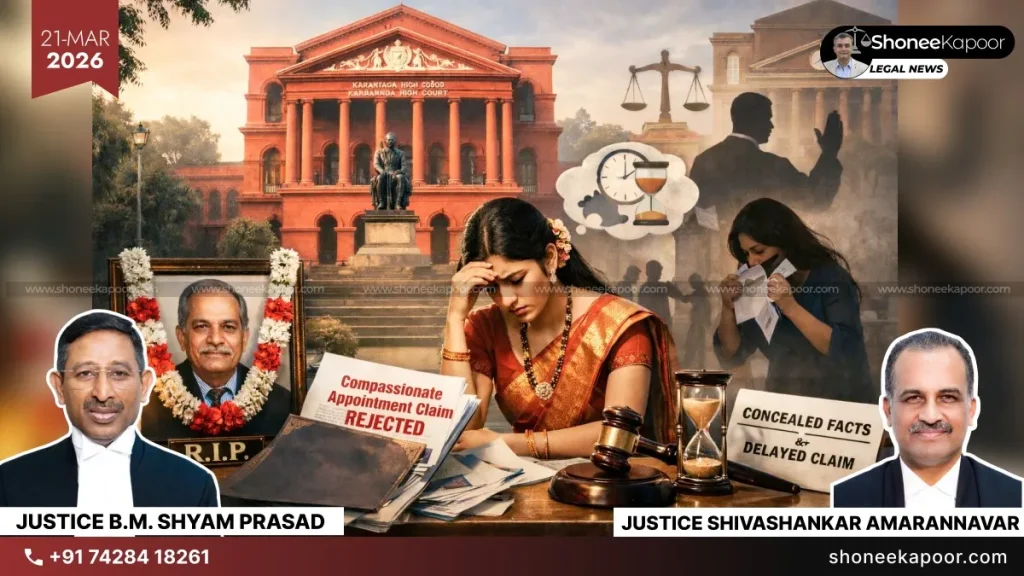
Karnataka High Court says compassionate appointment is not an inheritance but relief for a real financial crisis. When the dependency of married daughters is questionable, can the law still be stretched to claim benefits?
BENGALURU: The Karnataka High Court at Dharwad, comprising Justice B.M. Shyam Prasad and Justice Shivashankar Amarannavar, dismissed the appeal of a married daughter who sought compassionate appointment after her father’s death. The judgment clarifies key legal principles around dependency, delay, and financial responsibility after marriage.
The petitioner’s father, a court employee, died in service in 2005. The daughter applied for a job on compassionate grounds, claiming financial hardship. However, her application was rejected as she was a married daughter living with her husband, and under the applicable rules, she was not considered dependent on her father.
Instead of directly challenging that rejection, she later approached the court by stating that her application was still pending. The High Court took note that she had already been informed about the rejection earlier and had not disclosed this fact. This suppression of material information weakened her claim and affected her credibility.
The Court emphasized that compassionate appointment is not a matter of right but only a temporary relief for immediate hardship. It observed:
“The essence of compassionate appointment lies in addressing the immediate financial distress experienced by the family in the aftermath of the employee’s demise. The term dependent within the context of compassionate appointment denotes family members who were reliant on the deceased employee for financial support.”
Another crucial factor was the long delay in pursuing the claim. The Court noted that compassionate appointment loses its relevance if sought after many years, as the purpose is to provide immediate relief and not long-term benefit.
The Court recorded that:
“The object of compassionate appointment is firmly rooted in addressing the immediate financial crisis faced by families following the demise of a family member, without conferring appointment as a matter of right or inheritance.”
In essence, the Court held that if a family has managed to sustain itself over time, the justification for compassionate appointment no longer survives.
The High Court ultimately concluded that the petitioner did not meet the eligibility criteria and had no enforceable legal right to claim such employment, leading to dismissal of the appeal.
Explanatory Table: Laws And Provisions Involved
| Law / Provision | Purpose | How Applied In This Case |
| Karnataka High Court Act, 1961 (Section 4) | Governs filing of writ appeals before High Court | Appeal was filed under this provision |
| Karnataka Civil Services (Appointment on Compassionate Grounds) Rules, 1996 | Provides rules for compassionate appointment to dependents of deceased employees | Used to reject claim as married daughter not treated as dependent |
| Concept of “Dependency” in Service Law | Defines who is financially dependent on deceased employee | Court held married daughter living with husband is not dependent |
| Principle of Compassionate Appointment | Meant for immediate financial relief, not as inheritance or entitlement | Central reasoning for rejecting delayed claim |
| Doctrine of Suppression of Material Facts | Courts deny relief if party hides important facts | Petitioner suppressed earlier rejection of application |
| Delay and Laches (Equity Principle) | Relief can be denied if there is unreasonable delay | Long delay weakened claim as urgency no longer existed |
| Maintenance Responsibility in Marriage | Husband has primary duty to maintain wife after marriage | Reinforced reasoning that dependency shifts after marriage |
Case Details
- Case Title: Smt. Laxmi vs The Registrar General & Others
- Court: High Court of Karnataka, Dharwad Bench
- Case Number: Writ Appeal No. 100548 of 2024 (S-RES)
- Date of Judgment: 13 March 2026
- Neutral Citation: NC: 2026:KHC-D:4011-DB
- Bench: Hon’ble Mr. Justice B.M. Shyam Prasad | Hon’ble Mr. Justice Shivashankar Amarannavar
- Counsels:
- For Appellant: Sri H.M. Dharigond, Advocate
- For Respondents: Sri Mallikarjunswamy B. Hiremath, Advocate
Kay Takeaways
- Court correctly held that compassionate appointment is not a right or inheritance, but only a temporary relief for immediate financial crisis.
- Judgment rightly reinforces that a married daughter living with her husband cannot automatically be treated as dependent on her father.
- The Court took a strong stand against suppression of facts, making it clear that misuse of process will not be rewarded.
- By rejecting a delayed claim, the Court upheld the principle that such relief must be sought promptly and cannot be revived after years.
- Overall, the order strengthens legal clarity and prevents misuse of compassionate appointment schemes, ensuring they remain limited to genuine cases of immediate hardship.
This Could Change Your Case-Get FREE Legal Advice-Click Here!
Disclaimer: The views and opinions expressed in this article are those of the Indian courts and do not necessarily reflect the official policy or position of “ShoneeKapoor.com” or its affiliates. This article is intended for informational and educational purposes only. The content provided is not legal advice, and viewers should not act upon this information without seeking professional counsel. Viewer discretion is advised.