
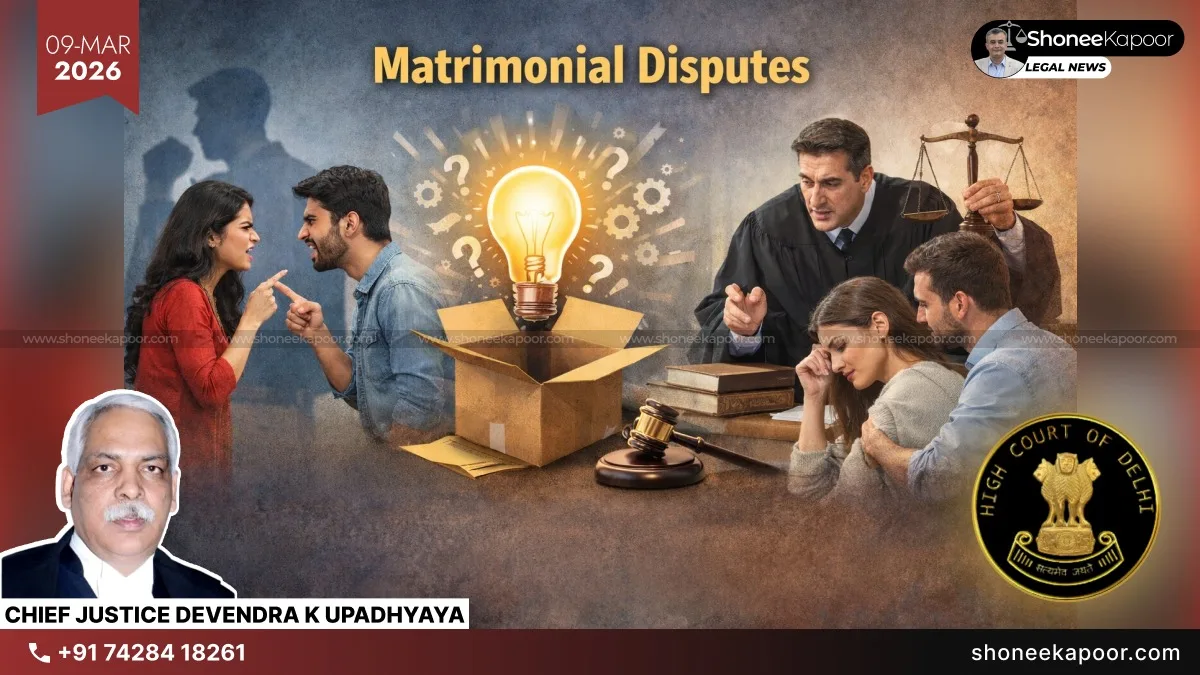
Matrimonial Disputes Needs Out-of-Box Thinking. Lawyers, Judges Must Show Sensitivity In Family Conflicts As Law Alone Cannot Ensure Justice: Delhi HC Chief Justice

Written and analysed by Shonee Kapoor
Legal Consultant, Author & Men's Rights ActivistCan strict legal rules alone solve bitter matrimonial battles in India? Delhi High Court Chief Justice explains why justice in such disputes often lies beyond the “four corners of law.”
Chandigarh: Delhi High Court Chief Justice Devendra Kumar Upadhyaya highlighted the complex reality of matrimonial disputes in India, stating that resolving such cases requires sensitivity and practical thinking beyond rigid legal provisions. His remarks came during the second day of India International Disputes Week 2026 held in Chandigarh.
Speaking at the event, the Chief Justice emphasised that matrimonial disputes often involve deeper social conflicts and emotional breakdowns that cannot always be addressed by simply applying statutory provisions. He noted that these disputes are rarely limited to legal arguments and frequently involve human relationships, family pressures and social circumstances that courts must carefully consider.
“It’s more of a social problem than a legal one,” Chief Justice Upadhyaya said.
According to him, both lawyers and judges must approach matrimonial cases with empathy and broader understanding rather than limiting themselves strictly to legal technicalities. He stressed that justice in family disputes often requires creative thinking and problem-solving rather than a mechanical interpretation of the law.
“So you have to do some something called out of box, both on the part of the lawyers representing the parties as also the judges. If you try to search out the solution within the defined boundaries of a statute, perhaps you will not be able to render justice to the party in such disputes,” Chief Justice Upadhyaya underscored.
The Chief Justice pointed out that matrimonial disputes frequently become prolonged legal battles because personal conflicts spill into courtrooms. In such situations, judges and lawyers must remain sensitive to the emotional and social dimensions of the dispute, while ensuring that justice is delivered fairly.
He also spoke about the growing challenge of cross-border matrimonial disputes, particularly cases involving child custody when one parent moves to another country. According to him, the absence of clear international legal arrangements makes these disputes extremely complicated for Indian courts.
”Despite a recommendation made by the Law Commission of India, we are yet not signatories of certain international treaties. There is a growing urge and demand from all parties for India to be signatory of the international conventions,” he said.
The Chief Justice explained that without such international frameworks, courts often struggle to determine jurisdiction and enforce decisions when one parent and the child are located in different countries.
“In case of a parent seeking a custody of a child, where will he bring the lawsuit? Where will he initiate the legal action, and whether or not any legal verdict given by a court here in India or abroad will be respected by the other countries. These are some of the difficult problems which we are facing now. Fortunately, the constitutional courts in India, the Supreme Court and the High Court have, in absence of any such treaty, evolved certain case law,” he added.
Justice Upadhyaya further acknowledged that these issues are increasingly appearing before courts as cross-border marriages become more common. In such situations, courts are often required to rely on evolving judicial precedents to resolve disputes.
“In case of a parent seeking custody of a child, where will he bring the lawsuit? Where will he initiate the legal action, and whether or not any legal verdict given by a court here in India or abroad will be respected by the other country. These are some of the difficult problems which we are facing,” he said.
He also recognised the role played by constitutional courts in India in developing legal principles to handle such complicated family disputes in the absence of international treaties.
“Courts in India have done a wonderful job and given relief to such parents where child custody is sought,” he noted.
The remarks underline the evolving nature of matrimonial litigation in India. Family disputes today increasingly involve emotional, social and international dimensions, making it necessary for the justice system to balance legal rules with practical realities while protecting the rights of both parties involved in such sensitive conflicts.
Laws / Legal Frameworks Mentioned
| Law / Legal Reference | Purpose | How It Was Discussed In This Context |
| Indian Matrimonial Laws (General Statutory Framework) | Governs disputes such as divorce, maintenance, custody and matrimonial reliefs | Chief Justice observed that strict statutory interpretation may not always resolve matrimonial disputes which involve deep social and emotional issues |
| Domestic Family Law Framework In India | Regulates marriage related disputes including custody and family conflicts | Highlighted that matrimonial disputes often extend beyond legal questions and require sensitivity and broader understanding by courts |
| International Child Custody Conventions | Provide global mechanisms for resolving cross-border child custody disputes and recognition of foreign court orders | The Chief Justice noted that India is not yet a signatory to certain international treaties, which creates serious difficulties in cross-border custody litigation |
| Law Commission Of India Recommendations | Policy recommendations for improving Indian legal frameworks including international family law cooperation | Mentioned that the Law Commission has recommended India joining certain international conventions dealing with cross-border family disputes |
| Case Law Developed By Constitutional Courts | Judicial precedents evolved by Supreme Court and High Courts in absence of statutory or treaty framework | Courts in India have developed case law to deal with cross-border custody disputes due to absence of international treaties |
Key Takeaways
- Matrimonial disputes are not purely legal issues; they are social conflicts where rigid application of law often fails to deliver fair outcomes.
- The judiciary itself recognises that sensitivity and practical thinking are necessary because statutes alone cannot resolve the complex realities of family disputes.
- In many matrimonial litigations, prolonged legal battles show how the system often struggles to address the real dynamics between spouses.
- Cross-border custody disputes remain extremely complicated because India lacks clear international legal mechanisms to handle such conflicts.
- Courts frequently rely on evolving judicial precedents to handle family disputes, highlighting the gap between existing legal frameworks and the realities faced by parties involved in matrimonial litigation.
This Could Change Your Case-Get FREE Legal Advice-Click Here!
Disclaimer: The views and opinions expressed in this article are those of the Indian courts and do not necessarily reflect the official policy or position of “ShoneeKapoor.com” or its affiliates. This article is intended for informational and educational purposes only. The content provided is not legal advice, and viewers should not act upon this information without seeking professional counsel. Viewer discretion is advised.
Related Articles
False 498A – 85 BNS Fear And Need Legal Help? The Law Changed, The Risk Remains, The Defence Must Change Too
If arrest is “not automatic” now, why are families still rushing for bail and protection? Is Section 85 BNS just a ne...
The Silent Crisis: Men Destroyed by False Allegations in India – How Laws Meant for Protection Are Destroying Innocent Men
Laws Meant for Protection Are Destroying Innocent Men. An FIR is filed and a man’s life collapses before any evidence...
Relevant Judgements
Can an NRI Husband Be Forced to Pay Maintenance in India? Supreme Court Rules Explained for Overseas Indian Men
Living abroad does not automatically protect an NRI husband from maintenance claims in India.But can Indian courts pa...
Share Your Thoughts
Comments are moderated before publication.