
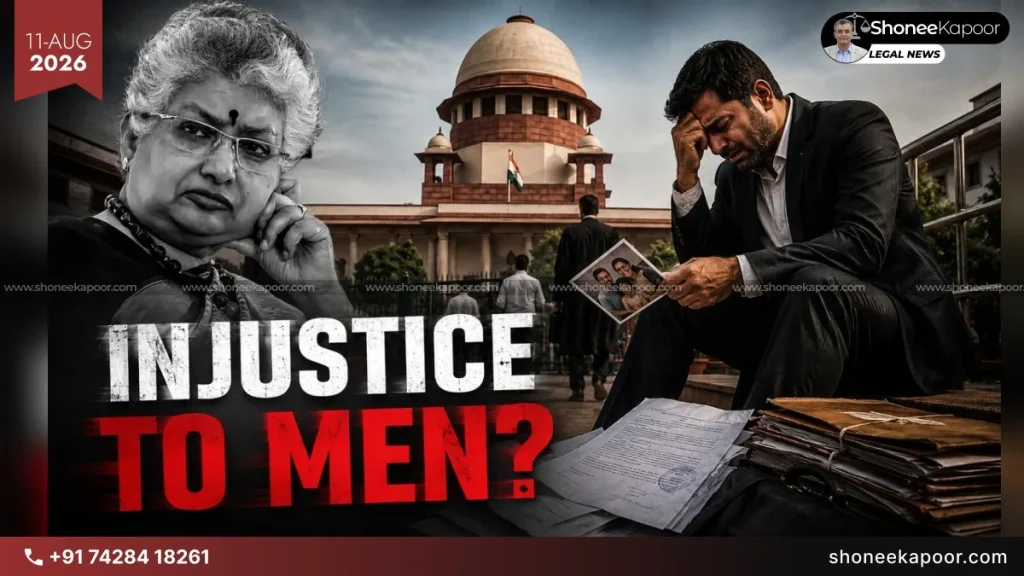
Why did Justice BV Nagarathna say, “We do not conduct seminars on justice for men.” at an NCW conference? Her remarks on women’s safety also raise a wider question: can the justice system discuss gender justice without examining the experiences of both women and men?
“We do not conduct seminars on justice for men.”
Supreme Court Justice B.V. Nagarathna made this remark while speaking at the South Zone Regional Conference on “Justice for Women”, organised by the National Commission for Women (NCW India).
During her address, Justice Nagarathna questioned whether the justice system has been able to protect women throughout their lives, “from the womb to the tomb.”
She observed that even after 76 years of the Constitution, the right to be born remains under threat for some women. She also spoke about the different forms of harm faced by women and said that, in many cases, the perpetrators are men on whom women may be financially or socially dependent.
Justice Nagarathna further noted that a home, which should ideally provide safety and protection to women, can sometimes become a place where violence and abuse take place.
Her opening observation, however, is also likely to attract attention in the larger debate around gender justice in India.
While laws and institutions have rightly focused on serious problems faced by women, the statement also indirectly brings attention to an issue rarely discussed at institutional forums: whether men facing domestic abuse, false allegations, denial of access to children, financial hardship arising from matrimonial litigation or other forms of victimisation receive comparable space in conversations on justice.
The constitutional idea of equality ultimately requires the justice system to examine genuine suffering without allowing gender alone to decide whose grievance deserves to be heard. Protecting women from violence and discrimination remains essential, but recognition of women’s rights need not exclude discussion of situations where men may also require legal protection.
Justice Nagarathna’s remarks therefore reopen an important question about the future of gender-neutral justice in India. A justice system becomes stronger when protection against violence, abuse and injustice is available to every genuine victim while safeguards remain in place against misuse of legal remedies.
LAWS AND CONSTITUTIONAL PROVISIONS MENTIONED
| LAW / PROVISION | WHAT IT SAYS | RELEVANCE HERE |
| Article 15, Constitution of India | Prohibits the State from discriminating against citizens on specified grounds including religion, race, caste, sex and place of birth, subject to constitutional exceptions. | Forms part of the constitutional framework governing equality and discrimination. |
| Article 15(3), Constitution of India | Permits the State to make special provisions for women and children despite the general prohibition against discrimination. | Justice Nagarathna referred to this constitutional distinction while discussing formal equality and substantive equality. |
| Constitution of India | Establishes fundamental rights and the constitutional framework governing equality and justice. | Her speech referred to India having completed 76 years of the Constitution while continuing to hold conferences specifically addressing justice for women. |
KEY TAKEAWAYS
- “We do not conduct seminars on justice for men.” That sentence itself exposes how invisible male victims remain in the gender-justice debate.
- Women’s safety deserves protection, but justice cannot become gender-selective.
- Men facing domestic abuse, false allegations, parental alienation and crushing matrimonial litigation rarely get the same institutional attention.
- Equality under the Constitution cannot mean protection for one gender and silence for the other.
- India does not need less justice for women. It needs justice for every genuine victim, including men.
This Could Change Your Case-Get FREE Legal Advice-Click Here!
Disclaimer: The views and opinions expressed in this article are those of the Indian courts and do not necessarily reflect the official policy or position of “ShoneeKapoor.com” or its affiliates. This article is intended for informational and educational purposes only. The content provided is not legal advice, and viewers should not act upon this information without seeking professional counsel. Viewer discretion is advised.