
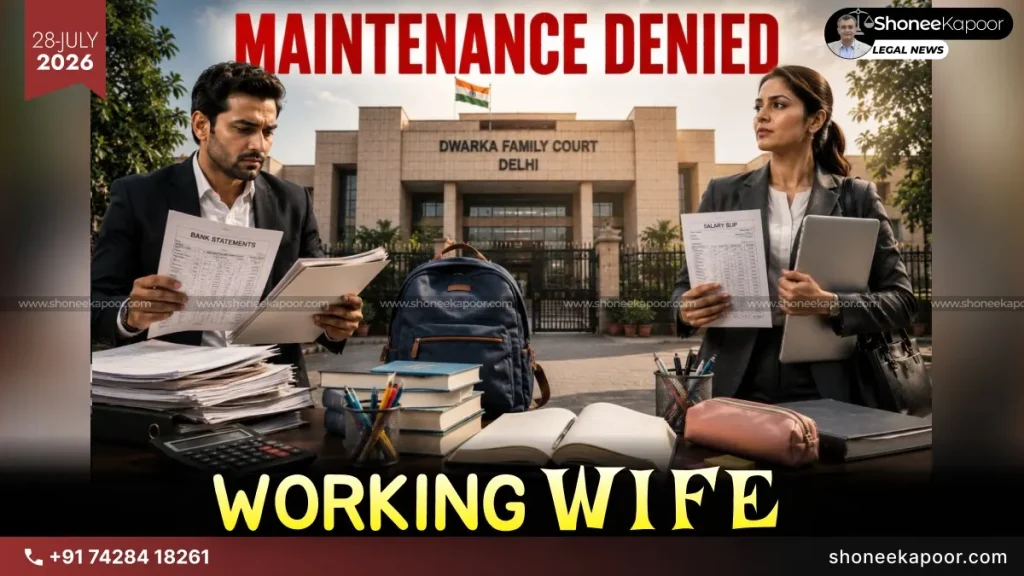
Can a financially independent wife earning more than ₹1 lakh per month still claim interim maintenance from her husband? The Dwarka Family Court answered this question while also reminding both spouses that hiding income can seriously affect a maintenance claim.
NEW DELHI: The Family Court at Dwarka has refused to grant interim maintenance to a working wife earning more than ₹1 lakh per month and has directed the husband to pay ₹12,000 per month only towards the maintenance of their minor daughter.
The dispute arose from a matrimonial case filed by the wife. She alleged that her husband had subjected her to cruelty and claimed that he earned more than ₹2.5 lakh every month through his businesses. Based on these allegations, she sought interim maintenance for herself as well as the child.
The husband strongly opposed the application. He argued that the wife is a qualified Chartered Accountant employed with ICICI Bank and is financially independent. According to him, she earns a gross monthly salary of over ₹1 lakh and is fully capable of maintaining herself. He also denied the income claimed by the wife and stated that his businesses had already shut down due to financial losses and ongoing matrimonial disputes.
During the hearing, the wife clarified that she was no longer seeking maintenance for herself and was pressing the application only for the expenses of the minor daughter. She claimed that she alone was paying the child’s preschool fees, daycare charges, medical expenses, travelling costs and house rent, and that these expenses together came to around ₹45,000 every month.
On the other hand, the husband submitted that he had earlier paid the child’s school fees and house rent. He also claimed that he had lost his job, his consultancy business had failed, and he was presently dependent on financial support from his father and brothers. He further alleged that the wife had concealed her true income by not placing complete bank account details before the Court.
After examining the material placed before it, the Family Court observed that although the wife was seeking maintenance for the child, the expenses claimed by her appeared to be much higher than necessary. The Court also noticed that the wife had not disclosed her educational qualifications, employment or salary anywhere in the petition despite making detailed allegations about the husband’s financial status.
The Court held,
“the petitioner has nowhere disclosed her qualification, her job profile or her earning/salary as she is only disclosing the business and earnings of the respondent which brings the court to draw an adverse inference against the petitioner.”
Referring to the Supreme Court’s decision in the case of Rajnesh Vs. Neha, the Family Court reminded litigants that maintenance proceedings require complete honesty regarding financial status.
The Court observed
“As per the legal proposition, all the parties shall approach the court with clean hands and a number of guidelines have already been laid down in this regard by Hon’ble Supreme Court vide Rajnesh Vs. Neha and Ors. And other judgments as well.”
The Court further found that the wife was drawing a gross monthly salary of around ₹1.16 lakh. It also observed that some deductions claimed by her were not necessary and appeared to reduce her disclosed income. At the same time, the husband had failed to produce reliable documents to establish his present financial position. After considering the bank statements of both parties, the Court concluded that neither side had fully disclosed its actual financial condition and that the true income of both parties could only be determined during trial.
The Court also found that the claim of ₹45,000 per month towards the child’s expenses was excessive.
It held that the total expenses for a sum of Rs. 45,000/- per month as claimed in the petition seems to be on a much higher side.”
However, the Court made it clear that irrespective of disputes between the spouses or the mother’s income, the father continues to have a legal obligation towards the child.
The Court observed,
“as he is the biological father of the minor child, he cannot avoid his responsibility towards the child as even if the mother is working, father is under an obligation to contribute in the upbringing of the minor child.”
Accordingly, the Family Court awarded interim maintenance of ₹12,000 per month for the minor daughter from the date of filing of the application until the disposal of the main matrimonial case. The Court declined to grant any interim maintenance to the wife. It also directed that any arrears be cleared within three months and that future payments be deposited directly into the wife’s bank account before the tenth day of every month.
EXPLANATORY TABLE OF LAWS AND SECTION
| LAW | WHAT IT MEANS | APPLICATION IN THIS CASE |
| Interim Maintenance | Temporary financial support granted during the pendency of matrimonial proceedings until the final decision. | The wife sought interim maintenance for herself and the minor child. The Court denied maintenance to the wife but granted ₹12,000 per month for the child. |
| Rajnesh v. Neha | The Supreme Court directed that parties seeking maintenance must make complete, truthful and transparent disclosure of their income, assets, liabilities and financial status. Courts may draw adverse inferences if material facts are concealed. | The Family Court relied upon this judgment while observing that the wife had not disclosed her qualifications, employment or salary and held that such concealment justified drawing an adverse inference. |
| Doctrine of Clean Hands | A person seeking relief from a court must disclose all relevant facts honestly and should not suppress material information. | The Court observed that parties approaching the Court for maintenance are expected to make full and truthful financial disclosures. |
| Parental Duty to Maintain a Minor Child | Both parents have a legal responsibility towards the upbringing and welfare of their child. A father’s obligation continues even if the mother is earning. | The Court held that the husband, being the biological father, cannot avoid contributing towards the child’s upbringing merely because the mother is employed. |
CASE DETAILS
| Particular | Detail |
| Case Title | Wife v. Husband |
| Case Number | MT No. 55/2025 |
| Court | Family Court-01, Dwarka, New Delhi |
| Bench | Ms. Niyay Bindu, Judge |
| Decision Date | 22 July 2026 |
| Nature of Order | Order on application seeking interim maintenance. |
COUNSELS APPEARED
| Party | Counsel Appeared |
| Petitioner (Bhawna Aggarwal) | Santosh Kumar, Advocate |
| Respondent (Ayush Mittal) | Tripaksha Litigation through Ms. Jyoti Sharma,Advocate and Sh. Rishabh Jain,Advocate |
KEY TAKEAWAYS
- A husband should not be forced to pay maintenance to a financially independent wife earning over ₹1 lakh per month.
- Courts must act against spouses who hide their income while seeking maintenance.
- False or exaggerated claims about a husband’s earnings should not become the basis for maintenance.
- Fathers must support their children, but they should not be treated as unlimited sources of money.
- Maintenance laws should protect the genuinely needy, not reward concealment or financial misuse.
This Could Change Your Case-Get FREE Legal Advice-Click Here!
Disclaimer: The views and opinions expressed in this article are those of the Indian courts and do not necessarily reflect the official policy or position of “ShoneeKapoor.com” or its affiliates. This article is intended for informational and educational purposes only. The content provided is not legal advice, and viewers should not act upon this information without seeking professional counsel. Viewer discretion is advised.