
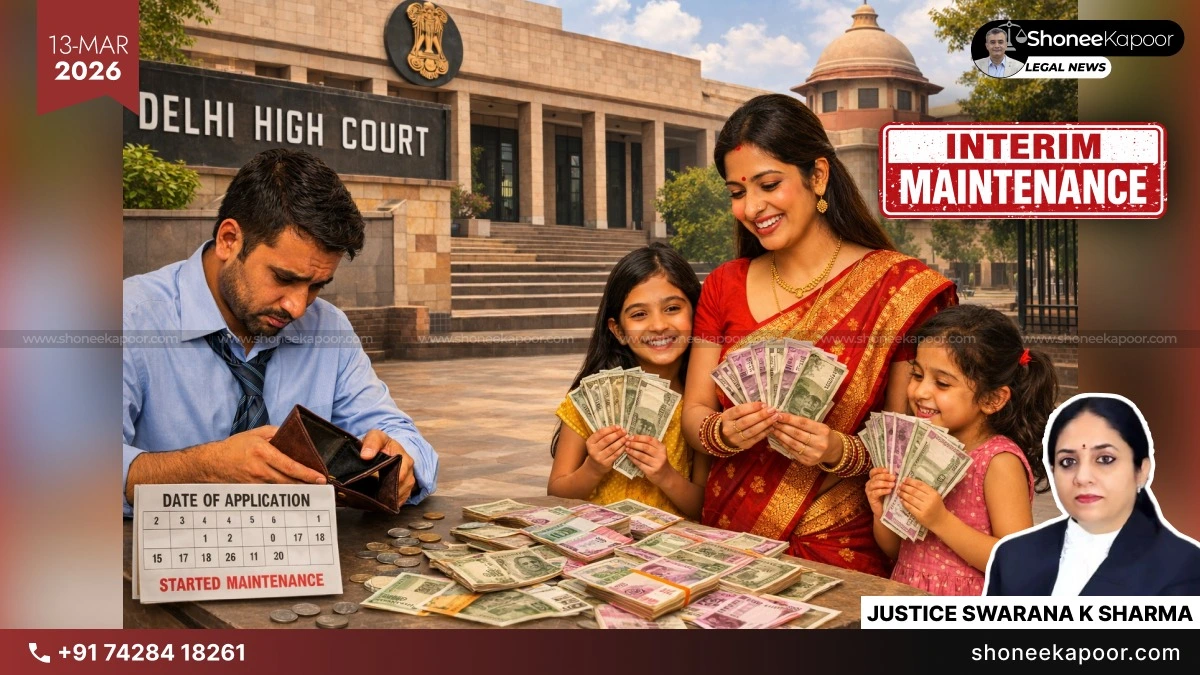
Years Of Court Delay | Financial Burden On Husband: Delhi High Court Says Interim Maintenance Under Section 125 CrPC Should Start From Date Of Filing

Written and analysed by Shonee Kapoor
Legal Consultant, Author & Men's Rights ActivistDelhi High Court ordered that maintenance under Section 125 CrPC should run from the date of filing of the application, while prolonged proceedings can still result in years of accumulated arrears and financial strain on husbands.
NEW DELHI: In an important ruling on maintenance law, the Delhi High Court held that maintenance should normally be granted from the date when the application is filed. The judgment was delivered by Justice Swarana Kanta Sharma while examining whether a Family Court had wrongly delayed the starting date of interim maintenance in a long-pending matrimonial dispute.
The dispute arose after a husband and wife started living separately following matrimonial conflicts. The wife and their two daughters approached the Family Court under Section 125 CrPC, claiming maintenance, stating that she had no independent income and was surviving with financial help from relatives while raising the children. Like many matrimonial disputes, the case dragged on for years in court, leaving both sides locked in prolonged litigation.
The Family Court eventually granted interim maintenance of ₹5,500 per month to each of the three petitioners, totalling ₹16,500 per month. However, it directed that the payment would begin from 1 January 2019 even though the maintenance petition had been filed in March 2016.
The order was challenged before the Delhi High Court, where it was argued that the maintenance should start from the date of filing of the petition because the case had remained pending for several years.
While examining the issue, the High Court referred to the legal principles laid down by the Supreme Court regarding the starting date of maintenance. The Court noted that although courts have discretion under Section 125 CrPC, the normal rule is that maintenance should relate back to the date when the application is filed, especially when delays in proceedings are not caused by the claimant.
After examining the record, the Delhi High Court noted that the Family Court had delayed maintenance by nearly three years without giving clear reasons. The Court also observed that the husband had earning capacity during that period and there was no finding that the wife caused the delay, but it also highlights how prolonged litigation can place financial pressure on men in maintenance disputes.
Justice Swarana Kanta Sharma observed that:
“A discretionary power, though wide, must be exercised on discernible principles and supported by reasons; in the absence of such reasons, the exercise of discretion becomes vulnerable to interference.”
The Court further emphasized that maintenance laws are meant to prevent financial hardship, and-
“The delay in adjudication of maintenance proceedings is ordinarily systemic and cannot be attributed to the dependent spouse or children.”
In view of these findings, the High Court modified the Family Court order and directed that interim maintenance would be payable from the date of filing of the petition, with adjustment of any amount already paid. However, the Court did not interfere with the total interim maintenance amount of ₹16,500 per month.
The case also reflects a growing concern in matrimonial litigation where proceedings often continue for years, placing serious financial and emotional pressure on men who remain tied to long legal battles, arrears of maintenance, and uncertainty until the final resolution of the dispute.
Explanatory Table: Laws And Provisions Involved
| Law / Provision | Explanation | Role in This Case |
| Section 125 Code of Criminal Procedure (CrPC) | Provides a legal remedy for wives, children, and parents to claim maintenance if they are neglected and unable to maintain themselves. | Wife and daughters filed maintenance claim under this section. |
| Section 125(2) CrPC | Allows courts to decide whether maintenance will start from the date of order or from the date of application. | Central issue of dispute in the case. |
| Section 127 CrPC | Allows modification of maintenance orders if circumstances change. | Court noted parties can approach the Family Court for modification if required. |
| Rajnesh v. Neha (2021) 2 SCC 324 | Supreme Court judgment laying down uniform guidelines for maintenance and directing that maintenance should normally be granted from the date of application. | Relied upon by the High Court to interpret maintenance law. |
| Shahjahan v. State of Uttar Pradesh (2025) INSC 528 | Supreme Court reaffirmed that maintenance should ordinarily be granted from the date of application to avoid hardship due to court delays. | Used as precedent to support the High Court’s reasoning. |
Case Details
- Case Title: Sanyogita Gupta & Ors. vs Ashok Kumar Gupta
- Case Number: CRL.REV.P. 520/2024 & CRL.M.A. 17787/2023
- Court: High Court of Delhi, New Delhi
- Bench: Hon’ble Dr. Justice Swarana Kanta Sharma
- Neutral Citation: 2026:DHC:1808
- Dates:
- Judgment Reserved On: 09 January 2026
- Judgment Pronounced On: 27 February 2026
- Judgment Uploaded On: 27 February 2026
- Counsels:
- For Petitioners: Mr. S. D. Windlesh, Advocate
- For Respondent: Mr. Nitin Saluja and Ms. Ishita Soni, Advocates
Key Takeaways
- Maintenance proceedings in India often run for years, while the financial responsibility on men continues to grow throughout the litigation period.
- Retrospective maintenance orders can suddenly create large arrears, placing unexpected financial burden on men after long delays in courts.
- Section 125 CrPC cases frequently turn into prolonged legal battles where men remain tied to continuous financial liability.
- Even moderate interim maintenance amounts can become a serious economic strain when accumulated over several years.
- Matrimonial litigation often exposes the financial vulnerability of men who must continue supporting families while simultaneously fighting lengthy court cases.
This Could Change Your Case-Get FREE Legal Advice-Click Here!
Disclaimer: The views and opinions expressed in this article are those of the Indian courts and do not necessarily reflect the official policy or position of “ShoneeKapoor.com” or its affiliates. This article is intended for informational and educational purposes only. The content provided is not legal advice, and viewers should not act upon this information without seeking professional counsel. Viewer discretion is advised.
Related Articles
Can Husband Stop Maintenance If Wife Is Working? Indian Law, Supreme Court Judgments & The Reality Men Must Know
Can a husband stop paying maintenance if wife is working in India? Read the latest legal position, Supreme Court judg...

Family Courts Refuse My RTI To Reveal Divorce Data: Is Transparency Selective When It Comes to Men?
Family Courts have refused to provide year-wise divorce and alimony statistics under the RTI Act, citing technical gr...
Relevant Judgements
Can an NRI Husband Be Forced to Pay Maintenance in India? Supreme Court Rules Explained for Overseas Indian Men
Living abroad does not automatically protect an NRI husband from maintenance claims in India.But can Indian courts pa...
Share Your Thoughts
Comments are moderated before publication.