
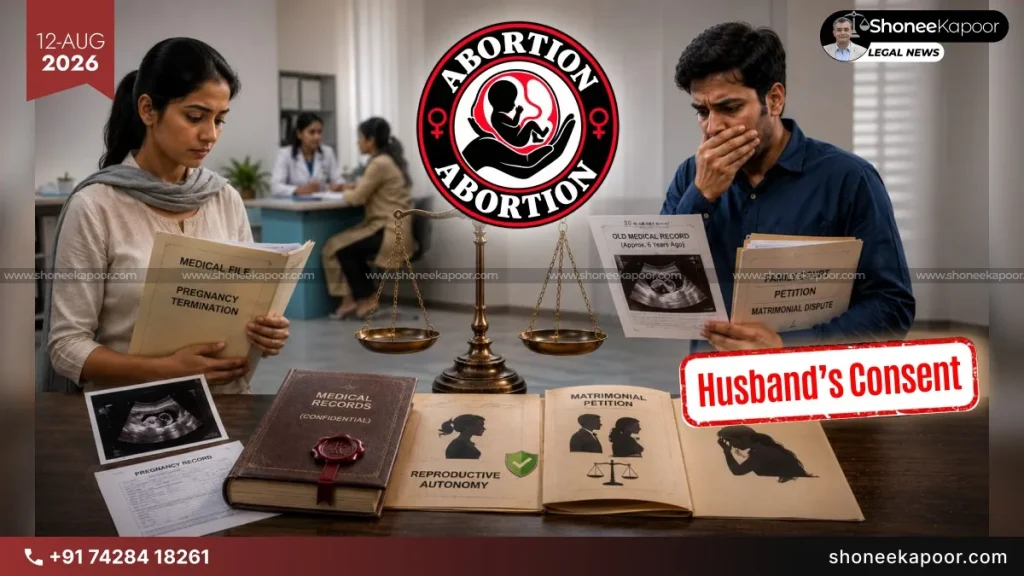
Can a decision taken during marriage become the subject of a criminal complaint years later? A Rajasthan case involving an alleged abortion without the husband’s consent has again brought the rights of both spouses into focus.
RAJASTHAN: A woman in Rajasthan has reportedly come under legal scrutiny over an abortion allegedly carried out around six years ago without informing or involving her husband.
The matter has drawn attention because it brings two distinct issues into focus: a woman’s reproductive autonomy and the husband’s emotional and matrimonial stake in a major decision concerning parenthood. These are separate legal questions and should not be treated as the same issue.
Under Indian abortion law, the consent of an adult pregnant woman is generally the legally relevant consent for a lawful medical termination of pregnancy. A husband’s consent is not ordinarily a statutory requirement merely because the woman is married.
Therefore, the fact that a wife allegedly terminated a pregnancy without taking her husband’s consent does not, by itself, automatically establish a criminal offence under the Medical Termination of Pregnancy Act, 1971. Indian courts have repeatedly recognised a woman’s bodily and reproductive autonomy.
However, matrimonial law deals with a different question. The Supreme Court has previously considered situations where a spouse takes important reproductive decisions without the knowledge of the other spouse while examining allegations of mental cruelty in marriage. This means that reproductive autonomy and matrimonial consequences are legally distinct issues.
EXPLANATORY TABLE OF LAWS AND SECTIONS
| Law / Principle | What It Means | Relevance To This Case |
| Medical Termination of Pregnancy Act, 1971 | Governs lawful termination of pregnancy in India subject to prescribed conditions. | The legality of the abortion has to be examined under the statutory conditions applicable when it occurred. |
| Consent for MTP | For an adult woman capable of giving consent, her own consent is ordinarily required for termination of pregnancy. | A husband’s consent is not generally an independent statutory requirement merely because the woman is married. |
| Reproductive Autonomy | Indian courts recognise a woman’s right to make decisions concerning continuation or termination of her pregnancy. | The criminal case cannot safely be understood as making every abortion without a husband’s approval illegal. |
| Mental Cruelty in Matrimonial Law | Certain unilateral decisions having a serious impact upon marital life may, depending upon facts, become relevant while deciding matrimonial cruelty. | Concealment of an abortion from a spouse can raise a matrimonial issue even though that is legally different from criminal liability. |
| Criminal Investigation | Registration of an FIR or case begins the criminal process; it is not proof of guilt. | The exact offence can be assessed only after the relevant complaint, FIR and statutory sections are known. |
CASE DETAILS
| Particular | Details |
| Case Title | Rajasthan Abortion Consent Case |
| State | Rajasthan |
| Nature of Matter | Criminal case reportedly registered against a woman |
| Core Allegation | Abortion allegedly undertaken without husband’s consent |
| Period Involved | Approximately six years before the reported case |
| Report Date | 12 August 2026 |
KEY TAKEAWAYS
- Her body, her choice cannot mean the husband’s role in parenthood becomes irrelevant.
- A major pregnancy decision was allegedly kept from the husband, destroying trust in the marriage.
- Reproductive autonomy should not erase a husband from serious marital decisions.
- Men are expected to provide, protect and parent, yet their voice is often ignored when it matters most.
- The husband’s grievance deserves legal scrutiny, not casual dismissal.
This Could Change Your Case-Get FREE Legal Advice-Click Here!
Disclaimer: The views and opinions expressed in this article are those of the Indian courts and do not necessarily reflect the official policy or position of “ShoneeKapoor.com” or its affiliates. This article is intended for informational and educational purposes only. The content provided is not legal advice, and viewers should not act upon this information without seeking professional counsel. Viewer discretion is advised.