
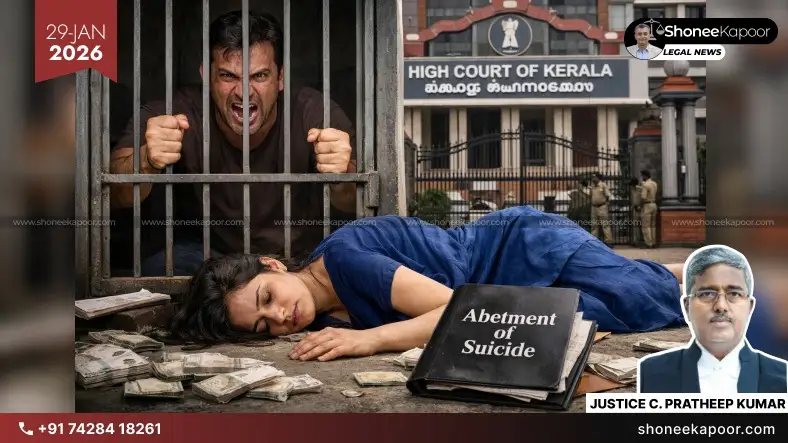
The Kerala High Court has ruled that words spoken in anger during a domestic quarrel cannot automatically be treated as abetment of suicide. The Court stressed that criminal liability depends on intention, not emotional reaction.
KOCHI: In a ruling that brings much-needed legal clarity to Section 306 of the Indian Penal Code, the Kerala High Court has held that a husband saying “go away and die” to his wife during a quarrel does not by itself amount to the offence of abetment of suicide.
The Court clearly observed that the intention of the accused is the decisive factor for proving abetment of suicide, and not how the deceased person emotionally perceived the words spoken during a heated moment.
The judgment was delivered by Justice C Pratheep Kumar while dealing with a criminal revision petition filed by a husband accused of abetting the suicide of his wife. The allegation against him was that during a domestic quarrel, he told his wife to “go away and die,” following which she later died by suicide.
The Court categorically examined whether such words, spoken during a verbal fight, can legally satisfy the ingredients of abetment under Section 306 IPC. While analysing the law, the Court made an important observation, stating:
“What is important is the intention of the accused and not what is felt by the deceased. In the instant case also, the words, ‘go away and die’ made by the petitioner was in the midst of a wordy quarrel between the petitioner and the deceased, in a heat of passion without having any intention to instigate the deceased to commit suicide and as such, the offence under Section 306 IPC is not made out,”
The background of the case, as placed by the prosecution, was that the husband was allegedly involved in an extramarital relationship. When the wife came to know about it, she contacted the other woman. This led to a heated argument between the husband and wife, during which he allegedly told her to “go away and die.”
The prosecution claimed that these words mentally disturbed the wife and pushed her into extreme distress, leading her to jump into a well along with her 5-year-old daughter.
Initially, the husband approached the Sessions Court seeking discharge from the case. However, the Sessions Court rejected his plea and decided to frame charges under Sections 306 and 204 IPC. Aggrieved by this decision, the husband approached the High Court.
Before the High Court, the husband argued that the statement attributed to him was made in the heat of the moment, during a quarrel, and without any intention to provoke or instigate his wife to take her own life.
The High Court closely examined settled legal principles and relied on earlier Supreme Court judgments. The Court noted that in Swamy Prahaladdas v. State of MP, the Supreme Court had already held that casual words spoken in anger during quarrels do not amount to abetment of suicide.
The Court also referred to the consistent legal position that mere harsh or insensitive words, without a clear intention to instigate suicide, cannot be stretched to create criminal liability under Section 306 IPC.
Applying these principles to the facts of the case, the High Court observed that the words “go away and die” were spoken during a heated exchange and not with a deliberate intention to push the deceased towards suicide.
Accordingly, the Court set aside the order of the Sessions Court and discharged the husband from the offences alleged against him.
Explanatory Table of Laws and Sections Referred in the Case
| Law / Section | Name / Provision | Simple Explanation |
| Indian Penal Code, Section 306 | Abetment of suicide | This section punishes a person only if it is proved that he intentionally instigated, aided, or provoked another person to commit suicide. Mere words spoken in anger are not enough unless intention is clearly established. |
| Indian Penal Code, Section 107 | Definition of abetment | This section explains what abetment means in law. It includes instigation, conspiracy, or intentional assistance. Intention and mens rea are essential. |
| Indian Penal Code, Section 204 | Destruction of document to prevent its use as evidence | This section applies only if there is a foundational offence proved. If abetment itself fails, this section cannot survive independently. |
| BNSS, Section 438 | Discharge of accused | This provision allows an accused to seek discharge if the allegations do not disclose any offence even if taken at face value. |
| BNSS, Section 442 | Revisional jurisdiction | This section empowers the High Court to examine and correct errors committed by lower courts in criminal proceedings. |
Case Details
- Case Title: Safwan Adhur v. State of Kerala
- Court: Kerala High Court
- Bench: Hon’ble Mr. Justice C. Pratheep Kumar
- Date of Judgment: 28 January 2026
- Neutral Citation: 2026:KER:6717
- Case Number: Criminal Revision Petition No. 1224 of 2025. Arising out of Crime No. 577/2023, Melparamba Police Station, Kasaragod. Sessions Case No. 427/2024, Additional District & Sessions Court–I, Kasaragod
Counsels Appearing in the Case
- For the Petitioner / Accused: R. Anas Muhammed Shamnad, C. C. Anoop, Saleek C. A., Thareek R. S, Hamdan Mansoor K.
- For the State: Senior Public Prosecutor A. Vipin Narayan
Key Takeaways
- Intention matters, not emotion — Courts must judge abetment of suicide based on the accused’s intent, not the emotional reaction of the deceased.
- Words in anger are not crimes — Statements made during heated domestic quarrels cannot be criminalised unless there is clear proof of instigation.
- Section 306 IPC has strict limits — Abetment requires mens rea; casual or impulsive remarks do not meet the legal threshold.
- Men deserve due process, not assumptions — Allegations alone cannot justify prolonged criminal trials without legal ingredients being satisfied.
- Judicial check on misuse — This ruling reinforces safeguards against the routine misuse of serious criminal sections against husbands.
This Could Change Your Case-Get FREE Legal Advice-Click Here!
Disclaimer: The views and opinions expressed in this article are those of the Indian courts and do not necessarily reflect the official policy or position of “ShoneeKapoor.com” or its affiliates. This article is intended for informational and educational purposes only. The content provided is not legal advice, and viewers should not act upon this information without seeking professional counsel. Viewer discretion is advised.