
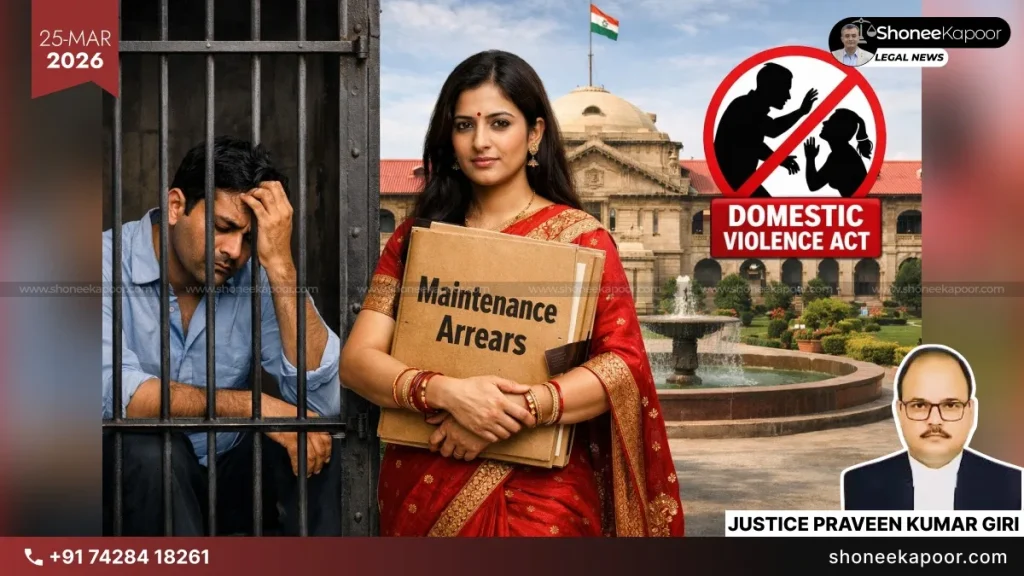
Went to jail for maintenance dues — but still forced to pay everything again?
This Allahabad High Court ruling exposes how liability continues even after imprisonment — read the full story.
PRAYAGRAJ: The Allahabad High Court has made it clear that even if a husband is sent to civil prison for not paying maintenance, his legal duty to pay monthly maintenance and pending arrears does not end. The Court said that jail is only a recovery method and not a replacement for payment.
This decision came from a bench of Justice Praveen Kumar Giri while hearing a petition filed by Hasina Khatoon. She challenged a 2023 order where her recovery application was rejected after her husband had already spent 30 days in jail for non-payment.
The case started in July 2019 when a Magistrate ordered the husband to pay Rs 4,000 per month to his wife and Rs 4,000 to their disabled son. However, the husband did not pay, and the total arrears reached Rs 2,64,000. The wife then filed for recovery, leading to his arrest in October 2022 and a 30-day civil imprisonment.
Even after coming out of jail, the husband did not pay the amount. When the wife again approached the court for recovery, her application was rejected on the ground that the husband had already completed his jail term for the same arrears. The lower court relied on Section 300 CrPC, which deals with double jeopardy.
The husband argued that since he had already served imprisonment, no further recovery should be allowed. He also said that the case should not be entertained under Section 482 CrPC as an appeal was available under the Domestic Violence Act.
However, the High Court disagreed with this approach. It clarified that Section 300 CrPC does not apply in maintenance cases because these proceedings do not result in conviction or acquittal. The Court observed that using this section to stop recovery shows a clear legal error.
“Refusing to execute the awarded maintenance amount under the Domestic Violence Act, by invoking a plea under Section 300 Cr.P.C. appears to be contrary to the law and indicates a non-application of judicial mind by the concerned learned Judicial Magistrate”
The Court also referred to the Supreme Court judgment in Rina Kumari vs Dinesh Kumar Mahto (2025), stating that even if penalties are involved, maintenance proceedings are not criminal trials.
Importantly, the Court said that sending a person to civil prison does not clear his financial liability. The obligation to pay maintenance continues until the full amount is paid.
The High Court set aside the earlier order and directed the trial court to recover the full arrears along with 6% simple interest. It further ordered that if the husband still fails to pay, his property can be attached to recover the amount.
“The proceeds shall be kept in the account of the Principal Judge, Family Court, Moradabad, or the District Judge, Moradabad, or any other concerned court of the Civil Judge/Magistrate of District Moradabad, to be applied toward the payment of the arrears with simple bank interest at 6% on delayed payment. O.P. No.2 shall continue to pay the current monthly maintenance to the applicant wife and her disabled son on regular basis and, thereafter, proceeds in accordance with law,”
Explanatory Table – Laws & Sections Involved
| Law / Section | Provision | What It Means in Simple Terms | How Court Used It |
| Section 482 CrPC | Inherent powers of High Court | High Court can intervene to correct injustice or legal error | Used to challenge wrongful rejection of recovery |
| Section 300 CrPC | Double Jeopardy | A person cannot be tried twice for same offence after conviction/acquittal | Court held this does NOT apply to maintenance cases |
| Section 12 DV Act | Complaint for domestic violence | Wife can file case seeking protection & monetary relief | Base proceeding for maintenance claim |
| Section 23 DV Act | Interim maintenance | Court can grant urgent temporary maintenance | Used to grant ₹8,000/month |
| Section 31 DV Act | Breach of protection order = offence | Non-compliance can lead to punishment (jail/fine) | Used for enforcement, not to wipe liability |
| Section 32 DV Act | Cognizable & non-bailable offence | Police can act without warrant | Strengthens enforcement power |
| Section 125 CrPC | Maintenance for wife/child | Ensures financial support to dependents | Referred for nature of maintenance (continuing obligation) |
| Section 128 CrPC | Enforcement of maintenance | Mechanism to recover unpaid maintenance | Supports recovery process |
| Section 20(6) DV Act | Monetary relief enforcement | Maintenance recoverable like civil decree | Reinforces recovery despite jail |
| Section 498A IPC | Cruelty by husband/relatives | Criminal provision related to matrimonial disputes | Mentioned in background litigation |
| Sections 3/4 Dowry Prohibition Act | Dowry offence | Penalises dowry demand | Part of earlier allegations |
| Evidence Act Section 40 | Previous judgment relevance | Bars re-litigation once issue settled | Used to show finality of maintenance order |
Case Details
- Case Title: Smt. Hasina Khatoon vs State of U.P. and another
- Case Number: Application U/s 482 No. – 7721 of 2023
- Court: High Court of Judicature at Allahabad
- Bench: Hon’ble Praveen Kumar Giri, J.
- Court No.: Court No. – 87
- Reserved On: 16 February 2026
- Delivered On: 24 March 2026
- Judgment Uploaded On: 24 March 2026
- Counsel for Applicant: Akshaya Kumar, Jaideep Pandey
- Counsel for Opposite Party: G.A., Mahtab Alam
Key Takeaways
- Going to jail gives no relief — a man can be imprisoned and still be forced to pay the full amount.
- Maintenance is called a civil liability but enforced with punishment similar to criminal law.
- Protection under Section 300 CrPC (double jeopardy) is effectively denied in such cases.
- Multiple coercive actions for the same amount — arrest, jail, recovery, and property attachment — can all run together.
- There is no exit mechanism — enforcement continues indefinitely, regardless of a man’s financial capacity.
This Could Change Your Case-Get FREE Legal Advice-Click Here!
Disclaimer: The views and opinions expressed in this article are those of the Indian courts and do not necessarily reflect the official policy or position of “ShoneeKapoor.com” or its affiliates. This article is intended for informational and educational purposes only. The content provided is not legal advice, and viewers should not act upon this information without seeking professional counsel. Viewer discretion is advised.