
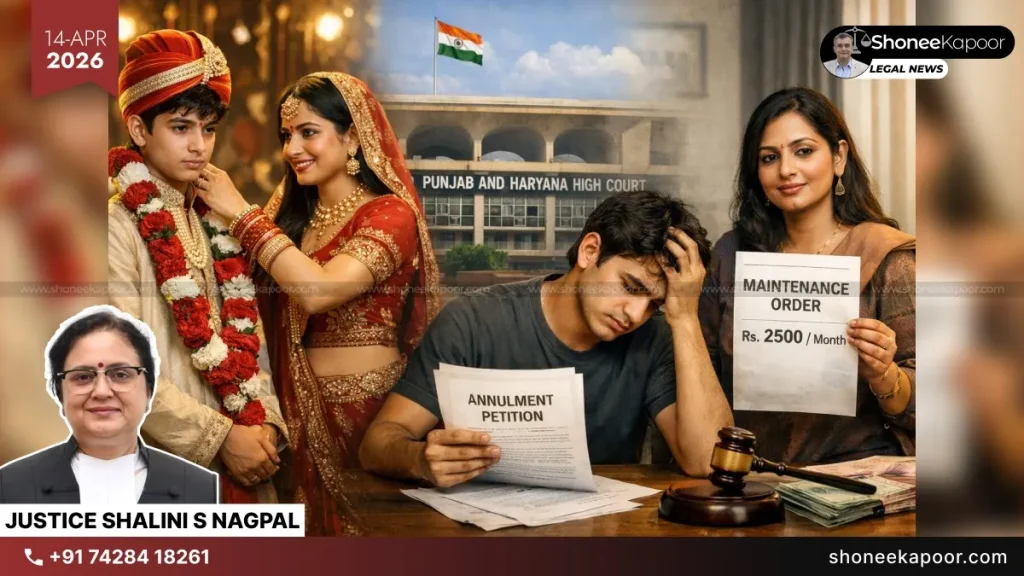
The Punjab & Haryana High Court upheld maintenance despite the husband being a minor at the time of marriage, a student, and having no proven income.
When the husband’s earning capacity is presumed without proof, why is the wife’s earning ability or financial backing not equally examined?
Husband Maintain: The Punjab and Haryana High Court, in a decision delivered by Justice Shalini Singh Nagpal, dismissed a revision petition filed by a 22-year-old engineering student and upheld the Family Court’s order directing him to pay ₹2,500 per month as interim maintenance to his wife.
The Court observed:
“Husband cannot be permitted to plead that he is unable to maintain his wife due to financial constraints as long as he is capable of earning. Nor can he be absolved on the ground that he is a student. Pursuit of education notwithstanding, the legal obligation to maintain the wife is absolute arising from the existence of the relationship”.
The marriage took place in 2020 when the husband was only 16 years and 4 months old, while the wife was 25 years old. Later, the husband approached the court seeking annulment under the Prohibition of Child Marriage Act. After living separately for around three years, the wife filed a maintenance case under Section 125 CrPC.
The husband argued that he was still studying and had no source of income. He also stated that his family depended on his mother’s small widow pension and that the wife was living comfortably with her earning family members. On this basis, he requested that the maintenance amount be set aside.
The Court, however, did not accept these arguments. It explained that maintenance law is not meant to punish a husband, but to ensure that a wife does not suffer financially after separation. The Court relied on the judgment in Shamima Farooqui vs Shahid Khan and noted that such claims of having no income are often used as excuses.
Referring to the earlier ruling, the Court highlighted that excuses like unemployment or financial difficulty are only “bald excuses” and are not acceptable under the law when a person is capable of earning.
The Court further observed that a healthy and able-bodied man has a clear legal responsibility to support his wife. In this case, since the husband had no disability and was capable of working, the Court assumed that he had the means to earn and provide maintenance.
The High Court also agreed with the Family Court’s view that even a daily wage worker earns around ₹12,000 to ₹13,000 per month, and therefore, claiming zero income cannot be accepted easily.
While deciding the amount, the Court noted the rising cost of living and the basic needs of the wife. It held that ₹2,500 per month is a very minimal amount and is only sufficient for basic survival, leaving no scope for reduction.
In the end, the High Court dismissed the revision petition and upheld the maintenance order, confirming that the husband must continue paying ₹2,500 per month to his estranged wife.
Explanatory Table: Laws & Provisions Involved
| Law / Provision | Purpose | How Applied in This Case |
| Section 125 CrPC | Provides maintenance to wife, children, and parents to prevent destitution | Wife filed for maintenance after separation; court upheld her right |
| Prohibition of Child Marriage Act, 2006 | Declares child marriages voidable and allows annulment | Husband filed annulment petition claiming he was minor at marriage |
| Judicial Precedent: Shamima Farooqui vs Shahid Khan (2015) | Establishes that husband’s duty to maintain wife is strict and excuses are not valid | Court relied on it to reject husband’s claim of no income |
| Principle of Maintenance Law | Ensures wife does not suffer financial hardship after separation | Court emphasized maintenance is for survival, not punishment |
Case Details
- Case Title: ABC VS. XYZ
- Court: Punjab and Haryana High Court
- Case Type: Criminal Revision Petition (CRR)
- Bench: Justice Shalini Singh Nagpal
- Impugned Order: Family Court, Faridabad (August 2025)
- Relief Sought: Setting aside interim maintenance of ₹2,500/month
- Outcome: Revision dismissed, maintenance upheld
Key Takeaways
- A husband’s liability to pay maintenance continues even if he was a minor at the time of marriage and is challenging its validity.
- Courts presume earning capacity if the man is healthy, regardless of actual income or student status.
- Claims of financial hardship or unemployment are routinely dismissed as insufficient defenses.
- Even minimal maintenance amounts are upheld without strict scrutiny of the husband’s real financial condition.
- The legal framework places a near-absolute burden on men, with limited consideration of the wife’s independent support system.
This Could Change Your Case-Get FREE Legal Advice-Click Here!
Disclaimer: The views and opinions expressed in this article are those of the Indian courts and do not necessarily reflect the official policy or position of “ShoneeKapoor.com” or its affiliates. This article is intended for informational and educational purposes only. The content provided is not legal advice, and viewers should not act upon this information without seeking professional counsel. Viewer discretion is advised.