
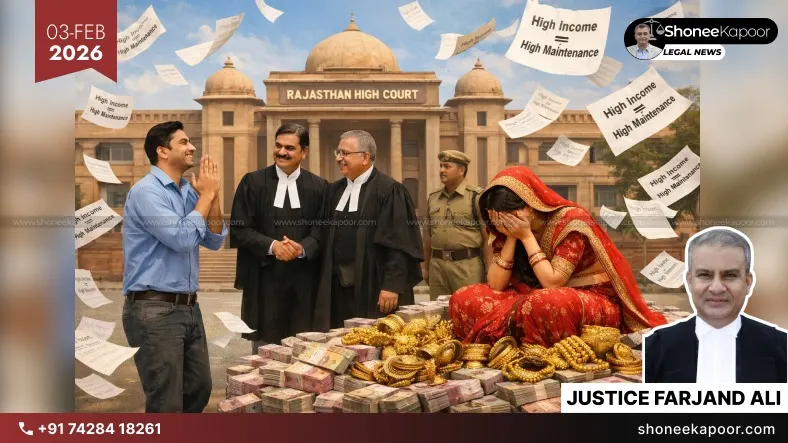
Husband’s High Salary/Income Doesn’t Automatically Mean High Maintenance For Wife: Rajasthan High Court

Written and analysed by Shonee Kapoor
Legal Consultant, Author & Men's Rights ActivistThe Rajasthan High Court refused to increase a wife’s maintenance merely because the husband earns over ₹1.5 lakh per month. The Court made it clear that maintenance is support, not income-sharing, especially when the marriage lasted only 57 days.
JAIPUR: The Rajasthan High Court has once again clarified an important legal principle in maintenance cases, especially in disputes where the husband has a high income. The Court rejected a woman’s petition seeking enhancement of maintenance from ₹8,000 per month only on the ground that her husband earns more than ₹1.5 lakh per month. The Court made it clear that maintenance cannot be decided by a fixed formula based on the husband’s salary alone.
The case arose from a marriage that lasted only 57 days. After the separation, the wife filed a petition under Section 125 Cr.P.C. seeking maintenance. The Family Court at Sri Ganganagar granted her ₹8,000 per month as maintenance. Dissatisfied with this amount, the wife approached the Rajasthan High Court arguing that the sum was too low considering the husband’s income, government job, and professional status.
While examining the challenge, the High Court clearly stated that the law does not treat maintenance as a right to share the husband’s income or property.
Justice Farjand Ali observed:
“The law does not envisage that because the husband earns more, the wife must necessarily receive half or a substantial fraction thereof. Such an approach would amount to converting maintenance proceedings into a de facto claim for sharing of income or property, which is impermissible.”
Making it clear that maintenance is meant for reasonable support, not financial parity.
The Court carefully looked at the wife’s background and qualifications. It noted that she was highly educated, professionally qualified, and had previously worked at reputed institutions. The Court explained that simply stating that she is unemployed at present does not automatically prove that she is unable to maintain herself.
On this issue, the Court reiterated the settled legal position by observing:
“The settled legal position is that while mere capacity to earn does not disentitle a wife from maintenance, the Court is entitled to take into account the earning potential, qualifications and past employment while determining the quantum. The learned Family Court has not denied maintenance on this ground; rather, it has calibrated the quantum after due consideration, which cannot be said to be illegal or perverse.”
An important factor that weighed with the Court was the extremely short duration of the marriage. The relationship lasted only about 57 days, which the Court found relevant while assessing dependency and lifestyle adjustment.
The Court observed:
“Matrimonial relationship between the parties subsisted for an extremely short duration of about 57 days. While the length of marriage by itself is not determinative of entitlement under Section 125 Cr.P.C., it is nonetheless a relevant factor in assessing the nature of dependency, adjustment of lifestyle, and the extent to which parties had, in fact, shared a common standard of living.”
The High Court also took note of the husband’s conduct. Despite contesting the maintenance claim, he regularly deposited the maintenance amount as directed by the Family Court.
The Court appreciated this approach and remarked:
“Courts are not oblivious to conduct of parties, as equity and good conscience are integral to the dispensation of justice.”
This observation reflects that compliance with court orders and responsible behaviour are relevant considerations in matrimonial disputes.
After examining all aspects, including income, qualifications, conduct, and the brief marriage, the Court concluded that the Family Court had exercised its discretion properly. The High Court held that maintenance proceedings cannot be used as a tool to demand a percentage of the husband’s income, especially when the facts do not justify such a claim.
Accordingly, the Rajasthan High Court dismissed the wife’s revision petition and upheld the maintenance of ₹8,000 per month. The judgment sends a strong message that while maintenance laws exist to prevent destitution, they cannot be stretched to unfairly burden one party or convert marital disputes into income-sharing arrangements, particularly in cases where the marriage itself was of a very short duration.
Explanatory Table: Laws & Sections Involved In This Case
| Law / Section | Purpose | How Applied in This Case |
| Section 125 Cr.P.C. | Provides maintenance to wife, children, or parents to prevent destitution and vagrancy | Wife sought enhancement of maintenance; Court held ₹8,000 per month was reasonable and not illegal |
| Section 125(4) Cr.P.C. | Bars maintenance if wife lives separately without sufficient cause | Considered due to admissions of voluntary separation and no steps for restitution |
| Section 498-A IPC | Penal provision for cruelty by husband or relatives | Allegations noted, but Court held presumption of cruelty cannot arise merely due to pendency of case |
| Section 323 IPC | Punishment for voluntarily causing hurt | Mentioned as part of allegations filed by wife |
| Section 406 IPC | Criminal breach of trust | Alleged regarding dowry articles; not determinative for maintenance quantum |
| Section 9 Hindu Marriage Act, 1955 | Restitution of conjugal rights | Court noted wife never took steps under this provision |
| Section 12(1)(a) Hindu Marriage Act, 1955 | Voidable marriage due to impotence | Referred to regarding petitioner’s previous marriage |
| Article 51A(k) Constitution of India | Fundamental duty of parents towards children | Raised by husband to highlight wife’s refusal to care for minor child |
| Rajnesh v. Neha, 2020 SCC OnLine SC 903 | Supreme Court guidelines on maintenance | Cited for considering short duration of marriage and financial disclosures |
Case Details
- Case Title: Ritu Khatri vs Navneet Khanna
- Court: High Court of Judicature for Rajasthan at Jodhpur
- Bench: Hon’ble Mr. Justice Farjand Ali
- Neutral Citation: 2026:RJ-JD:2380
- Case Number: S.B. Criminal Revision Petition No. 1083/2024
- Date of Conclusion of Arguments: 14/01/2026
- Date of Pronouncement: 20/01/2026
- Counsels:
- For Petitioner (Wife): Mr. Aakash Kukkar
- For Respondent (Husband): Mr. Navneet Khanna (appearing in person through video conferencing)
Key Takeaways
- High income of a husband does not create an automatic right for the wife to claim a fixed share of his earnings under maintenance law.
- Maintenance under Section 125 Cr.P.C. is meant to prevent destitution, not to convert marriage into a lifetime income-sharing arrangement for men.
- Short-duration marriages matter; a relationship that lasted only 57 days cannot be used to claim a lifestyle or dependency that never truly existed.
- An educated and professionally capable wife cannot indefinitely rely on present unemployment to financially burden the husband.
- A man’s responsible conduct – regularly paying court-ordered maintenance despite contesting entitlement – must be legally acknowledged, not ignored.
This Could Change Your Case-Get FREE Legal Advice-Click Here!
Disclaimer: The views and opinions expressed in this article are those of the Indian courts and do not necessarily reflect the official policy or position of “ShoneeKapoor.com” or its affiliates. This article is intended for informational and educational purposes only. The content provided is not legal advice, and viewers should not act upon this information without seeking professional counsel. Viewer discretion is advised.
Related Articles
The Silent Crisis: Men Destroyed by False Allegations in India – How Laws Meant for Protection Are Destroying Innocent Men
Laws Meant for Protection Are Destroying Innocent Men. An FIR is filed and a man’s life collapses before any evidence...
Family Courts Refuse My RTI To Reveal Divorce Data: Is Transparency Selective When It Comes to Men?
Family Courts have refused to provide year-wise divorce and alimony statistics under the RTI Act, citing technical gr...
Can an Educated Wife Claim Maintenance from Her Husband? The Legal Reality No One Explains
Indian courts recognise education and earning capacity, yet husbands are still routinely ordered to pay maintenance.I...
Relevant Judgements
Can an NRI Husband Be Forced to Pay Maintenance in India? Supreme Court Rules Explained for Overseas Indian Men
Living abroad does not automatically protect an NRI husband from maintenance claims in India.But can Indian courts pa...
Share Your Thoughts
Comments are moderated before publication.