
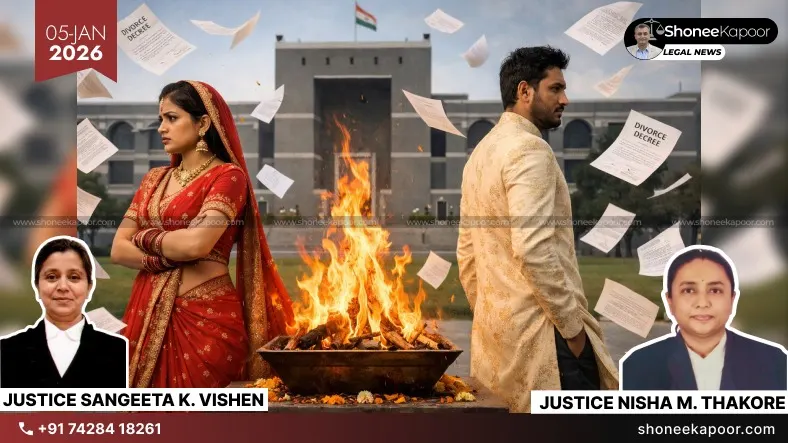
Gujarat High Court Ends Forced Waiting in Dead Marriages: Cooling Period U/S 13B of HMA Can’t Be Used As Legal Punishment

Written and analysed by Vaibhav Ojha
Head Of Legal CommunicationsThe Gujarat High Court has clarified that the six-month cooling-off period under Section 13B of the Hindu Marriage Act is not compulsory in all cases. The Court held that forcing such waiting where reunion is impossible only increases mental suffering.
Gujarat High Court Ends Forced Waiting in Dead Marriages: The Gujarat High Court has set aside an order passed by a Family Court which had rejected a couple’s application for divorce by mutual consent only on the ground that the mandatory six-month cooling-off period had not been completed.
The High Court observed that the couple had already been living separately for more than one year and were settled in different countries, leaving no real possibility of reconciliation.
The High Court made it clear that the purpose of the cooling-off period is to give parties a chance to reconsider their decision, but it cannot be applied mechanically in cases where the marriage has completely broken down. The Court noted that denying divorce in such situations only prolongs the emotional and mental agony of both parties.
The couple had approached the High Court challenging the Family Court’s order which rejected their plea for divorce by mutual consent. The Family Court had held that the six-month cooling-off period under Section 13B of the Hindu Marriage Act is not “an empty formality but a meaningful opportunity for reconciliation” and also noted that no formal waiver application had been filed. Aggrieved by this approach, the couple sought a direction that their divorce application be reconsidered afresh.
While deciding the appeal, the Division Bench of Justice Sangeeta K. Vishen and Justice Nisha M. Thakore examined the facts and legal position and observed that the six-month period prescribed under Section 13B is directory and not mandatory. The Court recorded as follows:
“Perceptibly, there is no scope of reunion between the parties for, the parties are staying separately since more than one year as on the date of presenting the petition under section 13B of the Act of 1955. Both the parties have mutually agreed for divorce, therefore, the six months period as well as one year as provided in section 13B(1) is almost over.
Considering the stand taken by the respective parties, reunion is not possible. Not accepting the request of the parties, in the opinion of this Court, will only prolong their agony. Both the parties, are young and are desirous of pursuing their careers, as per their own wish.In the case on hand, the parties have fairly conceded before this Court that application seeking waiver was not filed, however, it is agreed that it shall be filed within a period of two weeks from today. Hence, in the interest of justice, it would be appropriate to allow an opportunity to both the parties, to file an application before the Court below as enumerated under section 13B of the Act of 1955 and let the Court below decide it in accordance with law.”
The advocates appearing for both sides informed the Court that the marriage took place on December 9, 2023, and that the parties had been living separately since January 17, 2024. It was further submitted that the husband had moved to the United Kingdom for higher studies and intended to settle there permanently, while the wife was settled in Ahmedabad and wished to continue her career in India. Due to these completely different life paths, there was no chance of the couple resuming cohabitation.
The lawyers also pointed out that both parties had filed examination-in-chief affidavits clearly stating that the decision to seek divorce by mutual consent was taken voluntarily, without any pressure, force, or coercion from either side.
It was further argued that the application for divorce by mutual consent was filed on April 1, 2025, which was well after one year of separation. Despite this, the Family Court rejected the application on August 8, 2025, treating it as premature because the six-month period had not fully expired and no waiver application had been filed.
After considering the pleadings, affidavits, and submissions, the High Court noted that the couple had been living separately since January 2024 and had consciously chosen to pursue their careers in different countries. Because of this, they jointly filed a petition for divorce by mutual consent under Section 13B of the Hindu Marriage Act, 1955.
The High Court also took note that the second motion was moved in July 2025, while the six-month period would have formally ended in October 2025. Referring to the provisions of Section 13B and the Supreme Court’s judgment in Amardeep Singh vs. Harveen Kaur, the Court reiterated that the law allows waiver of the six-month cooling-off period in appropriate cases.
The Supreme Court has already held that where parties have lived separately for one year or more, are unable to live together, and have genuinely settled all disputes, the waiting period may be waived if continuing it would only prolong suffering.
In view of these settled legal principles and the facts of the case, the High Court allowed the appeal and set aside the Family Court’s order. The matter was remanded back with a clear direction to the Family Court to give the parties an opportunity to file a waiver application and to decide the divorce application afresh, strictly in accordance with law, within a period of six months.
Explanatory Table: Laws & Sections Involved in the Case
| Law / Provision | Section | Simple Explanation | How It Applied in This Case |
| Hindu Marriage Act, 1955 | Section 13B(1) | Allows divorce by mutual consent if husband and wife have lived separately for at least one year, cannot live together, and agree to end the marriage | The couple had been living separately since January 2024 and jointly agreed to divorce |
| Hindu Marriage Act, 1955 | Section 13B(2) | Provides a six-month “cooling-off period” after filing the first motion before granting divorce | The Family Court treated this period as compulsory, which the High Court corrected |
| Hindu Marriage Act, 1955 | Section 13B (overall scheme) | Enables peaceful dissolution of marriage by consent instead of forcing unwilling parties to stay married | The High Court held the provision must reduce suffering, not extend it |
| Code of Civil Procedure, 1908 | Order XXXIIA Rule 3 | Encourages courts to attempt reconciliation in matrimonial disputes | The Court noted reconciliation was not possible due to settled facts |
| Hindu Marriage Act, 1955 | Section 23(2) | Requires courts to make efforts for reconciliation before granting relief | Already satisfied; parties lived apart, careers and countries differed |
| Family Courts Act, 1984 | Section 9 | Mandates Family Courts to make efforts for settlement | Held ineffective in this case due to complete breakdown of marriage |
| Supreme Court Judgment | Amardeep Singh vs. Harveen Kaur (2017) 8 SCC 746 | Clarified that the six-month cooling-off period is directory, not mandatory | Relied upon to set aside the Family Court’s rigid approach |
Case Summary
- Case Title: ABC vs XYZ
- Case Number: C/FA/4404/2025
- Court: High Court of Gujarat at Ahmedabad
- Bench: Honourable Ms. Justice Sangeeta K. Vishen & Honourable Ms. Justice Nisha M. Thakore
- Date of Decision: 22 December 2025
- Neutral Citation: 2025:GUJHC:74569-DB
- Appeal Arising From: Family Suit No. 1054 of 2025. Order dated 08.08.2025 passed by the Family Court, Ahmedabad
Counsels Appearing
| Side | Counsel |
| Appellants (Husband & Wife) | Ms. Pooja D. Baswal |
| Respondent | Ms. Bhakti M. Joshi |
Key Takeaways
- Cooling-off period is a safeguard, not a weapon to trap men in dead marriages.
- When separation is long and consent is clear, forced waiting only increases mental torture of husbands.
- Courts must stop treating Section 13B as a technical trap instead of a relief provision.
- Career, geography, and reality matter more than artificial reconciliation attempts.
- Justice means ending suffering, not prolonging it in the name of procedure.
This Could Change Your Case-Get FREE Legal Advice-Click Here!
Disclaimer: The views and opinions expressed in this article are those of the Indian courts and do not necessarily reflect the official policy or position of “ShoneeKapoor.com” or its affiliates. This article is intended for informational and educational purposes only. The content provided is not legal advice, and viewers should not act upon this information without seeking professional counsel. Viewer discretion is advised.
Related Articles
NRI Divorce Litigation in India: Step By Step Legal Guide, Real Cases, Real Data, Real Struggles
The article explores how cross-border marriages turn into complex legal battles when love meets the limits of jurisdi...
Share Your Thoughts
Comments are moderated before publication.