
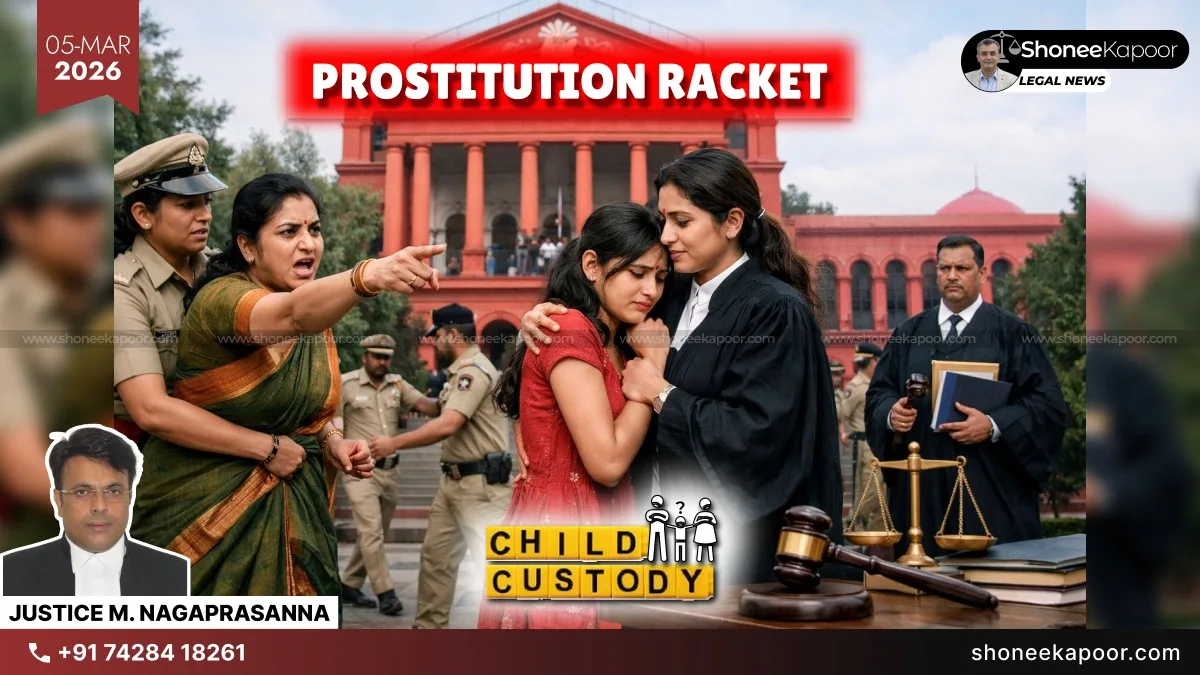
Rescued Girl Not Safe With Mother: Karnataka High Court Rejects Custody Bid Amid Allegations of Prostitution Exploitation

Written and analysed by Vaibhav Ojha
Head Of Legal CommunicationsCan a rescued girl be handed over to her mother amid allegations that the mother forced her into prostitution?
The Karnataka High Court rejected the custody plea, noting serious allegations that the mother pushed the girl into a prostitution racket.
BENGALURU: The Karnataka High Court at Bengaluru, in a decision delivered by Justice M. Nagaprasanna, refused to grant custody of a young woman to her mother after allegations surfaced that the mother had pushed her daughter into prostitution.
The Court dismissed the criminal petition filed by the mother challenging the trial court’s earlier order rejecting her custody request.
The case began after police raided a lodge in Bengaluru and rescued a girl who was allegedly part of a prostitution racket. After the rescue, she was placed in a Child Welfare Home. The mother later approached the court seeking custody, claiming the girl had now turned 18 and should be handed over to her.
During the hearing, the prosecution told the Court that investigation records indicated the mother herself had earlier forced the girl into prostitution. It was also pointed out that the girl had previously been released to the mother’s custody in another case but was again found in a prostitution racket later.
The High Court noted the seriousness of the allegations and observed that:
“The statement of the victim and the statement of others would prima facie indicate that the mother had forced the daughter to prostitution.”
The Court further stated that:
“When a child is rescued from a prostitution racket and is in the custody of the State or the Child Welfare Home, but when there are allegations against the mother that she is indulging in the act of using her daughter for the purpose of prostitution, the girl should not be handed over to the custody of the mother.”
The Court also questioned why the mother was not included as an accused in the charge sheet, observing that:
“It is un-understandable as to how the mother is left while filing the charge sheet, notwithstanding the fact that there is a lurking suspicion that she has indulged in forcing her daughter for prostitution.”
In conclusion, the Court held that the safety and welfare of the rescued victim must come first and ruled that:
“The child cannot be handed over to the mother who is allegedly using her daughter in the prostitution racket. Therefore, the petition lacking in merit, stands rejected.”
Explanatory Table: Laws And Sections Included
| Law / Section | Purpose | How Applied in This Case |
| Section 482 CrPC / Section 528 BNSS | Gives High Courts inherent powers to prevent abuse of process and ensure justice. | The mother filed the criminal petition before the High Court under this provision challenging the trial court order that refused custody. |
| Immoral Traffic (Prevention) Act, 1956 – Section 3 | Punishes keeping or managing a brothel or allowing premises to be used as a brothel. | Police registered the crime after a raid on a lodge where the victim girl was allegedly being used in prostitution activities. |
| Immoral Traffic (Prevention) Act, 1956 – Section 4 | Punishes living on the earnings of prostitution of another person. | Investigation indicated that persons involved in the racket were benefiting financially from prostitution. |
| Immoral Traffic (Prevention) Act, 1956 – Section 5 | Punishes procuring or inducing a person for prostitution. | The prosecution alleged that the victim was brought into prostitution through inducement and exploitation. |
| Immoral Traffic (Prevention) Act, 1956 – Section 17(2) | Provides procedure for inquiry by a Magistrate regarding custody of persons rescued from prostitution. | The mother filed an application under this section seeking custody of her daughter after she turned 18. |
| Immoral Traffic (Prevention) Act, 1956 – Section 17A | Requires verification of parents or guardians before handing over custody of rescued victims. | The Court emphasized that custody cannot be given to a parent if there is suspicion that the parent may influence or exploit the victim. |
| Protection of Children from Sexual Offences Act, 2012 – Section 4 | Punishes penetrative sexual assault on a child. | Added during investigation since the rescued victim was a minor at the time of the alleged offence. |
| Protection of Children from Sexual Offences Act, 2012 – Section 8 | Punishment for sexual assault on a child. | Included in the charge sheet for offences committed against the minor victim. |
| Protection of Children from Sexual Offences Act, 2012 – Section 12 | Punishes sexual harassment of a child. | Applied as part of the allegations linked to the exploitation of the minor. |
| Protection of Children from Sexual Offences Act, 2012 – Section 17 | Punishes abetment of offences under the POCSO Act. | Relevant where individuals were suspected of facilitating the exploitation of the child. |
| Bharatiya Nyaya Sanhita, 2023 – Section 62 | Deals with offences affecting bodily autonomy and safety. | Included in the criminal case arising from the prostitution racket. |
| Bharatiya Nyaya Sanhita, 2023 – Section 64(1) | Provides punishment for serious sexual offences under the new criminal code. | Applied due to the alleged sexual exploitation linked to the trafficking activity. |
| Bharatiya Nyaya Sanhita, 2023 – Section 75 | Addresses cruelty or harm towards a child. | Invoked considering the victim was a minor at the time of the alleged exploitation. |
| Bharatiya Nyaya Sanhita, 2023 – Section 143(4) | Relates to organized criminal acts or unlawful activities involving multiple persons. | Used because the offence allegedly involved several persons running a prostitution racket. |
Case Details
- Case Title: Mother of Victim Girl v. State
- Court: High Court of Karnataka at Bengaluru
- Case Number: Criminal Petition No. 17299 of 2025
- Bench: Justice M. Nagaprasanna
- Neutral Citation: NC: 2026:KHC:3305
- Date of Decision: 21 January 2026
- Counsels:
- For Petitioner: Sri Gireesha R. J., Advocate
- For Respondent: Sri B. N. Jagadeesha, Additional State Public Prosecutor
Key Takeaways
- Exploitation within families is a harsh reality, and the assumption that a biological mother is always the safest guardian does not always hold true.
- Custody disputes involving rescued victims often raise serious concerns about the role of the mother in the alleged exploitation.
- In such situations, the welfare and protection of the victim becomes the central consideration in custody decisions.
- Courts closely examine whether returning a rescued victim to the same mother and family environment may expose them to further risk.
- Cases like these highlight how even a mother’s role may come under scrutiny when allegations of criminal exploitation arise.
This Could Change Your Case-Get FREE Legal Advice-Click Here!
Disclaimer: The views and opinions expressed in this article are those of the Indian courts and do not necessarily reflect the official policy or position of “ShoneeKapoor.com” or its affiliates. This article is intended for informational and educational purposes only. The content provided is not legal advice, and viewers should not act upon this information without seeking professional counsel. Viewer discretion is advised.
Related Articles

Settlement Pressure on Men in 69 BNS Cases: Marriage or Jail, Police Arrest Threats, and FIR-Based Extortion
Can Section 69 BNS be used to force marriage or money settlements? A deep legal analysis of arrest powers, extortion ...

Section 69 BNS: Legal Protection or Weapon Against Men?
A new criminal provision was supposed to punish deception. In practice, it is already raising an older question in a ...

Top 10 Signs a 498A / Section 85 BNS Case May Be Prepared Against You: Early Warning Guide for Husbands
What if the case against you didn’t start at the police station—but months earlier inside your own home? These silent...
Share Your Thoughts
Comments are moderated before publication.