
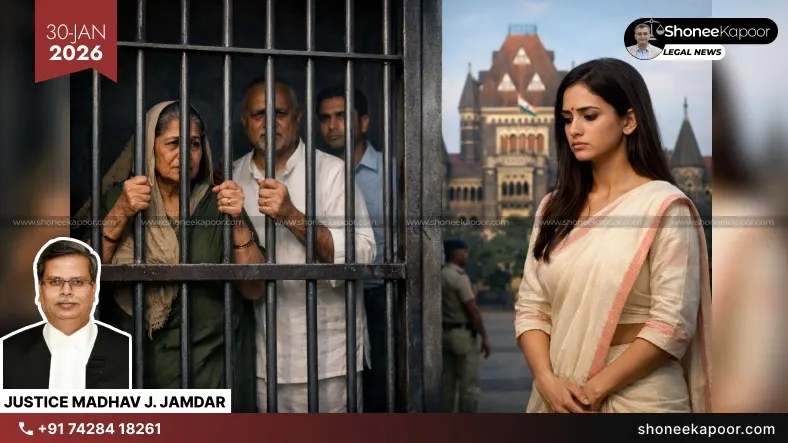
Bombay High Court Denies Anticipatory Bail to In-Laws in Matrimonial Domestic Violence Case Despite Wife’s Willingness to Save Marriage

Written and analysed by Shonee Kapoor
Legal Consultant, Author & Men's Rights ActivistIn a case arising from a matrimonial dispute, the Bombay High Court rejected anticipatory bail sought by the husband’s parents. The Court held that serious allegations, prima facie evidence, and the need for custodial interrogation outweighed claims of reconciliation. The order makes it clear that attempts to save a marriage cannot dilute criminal scrutiny in grave matrimonial offences.
Mumbai: The Bombay High Court has rejected the anticipatory bail application filed by the father-in-law and mother-in-law in a serious matrimonial offence case, after finding that the allegations were grave, supported by material evidence, and required custodial interrogation.
The Court held that this was not a fit case for granting the extraordinary relief of pre-arrest bail.
After hearing all sides and examining the investigation material, the Court observed that the FIR and collected evidence clearly show involvement of the applicants in the alleged offences.
The Court noted that the accusations were not limited to minor domestic disputes but included repeated harassment, assaults, threats to life, and conduct serious enough to push the complainant towards suicide.
The Court categorically recorded that:
“The contents of FIR prima facie shows that all the accused not only harassed, abused, threatened and assaulted the First Informant but also created a situation where she should be constrained to die by suicide or they would have killed her.”
While considering the argument that the complainant earlier wanted to continue the marriage, the Court rejected the claim that this weakens the case. It explained that many victims tolerate abuse due to social pressure and fear.
The Court observed:
“This is a sad reality of Indian Society, where many victims of domestic violence in spite of facing grave threat to their life continue the matrimonial relationship as due to the orthodox atmosphere, they face social stigma.”
The Court further relied on investigation material such as photographs, medical evidence, messages, and witness statements, and concluded that there was sufficient prima facie material to support the prosecution case. It held that claims of a false or exaggerated FIR had no basis at this stage.
A crucial factor weighed heavily against the applicants was their conduct after registration of the FIR. The Court recorded that despite rejection of anticipatory bail by the Sessions Court, the applicants were not arrested and were not available for investigation. Relying on Supreme Court precedent, the Court held that an absconding accused is not entitled to anticipatory bail.
The Court also took serious note of the applicants’ social and political influence and the real possibility of witness intimidation. It found that their position and connections created a reasonable apprehension that the investigation could be affected if protection was granted.
While discussing the gravity of matrimonial crimes, the Court quoted the Supreme Court’s observations on dowry-related cruelty and social accountability, stating:
“Marriage, in its true essence, is a sacred and noble institution founded on mutual trust, companionship, and respect. However, in recent times, this pious bond has regrettably been reduced to a mere commercial transaction.”
The Court further said:
“The social evil of dowry not only corrodes the sanctity of marriage but also perpetuates systemic oppression and subjugation of women.”
It also reproduced the Supreme Court’s warning that:
“Judicial passivity or misplaced leniency in the face of such atrocities would only embolden perpetrators and undermine public confidence in the administration of justice.”
Applying these principles, the High Court held that anticipatory bail, being an exceptional remedy, cannot be granted as a matter of routine in cases involving serious and grave offences. It reiterated that custodial interrogation is often necessary in such cases to ensure a fair and effective investigation.
The Court relied on settled law and observed that:
“Anticipatory bail is an exceptional remedy and ought not to be granted in a routine manner,” especially where granting protection may lead to miscarriage of justice or hamper investigation.
Finally, after assessing the seriousness of the allegations, the strength of the material on record, the influence of the accused, and their conduct of absconding, the Court concluded that no case was made out for granting anticipatory bail and dismissed the application.
Explanatory Table: Laws And Sections Involved
| Law & Section | Purpose (In Short) | How Applied in This Case (In Short) |
| BNSS, 2023 – Section 482 | Power to grant or refuse anticipatory bail | Used by the High Court to examine and ultimately refuse pre-arrest bail |
| BNS, 2023 – Section 85 | Cruelty by husband or relatives | Allegations of continuous physical and mental cruelty by in-laws |
| BNS, 2023 – Section 351(2) | Criminal intimidation | Threats allegedly issued to the complainant |
| BNS, 2023 – Section 351(3) | Aggravated criminal intimidation | Threats involving serious consequences, including threat to life |
| BNS, 2023 – Section 352 | Assault or use of criminal force | Physical assault allegations supported by photographs |
| BNS, 2023 – Section 115(2) | Voluntarily causing hurt | Injuries allegedly inflicted during acts of violence |
| BNS, 2023 – Section 64(1) | Sexual offence provision | Allegations of sexual misconduct considered at prima facie stage |
| BNS, 2023 – Section 74 | Outraging modesty | Alleged acts violating dignity and bodily autonomy |
| BNS, 2023 – Section 77 | Voyeurism | Allegations of recording private acts without consent |
| BNS, 2023 – Section 89 | Abetment | Acts allegedly creating circumstances pushing the complainant towards suicide |
| BNS, 2023 – Section 75(1) | Dowry-related cruelty | Dowry demands made before and after marriage |
| BNS, 2023 – Section 75(2) | Aggravated dowry cruelty | Continued and severe dowry-linked harassment |
| BNS, 2023 – Section 3(5) | Common intention / group liability | Applied to treat in-laws as acting together in alleged offences |
Case Details
- Case Title: Anil Kisan Lokhande & Anr. v. State of Maharashtra
- Court: Bombay High Court
- Case Number: Anticipatory Bail Application No. 4 of 2026 (with Interim Application No. 113 of 2026)
- Date of Order: 21 January 2026
- Bench: Hon’ble Mr. Justice Madhav J. Jamdar
- Neutral Citation: Not mentioned in the order copy
- Counsels Appearing:
- Amicus Curiae: Mr. Girish Kulkarni, Senior Advocate
- For the Applicants: Mr. Rajiv Chavan, Senior Advocate, with assisting counsels
- For the State: Ms. R. V. Newton, APP
- For the First Informant: Ms. Surbhi Agrawal, Advocate
Key Takeaways
- Anticipatory bail is not automatic in matrimonial cases; courts will deny protection when allegations appear serious and investigation demands custody.
- A wife’s willingness to continue the marriage does not erase criminal allegations or convert a case into a civil dispute.
- Courts rely on prima facie material like messages, photographs, and statements, not on emotional narratives or reconciliation claims.
- Influence, political connections, or social standing of in-laws can work against them if there is risk of witness intimidation.
- Absconding or non-cooperation with police almost shuts the door on pre-arrest bail, even before trial begins.
This Could Change Your Case-Get FREE Legal Advice-Click Here!
Disclaimer: The views and opinions expressed in this article are those of the Indian courts and do not necessarily reflect the official policy or position of “ShoneeKapoor.com” or its affiliates. This article is intended for informational and educational purposes only. The content provided is not legal advice, and viewers should not act upon this information without seeking professional counsel. Viewer discretion is advised.
Related Articles
False 498A – 85 BNS Fear And Need Legal Help? The Law Changed, The Risk Remains, The Defence Must Change Too
If arrest is “not automatic” now, why are families still rushing for bail and protection? Is Section 85 BNS just a ne...

Section 498A & BNS Laws: The Hidden Legal Trap Every NRI Husband Must Know Before It’s Too Late
A deep exposé on how India’s 498A IPC and its new BNS versions (Sections 85 & 86) are being weaponized against NRI me...

Legal Mistakes Men Make During Divorce: Costly Errors That Destroy Cases
Costly legal mistakes Indian men make during divorce, maintenance, custody, 498A/BNS cruelty cases and evidence colle...
Share Your Thoughts
Comments are moderated before publication.