
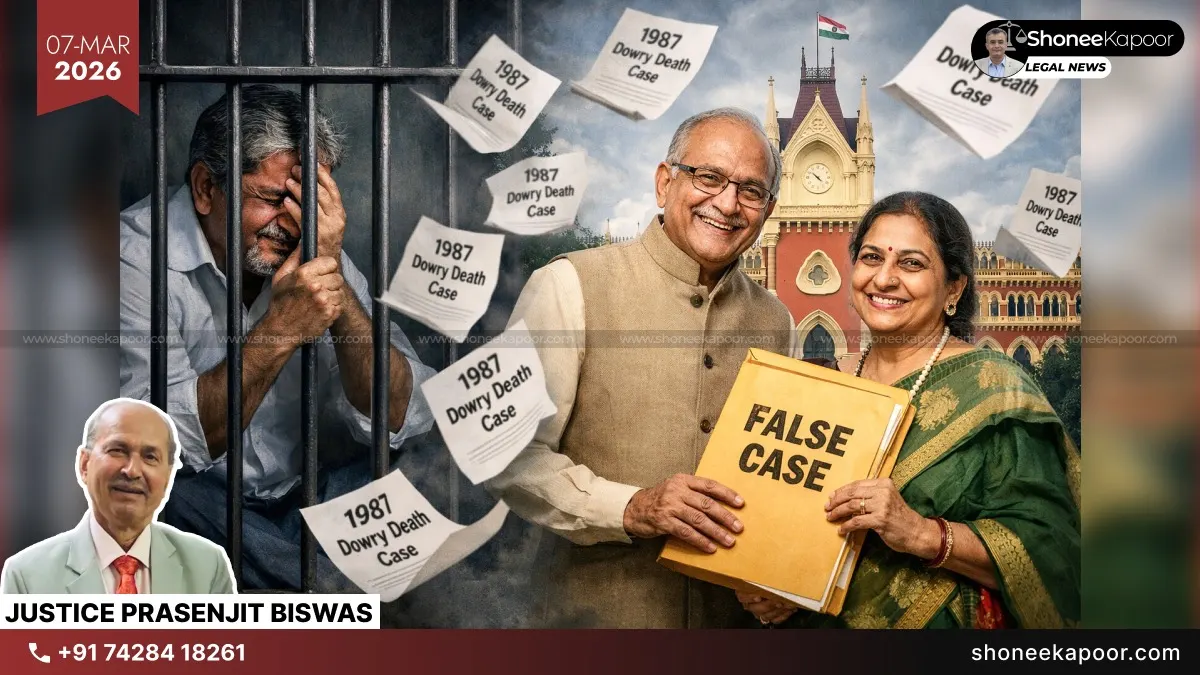
1987 Dowry Death Case | “Wife’s Family’s Unnatural Silence Raises Doubt”: Calcutta High Court Acquits Husband in 39-Year-Old Case

Written and analysed by Shonee Kapoor
Legal Consultant, Author & Men's Rights ActivistIf a woman was allegedly facing constant dowry harassment, why did her family never complain to police earlier?
The Calcutta High Court raises serious doubts and acquits the husband after finding major contradictions in witness statements.
WEST BENGAL: In an important judgment, the Calcutta High Court has acquitted a husband in a 1987 dowry death case after finding serious weaknesses in the prosecution’s story. The Court held that the allegations of cruelty and abetment of suicide were not proved beyond reasonable doubt. The decision came after the Court noticed major contradictions in witness statements and unexplained delays in filing the complaint.
Justice Prasenjit Biswas observed that statements made by the relatives of the deceased woman during the trial were different from what they had told the police during investigation. These inconsistencies raised serious concerns about the reliability of their claims.
The Court also found the behaviour of the woman’s family unusual. According to the brother of the deceased, who filed the complaint, the woman had told him several times that she was being harassed for dowry. However, despite allegedly knowing about such harassment, he never filed any complaint with the police before her death.
The Court remarked:
“Such inaction on the part of a brother, who claims to have been aware of persistent torture and unlawful demands, appears unnatural and inconsistent with normal human conduct.”
The Court also noted that even after the woman’s death under allegedly suspicious circumstances, the complainant did not immediately submit a written complaint to authorities.
“The absence of prompt action raises serious doubt regarding the veracity of his version.”
Another issue highlighted by the Court was the delay in starting criminal proceedings. The complaint was filed before the Magistrate several days after the incident, and the prosecution failed to provide a convincing explanation for this delay.
The Court also examined the statements of the deceased woman’s parents and sister-in-law and found important omissions in their testimonies.
The Investigating Officer informed the Court that during the investigation these witnesses never stated that the accused had tortured the deceased or demanded additional dowry.
The Court held that such missing details seriously weaken the prosecution case and observed:
“When crucial facts are absent in the statement made during investigation but are later introduced in Court, they assume the character of afterthoughts and cannot be accepted without caution.”
The Court further considered the conduct of the woman’s family members. Even though they claimed they knew about repeated harassment and demands for money, none of them approached the police or any local authority while the woman was alive.
The Court said such silence did not match normal parental behaviour if a daughter was really facing continuous cruelty.
The case started with a complaint filed by the deceased woman’s brother. He alleged that his sister was harassed and tortured by her husband and mother-in-law for additional dowry.
According to the prosecution, the woman married the first accused in 1986. After the marriage, it was claimed that the husband and his family demanded more money from her parental home and allegedly subjected her to cruelty when the demands were not fulfilled.
On July 31, 1987, the woman died by hanging in her matrimonial house. The prosecution argued that the continuous harassment forced her to take this extreme step.
Earlier, the trial court had convicted the husband and his mother under Sections 498A (cruelty by husband or relatives) and 306 (abetment of suicide) of the Indian Penal Code and sentenced them to seven years of rigorous imprisonment.
However, during the appeal proceedings, the mother-in-law passed away and the case against her was closed. After reviewing the evidence and the conduct of witnesses, the High Court concluded that the prosecution had failed to prove the charges against the husband beyond reasonable doubt, leading to his acquittal.
Explanation Table Of Laws And Sections Involved
| Law / Section | Legal Provision | Meaning In Simple Terms | Relevance In This Case |
| Section 498A IPC | Cruelty by Husband or Relatives | Punishes husband or his family if they subject a woman to cruelty, harassment, or dowry demands | Trial court convicted husband and mother-in-law under this section alleging dowry harassment |
| Section 306 IPC | Abetment of Suicide | Applies when someone intentionally instigates, helps, or encourages another person to commit suicide | Prosecution claimed harassment forced the woman to commit suicide |
| Section 107 IPC | Definition of Abetment | Defines abetment as instigation, conspiracy, or intentional aid to commit an offence | High Court examined this section to determine whether the accused actually instigated suicide |
| Section 437A CrPC | Bail to appear before higher courts | Requires accused to execute bail bonds after acquittal so they can appear if appeal is filed | Court directed the acquitted appellant to furnish bail bonds after judgment |
| Section 483 BNSS 2023 | Equivalent provision to Section 437A CrPC | Modern procedural requirement ensuring presence of accused in appellate proceedings | Mentioned while directing bail bonds after acquittal |
Key Observations From The High Court
| Issue | Court’s Finding |
| Family’s Conduct | Court found the brother’s failure to complain earlier about alleged harassment to be unnatural |
| Delay In Complaint | Complaint was filed several days after the death without convincing explanation |
| Witness Statements | Major omissions between investigation statements and court testimony |
| Independent Evidence | No strong independent proof of cruelty or dowry demand |
| Medical Evidence | Post-mortem report was not exhibited, weakening prosecution case |
| Abetment Requirement | No evidence showing direct instigation or intention to drive the woman to suicide |
Case Details
| Particular | Details |
| Court | Calcutta High Court |
| Jurisdiction | Criminal Appellate Jurisdiction – Appellate Side |
| Bench | Justice Prasenjit Biswas |
| Case Title | Purna Chandra Raul & Anr. vs The State of West Bengal |
| Case Number | C.R.A. 114 of 1990 |
| Neutral Citation | 2026:CHC-AS:362 |
| Trial Court Judgment Challenged | Judgment dated 08.03.1990 passed by Additional Sessions Judge, Midnapore |
| Sessions Trial | Sessions Trial No. XXII of September, 1988 |
| Originating Case | G.R. Case No. 1166/1987 |
| Hearing Concluded On | 20 February 2026 |
| Judgment Delivered On | 05 March 2026 |
| Appellants | Purna Chandra Raul & Another |
| Respondent | State of West Bengal |
| Counsel for Appellants | Mr. Angshuman Chakraborty, Mr. Niladri Saha, Mr. Subhojit Seth |
| Counsel for State | Mr. Avishek Sinha, Mr. Tirupati Mukherjee |
| Police Station Case | Sabang Police Station Case No. 3 dated 17.08.1987 |
| Result | Conviction set aside and husband acquitted |
| Co-accused Status | Mother-in-law Sarala Rani Raul died during appeal; proceedings abated against her |
Key Takeaways
- Delayed Complaints Can Destroy Justice
The complaint was filed days after the death with no convincing explanation. Yet the man was convicted earlier and had to fight for decades to clear his name. - Family Testimony Alone Is Not Reliable Evidence
The main witnesses were close relatives whose statements changed between investigation and trial, showing how easily narratives can be improved later. - Serious Allegations Without Prior Action Raise Doubts
If the victim was allegedly tortured repeatedly, why did none of the relatives complain to police earlier. The Court rightly called this conduct unnatural. - Basic Evidence Was Missing
Even the post-mortem report was not formally exhibited. Despite such glaring gaps, the trial court still convicted the accused earlier. - Another Example Of How Men Can Be Trapped In Weak Cases
Vague allegations, emotional testimony and procedural lapses nearly ruined a man’s life for decades until the High Court finally applied the standard of proof required in criminal law.
This Could Change Your Case-Get FREE Legal Advice-Click Here!
Disclaimer: The views and opinions expressed in this article are those of the Indian courts and do not necessarily reflect the official policy or position of “ShoneeKapoor.com” or its affiliates. This article is intended for informational and educational purposes only. The content provided is not legal advice, and viewers should not act upon this information without seeking professional counsel. Viewer discretion is advised.
Related Articles

The Law That Forgot Its Sons: How India’s Gender Laws Turn Protection into Persecution
India’s gender laws were designed to protect women — but today, countless innocent men are being destroyed by false c...
Real Court Cases Where False Allegations Backfired On Wife
Real Indian court cases where false 498A, dowry, cruelty and defamatory allegations against husbands backfired, leadi...
Can a ‘girlfriend’ of the husband be implicated under Section 498A?
From landmark Supreme Court rulings to ground-level misuse, this article unpacks how Section 498A defines ‘husband’ a...
Share Your Thoughts
Comments are moderated before publication.