
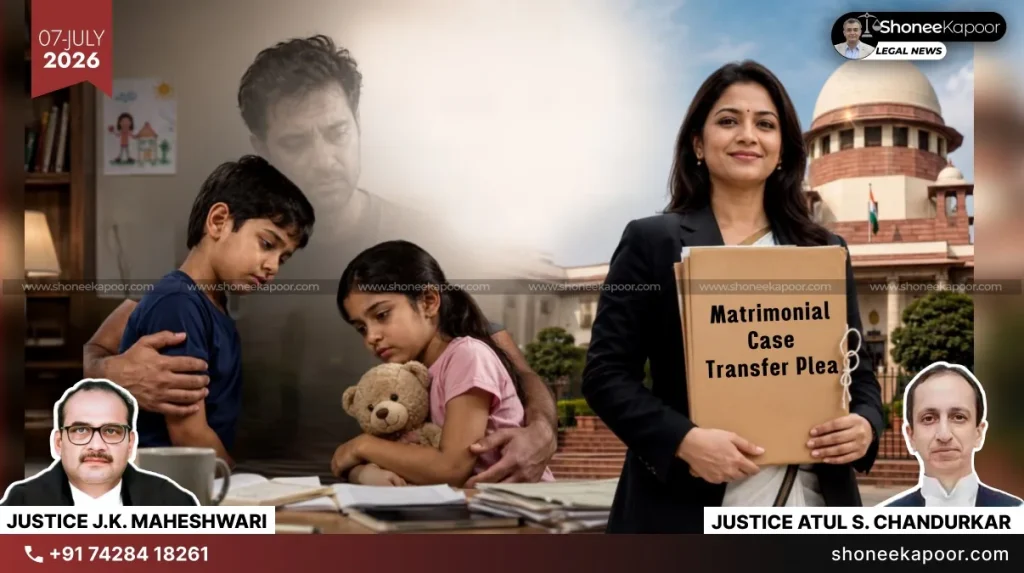
Can a matrimonial case be shifted only for the wife’s convenience when the husband is raising two minor children? Supreme Court said the husband’s hardship and children’s care cannot be ignored.
NEW DELHI: The Supreme Court has set aside the Gujarat High Court order which had transferred a matrimonial case from Ahmedabad to Vadodara on the wife’s request.
The case was between Vipul Chhanganlal Solanki and Nikita Vipul Solanki. The husband had filed a petition under Section 13A of the Hindu Marriage Act, 1955 before the Family Court at Ahmedabad. The wife sought transfer of the case to Vadodara, and the Gujarat High Court allowed her request on July 26, 2024.
The husband challenged this order before the Supreme Court. He argued that he was taking care of the couple’s two minor children, aged 14 years and 5 years. Both children were living with him. According to him, if the case was shifted to Vadodara, he would face serious difficulty in attending every hearing while also managing the children.
The husband also submitted that the wife was a working woman. He pointed out that the distance between Ahmedabad and Vadodara was only about 110 km. He said that this distance could be travelled by the wife without much difficulty. He further argued that she could also join the court proceedings through virtual mode, except when the trial court specifically required her personal appearance.
The wife opposed the appeal. Her counsel argued that the husband could take help from his family members to look after the children. On this ground, it was argued that the husband’s claim of inconvenience should not be accepted.
However, the wife’s counsel did not dispute two important facts. First, the wife was a working woman. Second, the distance between Ahmedabad and Vadodara was about 110 km.
The Supreme Court considered the facts and found that the Gujarat High Court was not justified in transferring the case. The Court noted that the husband was caring for two minor children. If he was required to travel for every hearing, it could cause inconvenience not only to him but also to the children.
A Bench of Justices J K Maheshwari and Atul S Chandurkar held that the husband’s practical difficulty could not be ignored in such a situation. The Court made it clear that transfer of matrimonial cases cannot be allowed mechanically only on the ground of the wife’s convenience, especially when the husband is the parent taking care of minor children.
The Supreme Court allowed the husband’s appeal and set aside the Gujarat High Court’s order. The matrimonial case will now continue before the Family Court at Ahmedabad.
The Court also protected the wife’s participation in the proceedings. It directed that she may attend the case through virtual mode unless the trial court specifically requires her personal presence.
EXPLANATORY TABLE – LAWS & SECTIONS MENTIONED
| LAW / SECTION / PROCEEDING MENTIONED | SIMPLE MEANING | ROLE IN THIS CASE | LEGAL IMPORTANCE |
| Section 13A, Hindu Marriage Act, 1955 | This provision deals with alternate relief in matrimonial proceedings, generally where the Court may grant judicial separation instead of divorce in appropriate cases. | The husband’s matrimonial petition, HMP No. 2582 of 2021, was pending under this section before the Family Court, Ahmedabad. | The main matrimonial case was not decided here; the Supreme Court only examined whether its transfer from Ahmedabad to Vadodara was proper. |
| HMP No. 2582 of 2021 | Hindu Marriage Petition before the Family Court. | This was the husband’s case titled Vipul Chhaganlal Solanki v. Nikita. | The Gujarat High Court had transferred this case from Ahmedabad to Vadodara, which the Supreme Court later set aside. |
| R/Misc. Civil Application (For Transfer) No. 1214 of 2024 | Transfer application filed before the Gujarat High Court. | The wife filed this transfer application seeking shifting of the husband’s matrimonial case to Vadodara. | The High Court allowed it, but the Supreme Court found the transfer improper after considering the husband’s difficulty and children’s care. |
| Special Leave Petition (Civil) No. 12441 of 2025 | Petition filed before the Supreme Court challenging the High Court order. | The husband approached the Supreme Court against the Gujarat High Court’s transfer order dated 26.07.2024. | The Supreme Court granted leave and converted the SLP into a civil appeal. |
| Civil Appeal No. ___ of 2026 | Appeal before the Supreme Court after leave was granted. | The husband’s challenge was heard as a civil appeal. | The Supreme Court allowed the appeal and restored the case before the Family Court, Ahmedabad. |
| Virtual Mode / Video Participation | Court proceedings attended online. | The Supreme Court permitted the wife to participate virtually unless the trial court specifically required her physical presence. | This balanced both sides: the wife was not forced to attend every date physically, while the husband raising minor children was protected from unnecessary travel hardship. |
CASE DETAILS
| DETAIL | INFORMATION |
| Court | Supreme Court of India |
| Jurisdiction | Civil Appellate Jurisdiction |
| Case Title | Vipul Chhanganlal Solanki v. Nikita Vipul Solanki |
| Appellant / Petitioner | Vipul Chhanganlal Solanki |
| Respondent | Nikita Vipul Solanki |
| Case Number | Civil Appeal No. ___ of 2026, arising out of SLP (C) No. 12441 of 2025 |
| Impugned Order | Gujarat High Court order dated 26.07.2024 in MCA No. 1214 of 2024 |
| Original Case Transferred By High Court | HMP No. 2582 of 2021 under Section 13A of the Hindu Marriage Act, 1955 |
| Original Court | Family Court, Ahmedabad |
| Transferred To By High Court | Vadodara |
| Supreme Court Final Result | Appeal allowed; High Court transfer order set aside |
| Date of Order / Judgment | January 12, 2026 |
| Bench | Justice J.K. Maheshwari and Justice Atul S. Chandurkar |
| For Petitioner / Husband | Mr. Hemal Kiritkumar Sheth, AOR; Mr. Vicky B. Mehta, Advocate; Mr. Suraj Singh, Advocate |
| For Respondent / Wife | Mr. Chandrashekhar A. Chakalabbi, Advocate; Mr. Varnik Kundaliya, Advocate; M/s Dharmaprabhas Law Associates, AOR |
KEY TAKEAWAYS
- Husband’s hardship matters: The Supreme Court recognised that the husband was taking care of two minor children, aged 14 and 5, and travel for court dates could prejudice him and the children.
- Wife’s convenience cannot be automatic: The wife was a working woman and the distance from Ahmedabad to Vadodara was only about 110 km, which was not denied.
- Father is also a caregiver: This case breaks the usual one-sided assumption that only women face inconvenience in matrimonial litigation.
- Virtual hearing balanced the case: The Court allowed the wife to appear virtually unless personal presence was specifically required, instead of forcing the father to travel repeatedly.
- Brutal truth: Men fight cases, raise children, manage work, and still their inconvenience is often treated as secondary. Here, the Supreme Court corrected that imbalance.
This Could Change Your Case-Get FREE Legal Advice-Click Here!
Disclaimer: The views and opinions expressed in this article are those of the Indian courts and do not necessarily reflect the official policy or position of “ShoneeKapoor.com” or its affiliates. This article is intended for informational and educational purposes only. The content provided is not legal advice, and viewers should not act upon this information without seeking professional counsel. Viewer discretion is advised.