Father Begging In Court With Folded Hands To Save Son’s Career: Supreme Court Considers Apology

Curated by NEWS DESK
Editorial DeskThe Supreme Court showed humanitarian concern and urged a medical university to consider a young doctor’s apology after nine years of career stagnation over a minor exam violation. The Court held that further damage to his career would be excessive and unfair.
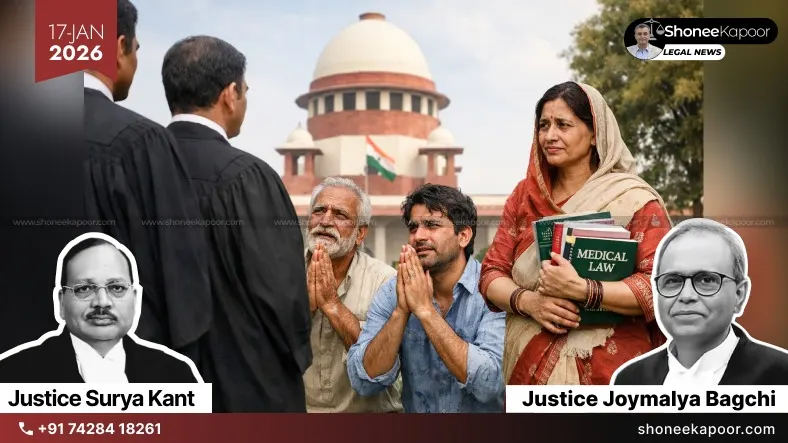
Father Begging To Save Son’s Career:: In a deeply human moment inside the courtroom, the Supreme Court of India allowed a young doctor to submit an unconditional apology to his medical university after he was found wearing a digital watch during an examination in 2017. At the same time, the Court requested the university to consider his plea with “utmost sympathy” and make an effort to save his professional career, which has remained stalled for nearly nine years.
The Court clearly noted that the long professional setback faced by the doctor was already a heavy price for a relatively minor lapse. It observed that the son’s nine-year exclusion from higher studies was “a more than sufficient punishment having regard to the nature of the misdemeanours,” and warned that permanently blocking his career would be “too harsh and disproportionate.”
The Bench comprising Justice Surya Kant and Justice Joymalya Bagchi passed strong observations while acknowledging the emotional distress of the family.
The Court said:
“At the end of the day, there is a father standing in court with folded hands, trying to save the academic career of his son, in whose MBBS degree, it appears that the University has made some adverse remarks based upon the history of adopting unfair means.
The sheer frustration caused due to the inability of his son to pursue higher studies, is seemingly prompting the first petitioner, seemingly has brought negativity and is instigating the first petitioner to file complaints here and there.
While we do not find any merit in those complaints, within the scope of interference under Article 137 of the Constitution, and consequently, we see no ground to interfere with the imprinted order passed by the Bar Council of India…”
The case dates back to February 2017, when the petitioner’s son, a medical student at Sri Ramachandra Medical College, Chennai, was found wearing a digital wristwatch during an examination. Under the university’s strict rules on “unfair means,” his exam was cancelled. Although he later cleared the required papers, the incident continued to follow him, leaving adverse remarks on his MBBS record and blocking his admission to higher specialised medical courses.
Over the years, the family pursued multiple legal remedies. They lost before the High Court, and later, their Review and Curative petitions were also dismissed by the Supreme Court. Despite repeated efforts, the professional future of the young doctor remained uncertain, leading to prolonged mental, emotional, and financial strain on the family.
In the latest round of proceedings, the father appeared in person before the Court and alleged a larger conspiracy. He claimed involvement of “polluted counsels” and “fabricated documents” and accused legal representatives of withdrawing cases without his consent. He further argued that the Bar Council of India failed to properly investigate these allegations.
While the Court did not accept these claims and refused to reopen settled issues, it chose not to burden the medical college with further litigation.
The Court recorded:
“We are conscious of the fact that Ramchandra Medical College and Research Institute, Purur, Chennai, has not been called or heard at this stage. It is so only to avoid them to be burdened with litigation expenses, especially when we are not passing an order of irreversible adverse impact on the functioning of the college.
So, all that we observe is that Petition No. 2, for that matter, even his father, Dr. M. Subramanian, Petition No. 1, to tender an unconditional apology to the university along with an application for expunsion of the adverse marks said to have been recorded in the marksheet of MBBS degree.
We request the medical college to consider such a representation with utmost sympathy and with an endeavour to save the professional career of a young doctor.The amendments in favour of the petitioners, it shall be highly appreciated if a favourable order is passed at the earliest and preferably within one month from the date of submission of the representation.”
The Court made it clear that it would not revisit the merits of the original disqualification or the already dismissed curative petition. However, it shifted focus to a humanitarian approach, recognising that the punishment had far exceeded the gravity of the act. A single incident involving a digital watch had resulted in nearly a decade of professional stagnation, which the Court found deeply concerning.
Emphasising proportionality and fairness, the Court further observed:
“However, it seems to us that the first petitioner, as well as his son, have suffered enough on account of the misdemeanours committed by Petitioner No. 2 while he was appearing in the examination held on 23rd February 2017.
The multiple rounds of unsuccessful litigation, coupled with the fact that Petition No. 2 has not been able to seek admission to higher specialised courses for almost nine years, is a more than sufficient punishment having regard to the nature of the misdemeanours attributed to him, his son, attributed to the second petitioner.
If his professional career as a doctor is permanently blocked, which is bound to happen if there are adverse marks in his degree issued by the medical college, such a punishment will become too harsh and disproportionate to the proven misconduct.”
With these observations, the Supreme Court disposed of the matter, leaving it to the medical university to take a compassionate call. The case quietly highlights how rigid systems, prolonged litigation, and institutional remarks can silently destroy a young man’s career, while families are left to fight for years just to restore dignity, opportunity, and a chance to move forward.
Explanatory Table – Laws & Sections Referred In The Case
| Law / Provision | Purpose | How It Appears In This Case |
| Constitution of India – Article 137 | Power of the Supreme Court to review its own judgments | The Court declined to reopen the matter under its limited review jurisdiction |
| University / Examination Regulations on “Unfair Means” | Maintain exam discipline and integrity | Used to cancel the exam and record adverse remarks for wearing a digital watch |
| Professional / Academic Discipline Principles | Ensure proportional punishment | Court assessed whether the penalty was excessive compared to the misconduct |
| Principles of Proportionality (Judicial Doctrine) | Punishment must match the gravity of misconduct | Applied to hold that nine years of career damage was disproportionate |
| Bar Council of India Disciplinary Framework | Regulates conduct of legal professionals | Allegations raised by petitioner against counsels were examined and rejected |
Case Details
- Court: Supreme Court of India
- Case Title: Dr. M. Subramanian and Anr. v. S. Thankasivan and Anr.
- Diary Number: 64972 of 2025
- Bench: Justice Surya Kant & Justice Joymalya Bagchi
- Medical Institution Involved: Sri Ramachandra Medical College, Chennai
- Status: Matter disposed of.
Key Takeaways
- A minor exam lapse was allowed to destroy a young man’s medical career for nearly nine years, showing how institutions punish men far beyond proportional limits.
- The Supreme Court clearly acknowledged that prolonged career blockage itself becomes an unjust punishment, even without reopening the original case.
- Endless litigation drained the family emotionally and financially, exposing how systems often ignore the human cost borne by fathers and sons.
- Adverse academic remarks can silently kill a man’s future more effectively than any formal conviction.
- Justice must balance discipline with compassion, or else rules turn into tools of lifelong exclusion for men.
This Could Change Your Case-Get FREE Legal Advice-Click Here!
Disclaimer: The views and opinions expressed in this article are those of the Indian courts and do not necessarily reflect the official policy or position of “ShoneeKapoor.com” or its affiliates. This article is intended for informational and educational purposes only. The content provided is not legal advice, and viewers should not act upon this information without seeking professional counsel. Viewer discretion is advised.
Related Articles
Delhi’s Crime Drop Didn’t Happen by Chance: How Our Men’s Rights Legal Activism Challenging Misuse, Forced Policing Reform (2024–2025)
Delhi’s improved crime metrics followed sustained legal pressure through RTIs, police engagement, and strategic litig...
Share Your Thoughts
Comments are moderated before publication.