
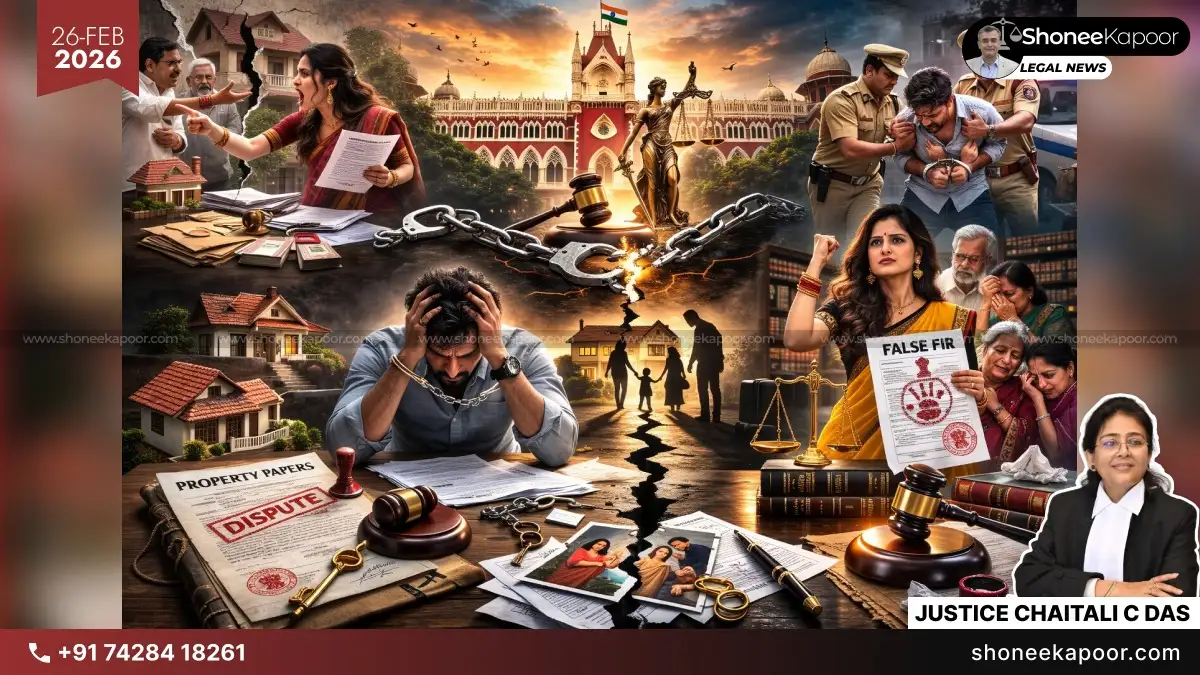
Family Property Disputes Turn Into False Criminal Cases Against Cousin: Calcutta High Court Exposes How Laws Can Be Misused Against Men

Curated by NEWS DESK
Editorial DeskCan criminal cases be filed to settle family property fights? Calcutta High Court steps in after finding vague allegations against men by female cousin with no clear evidence.
KOLKATA: The Calcutta High Court has set aside a criminal case filed in what was essentially a family property dispute, making it clear that criminal law cannot be misused to put pressure in civil matters.
The Court quashed defamation, insult and intimidation charges against a male private company executive after finding that the complaint did not disclose the basic ingredients required under the IPC.
Justice Chaitali Chatterjee Das observed that the allegations were vague and did not mention specific dates, times, places or exact words. The Court held that criminal proceedings cannot continue when there is no clear criminal intent shown from the complaint.
The matter came before the Court under Section 482 CrPC on a petition filed by Avijit Singha Roy. He sought quashing of a charge sheet filed under Sections 500 (defamation), 504 (intentional insult), 506 (criminal intimidation) and 509 (insult to modesty of a woman) IPC. The case was pending before the Chief Judicial Magistrate, Hooghly.
The petitioner, an employee of Hewlett Packard Enterprise, argued that the criminal case was a “counter blast” to several civil disputes and partition suits pending between the families regarding ancestral property.
The complainant, who is the petitioner’s cousin and a government officer, had alleged that he abused, threatened and stalked her, causing mental trauma during her pregnancy and damaging her reputation. She claimed verbal insults and harassment affecting her dignity. Based on these allegations, an FIR was registered and a charge sheet was later filed.
However, the petitioner submitted that the dispute was purely civil in nature and that the complaint was filed to harass him during ongoing property litigation. He pointed out that the FIR did not mention any specific incident, date, time, place or the exact words allegedly spoken. Relying on Supreme Court judgments, he argued that general and omnibus allegations cannot amount to offences such as defamation or criminal intimidation.
After examining the complaint and the case diary, the High Court found that the allegations were general and lacked concrete details. The witness statements also failed to mention any specific defamatory words or gestures that could amount to insult or intimidation. The Court noted that for offences under Sections 499 and 509 IPC, there must be clear imputations or gestures intended to harm reputation or insult modesty. Such essential elements were missing in this case.
The Court also considered the long-standing property dispute and multiple civil proceedings between the parties. It clarified that while the existence of a civil suit does not automatically bar criminal proceedings, a purely civil dispute cannot be given a criminal colour.
Referring to the principles laid down in State of Haryana v. Bhajan Lal, the Court held that when allegations, even if accepted at face value, do not disclose any offence, the High Court can use its inherent powers to prevent abuse of the legal process.
Finding no prima facie material to support the charges, the Court allowed the petition and quashed the entire criminal proceeding pending before the Magistrate.
The judgment reinforces an important principle: criminal law cannot be used as a weapon in family property disputes, especially when allegations are vague and unsupported by specific evidence.
Explanatory Table Of All Laws And Sections Involved
| Law / Section | Provision | What It Means in Simple Terms | Court’s Observation in This Case |
| Section 482 CrPC | Inherent powers of High Court | High Court can quash proceedings to prevent abuse of process or secure justice | Court used this power to quash the criminal case |
| Section 500 IPC | Punishment for defamation | Punishes harm to reputation through defamatory statements | No specific defamatory words or intent were shown |
| Section 504 IPC | Intentional insult to provoke breach of peace | Insult must be intentional and capable of provoking disturbance | Allegations lacked specific words, date, or clear provocation |
| Section 506 IPC | Criminal intimidation | Threat must create alarm with clear intent | No concrete material showing real criminal intimidation |
| Section 509 IPC | Word/gesture insulting modesty of a woman | Requires clear words/gesture intended to insult modesty | Essential ingredients not established |
| Section 499 IPC | Definition of defamation | Requires imputation made with intent to harm reputation | Complaint failed to show clear imputation or mens rea |
| Section 144 CrPC | Urgent cases of nuisance or apprehended danger | Executive order to prevent disturbance | Mentioned in background civil disputes |
| Section 164 CrPC | Recording of confession/statement | Statement before Magistrate during investigation | Statement recorded, but still insufficient material found |
| State of Haryana v. Bhajan Lal (1992 Supp (1) SCC 335) | Landmark quashing guidelines | If allegations do not disclose offence, proceedings can be quashed | Relied upon to prevent abuse of process |
| Subramaniam Swamy v. Union of India (2016) 7 SCC 221 | Clarified ingredients of defamation | Mens rea and harm to reputation are essential | Applied to assess absence of criminal intent |
| Nagawwa v. Veeranna Shivalingappa Konjalgi (1976) 3 SCC 736 | Grounds to quash complaint | If allegations are absurd or do not disclose offence | Principles followed |
| Kamala Devi Agarwal v. State of West Bengal (2001) 7 SCC 627 | Civil suit not automatic bar to criminal case | But allegations must still disclose offence | Distinguished in present facts |
Case Details
- Court: High Court at Calcutta, Criminal Revisional Jurisdiction, Appellate Side
- Bench: Hon’ble Justice Chaitali Chatterjee Das
- Case Title: AVIJIT SINGHA ROY VS THE STATE OF WEST BENGAL & ANR.
- Case Number: CRR 1577 OF 2023
- Neutral Citation: 2026:CHC-AS:324
- Last Heard On: 19.12.2025
- Judgment Delivered On: 24.02.2026
- Uploaded On: 24.02.2026
- Counsel for Petitioner:
- Mr. Akashdeep Mukherjee, Adv.
- Mr. Soumyadeep Nag, Adv.
- Mr. Satyam Pandey, Adv.
- Counsel for State:
- Mr. Sabir Ahmed, Adv.
- Mr. Bhaskar Hutait, Adv.
- Mr. Dhiman Banerjee, Adv.
- Mr. Quasi Ezaz Ahmed, Adv.
Key Takeaways
- Vague and omnibus allegations, without specific dates, words or incidents, are often used to convert a civil family dispute into a criminal prosecution.
- Serious sections like defamation, criminal intimidation and insult to modesty cannot be invoked casually; they require clear ingredients, intent and evidence.
- In this case, despite claims of harassment and mental trauma, the complaint failed to disclose any concrete imputation or specific act, exposing how loosely criminal provisions can be invoked.
- The High Court reaffirmed that when allegations, even if accepted at face value, do not make out an offence, proceedings must be quashed to prevent abuse of process.
- This judgment sends a message that criminal law cannot be used as a pressure tool in family property disputes—especially when a man is targeted amid ongoing civil litigation.
This Could Change Your Case-Get FREE Legal Advice-Click Here!
Disclaimer: The views and opinions expressed in this article are those of the Indian courts and do not necessarily reflect the official policy or position of “ShoneeKapoor.com” or its affiliates. This article is intended for informational and educational purposes only. The content provided is not legal advice, and viewers should not act upon this information without seeking professional counsel. Viewer discretion is advised.
Related Articles
How to Fight a 498A Case: Complete Legal Guide for Innocent Husbands Facing False Accusations
This detailed legal article explains step-by-step how an innocent husband can defend himself against a false Section ...
498A का सच: झूठे मामलों में गिरफ्तारी नहीं, सुप्रीम कोर्ट ने पुरुषों की स्वतंत्रता पर खींची लाल रेखा
धारा 498A के नाम पर बिना जांच गिरफ्तारी ने हजारों निर्दोष पुरुषों और परिवारों की जिंदगी तबाह की है। सुप्रीम कोर्ट ने ...
Share Your Thoughts
Comments are moderated before publication.