
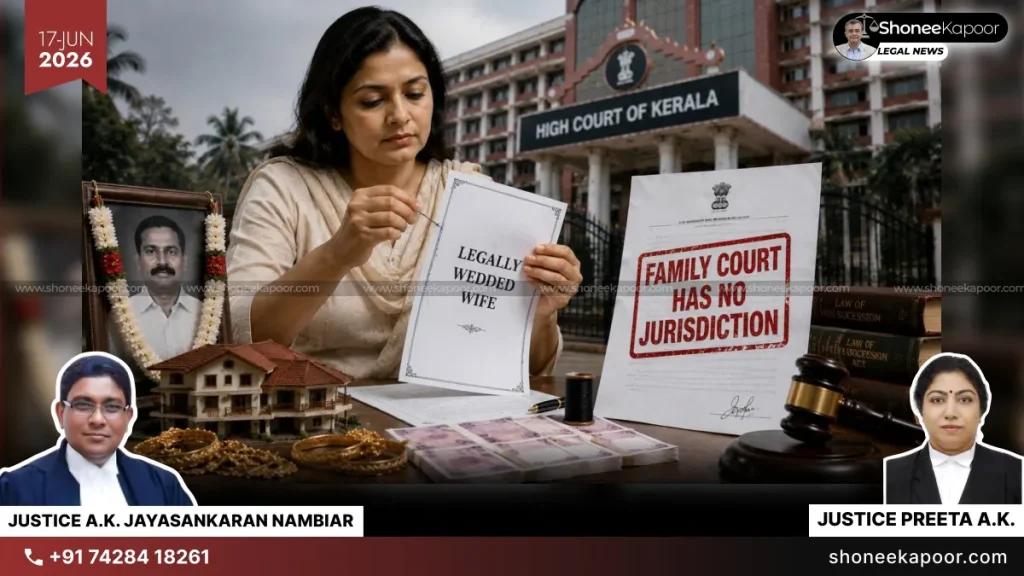
The Kerala High Court clarified that Family Courts adjudicate disputes arising from existing marital and family relationships between living persons, while inheritance disputes must be decided by civil courts.
ERNAKULAM: The Kerala High Court, through Justice A.K. Jayasankaran Nambiar and Justice Preeta A.K., has held that a Family Court cannot decide disputes relating to marital status when the alleged husband had already died before the case was filed.
The case was filed by a woman claiming that she was the legally wedded wife of late Sasikumar. She sought a declaration of her marital status and also claimed a share in his properties. She alleged that another woman and her children were claiming rights over the deceased man’s assets.
The respondents challenged the maintainability of the petition and argued that since Sasikumar had died before the case was filed, the dispute was no longer a family dispute but a civil dispute concerning property and inheritance rights.
The Family Court accepted this objection and directed the woman to approach a civil court. She then challenged that order before the Kerala High Court.
After examining the Family Courts Act and earlier Supreme Court judgments, the High Court agreed with the respondents. The Court observed that a dispute arising after the death of a spouse “cannot be viewed as a ‘family dispute'” and would instead-
“Retain the character of a civil dispute simpliciter that has to be adjudicated by a civil court of competent jurisdiction.”
The Bench further noted that the petition was filed mainly to obtain rights in the deceased man’s property and that-
“The declqaration of marriage sought for was merely to bolster the appellant’s principal claim for a share in the said property.”
The Court also clarified that the provisions relating to the validity of marriage and matrimonial status under the Family Courts Act apply to a subsisting marital relationship. According to the Bench, Family Courts are meant to decide disputes arising in:
“A subsisting relationship between live persons.”
The Court held that:
“A dispute that arises at a point in time when one of the parties to the marriage, whether actual or alleged, is no more, cannot be presented before a Forum that is tasked with adjudicating disputes that arise in a subsisting relationship between live persons.”
Accordingly, the Kerala High Court dismissed the appeal and upheld the order returning the case to the civil court. However, it protected the appellant by directing that the time spent before the Family Court and High Court should be excluded while calculating limitation for any civil suit she may file in the future.
EXPLANATORY TABLE: LAWS AND SECTIONS INVOLVED
| Law / Provision | Purpose | How It Was Applied In This Case |
| Section 7(1), Family Courts Act, 1984 | Defines jurisdiction of Family Courts | Court examined whether the dispute fell within Family Court jurisdiction |
| Explanation (b) to Section 7(1), Family Courts Act, 1984 | Covers declaration regarding validity of marriage and matrimonial status | Court held it applies only to subsisting marital relationships between living persons |
| Section 8, Family Courts Act, 1984 | Excludes jurisdiction of Civil Courts in matters assigned to Family Courts | Appellant relied on it to argue Family Court jurisdiction |
| Section 20, Family Courts Act, 1984 | Gives overriding effect to the Act | Appellant cited it to support exclusive Family Court jurisdiction |
| Order IX Rule 7, Code of Civil Procedure, 1908 | Allows setting aside ex parte proceedings | Respondents invoked this provision to re-enter proceedings and challenge maintainability |
CASE DETAILS
- Case Title: Renuka Kumari v. Pradeep Kumar & Another
- Case Number: Mat. Appeal No. 194 of 2026
- Court: Kerala High Court at Ernakulam
- Neutral Citation: 2026:KER:41503
- Date of Judgment: 11 June 2026
- Bench: Justice A.K. Jayasankaran Nambiar | Justice Preeta A.K.
- Counsels:
- For Appellant: D. Kishore, Meera Gopinath, R. Muraleekrishnan and Anant Kishore.
- For Respondents: Arun V.G., R. Harikrishnan and Neeraj Narayan.
KEY TAKEAWAYS
- Property disputes cannot be converted into family disputes merely by claiming marriage after the husband’s death.
- Family Courts exist to resolve disputes between living spouses, not inheritance battles after one spouse has passed away.
- A claim of being a legally wedded wife does not automatically give Family Court jurisdiction when the real dispute concerns property rights.
- Men’s estates and succession rights cannot be bypassed through Family Court proceedings once the alleged husband is no longer alive.
- Inheritance claims must follow proper civil law procedures instead of using matrimonial proceedings as a shortcut.
This Could Change Your Case-Get FREE Legal Advice-Click Here!
Disclaimer: The views and opinions expressed in this article are those of the Indian courts and do not necessarily reflect the official policy or position of “ShoneeKapoor.com” or its affiliates. This article is intended for informational and educational purposes only. The content provided is not legal advice, and viewers should not act upon this information without seeking professional counsel. Viewer discretion is advised.