
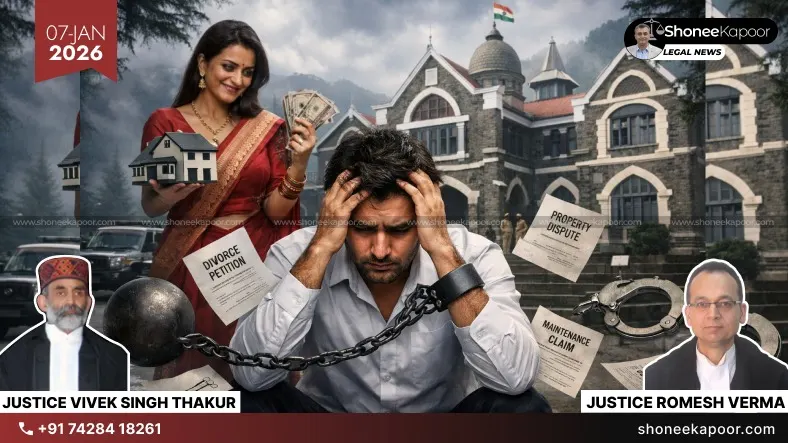
HP High Court: Family Court Can Decide Stridhan & Property Disputes Even After Divorce Decree | Big Relief For Husbands Facing Multiple Cases

Curated by NEWS DESK
Editorial DeskHimachal Pradesh High Court ruled that Family Courts retain jurisdiction to decide stridhan and matrimonial property disputes even after divorce, to avoid parallel litigation. Once again, property battles will stay inside Family Courts — reinforcing how post-divorce financial disputes continue to haunt men long after marriage ends.
Himachal Pradesh: Major clarification on matrimonial property rights has been delivered by the Himachal Pradesh High Court. The case arose when the wife filed an application under Section 27 of the Hindu Marriage Act seeking return of her property, istridhan, gifts and other articles.
Although the divorce had already been granted ex-parte earlier, the Family Court dismissed her property application, stating that once a divorce decree is passed and no property order is included, no independent order can be passed later and that the Family Court lacked jurisdiction to entertain such an application.
The High Court clearly rejected this narrow thinking. It examined the purpose and scope of the Family Courts Act and held that Family Courts exist precisely to avoid forcing parties, especially men already ruined by litigation, into multiple legal battles.
The Court explained that Section 27 of the Hindu Marriage Act states that “Court may make such provisions in the decree” regarding property and applies to property “which may belong jointly to both the husband and the wife”. The use of the word “may” shows that passing a property order along with divorce is discretionary and not mandatory. This means that failure to pass such an order at the time of divorce does not take away the court’s power later.
More importantly, the High Court emphasized that under the Family Courts Act, the Family Court has full authority to decide disputes relating to property of spouses. It relied on the statutory mandate that the Family Court shall have jurisdiction over “a suit or proceeding between the parties to a marriage with respect to the property of the parties or of either of them”.
The judgment highlights that Section 7 of the Family Courts Act gives wide jurisdiction to Family Courts, while Section 8 bars other civil courts from entertaining such disputes. Further, Section 20 makes it clear that the Family Courts Act has overriding effect over other laws. This legal structure exists to protect litigants, especially men who otherwise suffer repeated harassment through fragmented litigation.
The Court categorically held that merely because the marriage already stands dissolved, the Family Court cannot wash its hands of property disputes. Doing so would force parties, most often men, to file fresh civil suits, increasing financial burden, mental stress, and legal harassment.
The High Court also clarified that even if an application mentions only Section 27 of the Hindu Marriage Act, the Family Court must still adjudicate it fully, keeping in mind its wider powers under the Family Courts Act. This interpretation ensures that men are not denied justice due to technical drafting or procedural games.
Importantly, the Court noted that property disputes may include not only alleged istridhan but also gifts, joint property, or articles belonging exclusively to one spouse. These issues require evidence and proper adjudication and cannot be dismissed at the threshold.
Setting aside the Family Court’s order, the High Court remanded the matter back for fresh decision on merits. It directed that evidence be recorded and the dispute be decided according to law. The Court further clarified that any decree passed on property issues would be treated as part of the divorce decree already granted.
This judgment recognises that men are often treated as expendable in matrimonial litigation, expected to walk away silently after divorce while facing endless property and financial claims. The ruling restores balance by reaffirming that legal closure must be complete and fair, not selective.
In simple terms, divorce does not mean a man loses his right to property justice. Family Courts cannot escape responsibility. Men, already emotionally vulnerable after marital breakdown, deserve one forum, one fair hearing, and one final decision — not endless legal punishment disguised as procedure.
This judgment strengthens the principle that justice should reduce suffering, not multiply it.
Explanatory Table: Laws and Sections Involved
| Law/Statute and Section | Purpose | Relevance in This Case |
| Section 13(1)(ia) Hindu Marriage Act, 1955 | Divorce on ground of cruelty. | Divorce between parties was granted under this provision. |
| Section 27 Hindu Marriage Act, 1955 | Court may decide disposal of marriage-related property. | Wife sought return of property and istridhan under this section. |
| Section 7(1) Family Courts Act, 1984 | Gives Family Court jurisdiction over matrimonial and property disputes. | High Court confirmed Family Court has power to decide property disputes. |
| Section 7 Explanation (c) Family Courts Act, 1984 | Covers property disputes between spouses. | Justifies Family Court’s exclusive jurisdiction. |
| Section 8 Family Courts Act, 1984 | Bars civil courts once Family Court exists. | Prevents multiple parallel cases. |
| Section 20 Family Courts Act, 1984 | Family Courts Act overrides other laws. | Ensures Family Court power prevails over technical objections. |
| Chapter IX / X Criminal Procedure Code / Bharatiya Nagarik Suraksha Sanhita | Deals with maintenance jurisdiction. | Cited while explaining Family Court scope. |
| Supreme Court – Balkrishna Ramchandra Kadam (1997) | Recognised wide Family Court powers. | Supported jurisdiction argument. |
| Supreme Court – Balram Yadav (2016) | Clarified Family Court authority in matrimonial disputes. | Strengthened appellate reasoning. |
Case Summary
- Case Title: Astha Thakur vs. Dhananjay Kanwar, FAO(FC) No. 29 of 2022
- Court: High Court of Himachal Pradesh, Shimla
- Dates
- Judgment Reserved on: 17.12.2025
- Judgment Decided on: 31.12.2025
- Bench: Hon’ble Mr. Justice Vivek Singh Thakur and Hon’ble Mr. Justice Romesh Verma
Counsels
- For the Appellant: Mr. Vikrant Thakur, Advocate
- For the Respondent: Mr. Bhupender Gupta, Senior Advocate with Mr. Pranjal Munjal, Advocate
Key Takeaways
- Divorce does not mean open-ended property harassment against men.
- Family Court alone has power to decide all property disputes between spouses.
- No fresh civil cases can be forced on husbands after divorce.
- Section 27 HMA is discretionary, not a weapon for endless litigation.
- Law prioritises finality and protects men from multiple forum abuse.
This Could Change Your Case-Get FREE Legal Advice-Click Here!
Disclaimer: The views and opinions expressed in this article are those of the Indian courts and do not necessarily reflect the official policy or position of “ShoneeKapoor.com” or its affiliates. This article is intended for informational and educational purposes only. The content provided is not legal advice, and viewers should not act upon this information without seeking professional counsel. Viewer discretion is advised.
Related Articles
Chef Kunal Kapur Divorce Case: Inside the Courtroom Battle, Allegations, and the Legal Victory That Redefined Matrimonial Cruelty
Celebrity chef Kunal Kapur fought a long and intense courtroom battle to prove mental cruelty.The Delhi High Court’s ...
How to Fight False Child Alienation by Mother in India: Legal Strategy for Fathers
False child alienation is a silent form of psychological abuse where children are turned against loving fathers using...
Share Your Thoughts
Comments are moderated before publication.