
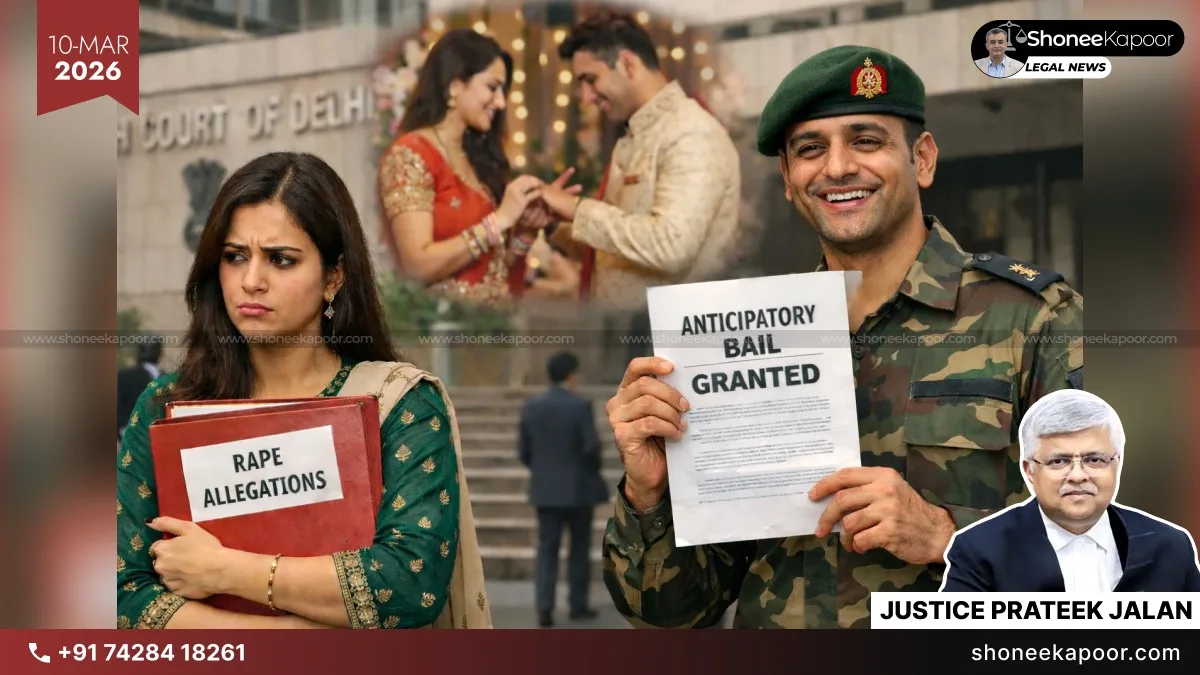
False Rape Allegation After Failed Relationship: Delhi High Court Grants Anticipatory Bail to Army Officer, Notes Roka Ceremony and 5-Year Association Supporting Man’s Case

Written and analysed by Shonee Kapoor
Legal Consultant, Author & Men's Rights ActivistGranting anticipatory bail to an Army officer in a false promise of marriage rape case, the Delhi High Court noted the long relationship and Roka ceremony between the parties, while also observing that such allegations require careful scrutiny and must be supported by credible evidence.
NEW DELHI: In a recent order dealing with allegations arising out of a failed relationship, the Delhi High Court granted anticipatory bail to Army personnel accused of rape on the alleged false promise of marriage.
Justice Prateek Jalan passed the order in a case registered at Police Station Khajuri Khas, Delhi, under Sections 376(2)(n) and 506 IPC.
According to the prosecution, the accused and the woman came into contact in 2021 through Instagram, where she ran an online cosmetics and garments business. They became friends and remained in a relationship for several years. The woman later alleged that the accused established physical relations with her on the promise of marriage and continued meeting her during his Army leave.
The complaint also stated that the couple performed a roka or engagement ceremony and their marriage was allegedly planned for a later date, but the dispute began when the accused allegedly refused to marry her.
While examining the matter, the High Court noted that the relationship between the parties had continued for several years and had even reached the stage of engagement ceremonies. The Court also considered earlier communications suggesting that the dispute initially related to the refusal of marriage rather than rape allegations.
Justice Prateek Jalan emphasised that while dealing with an application for anticipatory bail, the Court must balance the seriousness of the allegation with the accused’s right to personal liberty. The Court stated:
“For the purposes of the present case, which concerns an allegation of rape on the false pretext of marriage, the observations of the Supreme Court… provide valuable guidance.”
The Court also pointed out that the relationship between the parties had continued for a considerable period and included engagement ceremonies, which lent prima facie support to the petitioner’s case at the stage of bail.
The Court stated that:
“The fact that the petitioner and the prosecutrix performed pre-marriage rituals, such as the ‘Roka’/engagement ceremony in the course of a long relationship of almost five years, and a physical relationship of almost two years… renders prima facie plausibility to the petitioner’s case.”
Taking into account these circumstances and the absence of any prior criminal record, the Court concluded that the protection of liberty was justified at this stage. The Court therefore granted anticipatory bail to the accused while directing him to cooperate with the ongoing investigation.
Explanatory Table: Laws And Provisions Involved
| Law / Provision | Purpose | How Applied in This Case |
| Section 376(2)(n) IPC | Punishes repeated acts of rape by the same accused on the same woman. | The FIR alleged repeated sexual relations on the false promise of marriage. |
| Section 506 IPC | Deals with criminal intimidation where a person threatens another to cause fear or harm. | The complainant alleged the accused threatened to upload her private photos and ruin her life. |
| Section 183 BNSS | Allows recording of a victim or witness statement before a Magistrate during investigation. | The prosecutrix’s statement supporting the allegations was recorded under this provision. |
| Section 438 CrPC (Anticipatory Bail) | Allows a person to seek bail in anticipation of arrest in a criminal case. | The accused approached the Delhi High Court seeking protection from arrest in the FIR. |
| Non-Bailable Warrants (NBW) | Court orders directing police to arrest a person who fails to appear or cooperate in investigation. | NBWs were issued earlier when the accused allegedly did not join the investigation. |
| NCR (Non-Cognizable Report) | Police record of complaints where immediate arrest or investigation without court permission is not allowed. | An earlier NCR regarding assault was registered before the rape allegation was made. |
Case Details
- Case Title: Vineet Sorout vs State (NCT of Delhi)
- Case Number: Bail Appln. 4593/2025
- Court: High Court of Delhi at New Delhi
- Bench: Justice Prateek Jalan
- Neutral Citation: 2026:DHC:1898
- Dates:
- Judgment Reserved On: 27 February 2026
- Judgment Pronounced On: 3 March 2026
- Counsels:
- For Petitioner: Mr. Abhay Kumar, Mr. Shagun Ruhil, Mr. Karan Chopra
- For State: Ms. Manjeet Arya, Additional Public Prosecutor
- For Prosecutrix: Mr. Vishal Chaudhary
Key Takeaways
- Courts are increasingly recognising that long consensual relationships cannot automatically be converted into rape cases merely because the relationship later fails or marriage does not take place.
- The existence of a roka or engagement ceremony and a multi-year relationship weakens the claim that the relationship began only on a false promise of marriage.
- When earlier complaints do not mention rape allegations, but such allegations appear later, courts may treat them with caution while considering liberty of the accused.
- Criminal law should not be used as a weapon after personal relationships turn bitter.
- Courts must protect personal liberty when the case appears to arise from a failed relationship rather than clear criminal intent.
This Could Change Your Case-Get FREE Legal Advice-Click Here!
Disclaimer: The views and opinions expressed in this article are those of the Indian courts and do not necessarily reflect the official policy or position of “ShoneeKapoor.com” or its affiliates. This article is intended for informational and educational purposes only. The content provided is not legal advice, and viewers should not act upon this information without seeking professional counsel. Viewer discretion is advised.
Related Articles

Myth: Only Women Face Domestic Violence – Legal Reality, Court Judgments, and the Untold Truth in Indian Law
Indian law protects women under the Domestic Violence Act, but court judgments reveal a more complex truth about abus...

Delhi’s Crime Drop Didn’t Happen by Chance: How Our Men’s Rights Legal Activism Challenging Misuse, Forced Policing Reform (2024–2025)
Delhi’s improved crime metrics followed sustained legal pressure through RTIs, police engagement, and strategic litig...
Share Your Thoughts
Comments are moderated before publication.