

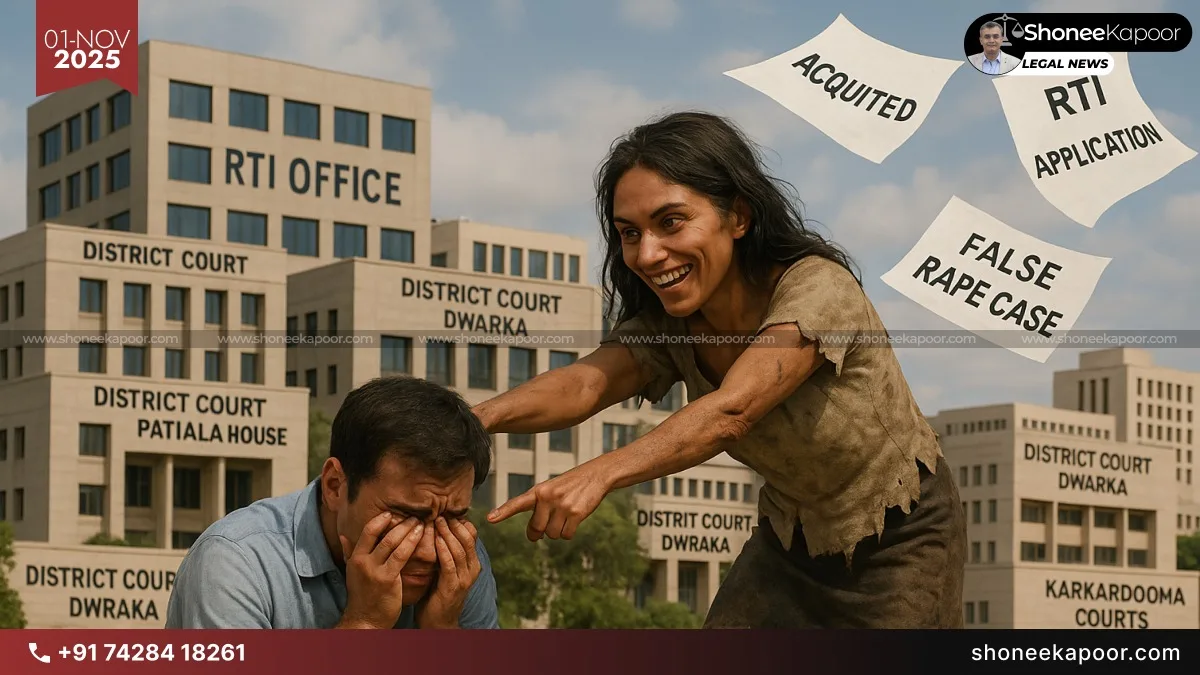
False Rape Cases Don’t Just Destroy Men, It Leads To Unfortunate Doubts On Women Who Are Real Victims: Delhi High Court

Curated by NEWS DESK
Editorial DeskDelhi High Court warns that false sexual offence complaints harm not just the accused but also genuine women victims. Court says misuse of law creates public doubt and weakens justice for real survivors.
NEW DELHI: The Delhi High Court has made strong and important observations on the serious impact of false Rape Cases and false sexual offence cases, stating clearly that such allegations cannot be taken lightly and must be examined strictly as per law.
Justice Swarana Kanta Sharma said that false cases do not end with damage to the accused alone but slowly harm the entire justice system meant to protect genuine victims.
While hearing a petition filed by the State against the discharge of accused persons in a rape case, the High Court explained how misuse of sexual offence laws creates long-term damage. The Court observed that when serious allegations are made and later withdrawn without any explanation, it affects public trust and creates suspicion even against genuine complaints.
The Court said:
“Such cases gradually create doubt and hesitation in the minds of people at large, where even a genuine complaint of sexual assault may begin to be viewed with suspicion. When serious allegations are made and then withdrawn without explanation, it weakens public confidence in the process meant to protect victims of sexual violence. The unfortunate result is that women who have truly suffered such crimes may find their voices questioned or their experiences doubted. For this reason, false allegations of sexual offences cannot be treated lightly and must invite careful and firm scrutiny in accordance with law, so that genuine victims are not made to suffer on account of misuse by a few.”
The Delhi High Court further highlighted that the suffering of a person who is falsely accused in such cases is deep and long-lasting. The Court noted that even if the accused is later discharged, the damage caused to reputation, mental health, and social standing cannot be fully reversed.
The Court observed that loss of reputation, jail time, social stigma, and mental trauma suffered by a falsely accused person may leave lifelong scars, just like the trauma faced by real victims of sexual assault. The Court stressed that such harm cannot be undone simply by a discharge order or by offering sympathy.
These observations were made while dismissing the State’s challenge to an order passed by the Additional Sessions Judge, Karkardooma Courts, Delhi, which had discharged all accused persons from offences under Sections 328 and 376 of the Indian Penal Code.
The High Court pointed out that a major turning point in the case came when the statement of the prosecutrix was recorded under Section 164 of the Criminal Procedure Code. In that statement, the woman completely withdrew her earlier allegations and clearly stated that she knew the accused and that the physical relationship was consensual.
The Court emphasised the importance of a statement recorded under Section 164 CrPC and stated:
“This Court cannot lose sight of the legal significance of a statement recorded under Section 164 of Cr.P.C. Such a statement is recorded by a Magistrate after due compliance with the statutory safeguards, including satisfying the Court that the statement is being made voluntarily, without any threat, inducement, or coercion…”.
Justice Swarana Kanta Sharma noted that the complete reversal of allegations, without any claim of pressure or threat, raised serious concerns that could not be ignored. The Court explained that rape allegations have serious consequences not only for the complainant but also for the accused and their families.
The Court further observed that the prosecutrix was a married and mature woman who was capable of approaching the police immediately, giving detailed allegations, and clearly explaining the incident to both the investigating officers and the medical professionals.
It was also noted that at no stage did the prosecutrix claim that her earlier statements were made under force, threat, or pressure. The Court pointed out that no explanation was given as to why such serious allegations of gang rape were first made and then completely withdrawn.
The High Court clearly stated the role of courts in criminal justice and said:
“The duty of the Court is to ensure a fair trial, and fairness in criminal jurisprudence does not mean justice to the victim alone, but justice to all parties who stand before the Court. In the present case, the conduct of the prosecutrix, as emerging from her voluntary statement under Section 164 of Cr.P.C., prima facie indicates false implication of the accused persons, which itself calls for serious scrutiny in accordance with law. Such scrutiny is also necessary to ensure that genuine cases of sexual violence do not suffer dilution or attract unwarranted scepticism on account of instances where grave allegations are made and subsequently withdrawn without explanation”.
The judgment strongly underlines that misuse of sexual offence laws not only destroys innocent lives but also creates fear, doubt, and hesitation in society, ultimately harming women who genuinely need legal protection and justice.
Explanatory Table: Laws And Sections Involved
| Law / Section | Explanation | Role in This Case |
| Section 376 IPC | Punishment for rape | Main allegation in FIR; accused were discharged |
| Section 328 IPC | Causing hurt by poison or intoxicating substance | Alleged along with rape; no prima facie case found |
| Section 164 CrPC | Statement before Magistrate | Prosecutrix voluntarily stated relationship was consensual; became decisive |
| Section 161 CrPC | Police statement during investigation | Earlier version contained allegations |
| Section 357A CrPC | Victim compensation scheme | Discussed regarding misuse and recovery of compensation |
| Section 182 IPC | Giving false information to public servant | Court noted applicability in false cases but gave no direction |
| Section 211 IPC | False charge of offence | Court observed provision but left action open |
| Delhi Victim Compensation Scheme, 2018 | Compensation framework for victims | Court examined misuse and recovery mechanism |
| POCSO Act (Reference) | Protection of Children from Sexual Offences | Mentioned in directions relating to compensation recovery |
| Sections 326A, 354A-D IPC | Acid attack, sexual harassment | Mentioned within compensation scheme context |
| Section 304B IPC | Dowry death | Mentioned under compensation reporting duties |
| Section 498A IPC | Cruelty by husband or relatives | Mentioned in compensation scheme framework |
Case Summary
| Particular | Details |
| Case Title | The State of GNCT of Delhi vs Toshib alias Paritosh & Ors. |
| Case Number | CRL.REV.P. 772/2024 |
| Court | High Court of Delhi at New Delhi |
| Bench | Hon’ble Dr. Justice Swarana Kanta Sharma |
| Judgment Reserved On | 01.12.2025 |
| Judgment Pronounced On | 15.12.2025 |
| Judgment Uploaded On | 20.12.2025 |
| Petitioner | The State of GNCT of Delhi |
| Respondents | Toshib alias Paritosh & Ors. |
| Trial Court | Court of Additional Sessions Judge (SC-RC), East District, Karkardooma Courts, Delhi |
| Trial Court Case No. | SC No. 370/2023 |
| Police Station | Vivek Vihar, Delhi |
| FIR Date | 21.01.2023 |
| Impugned Order Date | 31.08.2023 |
| Result | State petition dismissed; discharge of accused upheld |
Counsels Appearing
| Side | Counsel |
| For the State (Petitioner) | Mr. Naresh Kumar Chahar, APP for the State, along with SI Sumeet Poonia |
| For the Accused (Respondents) | Mr. Lokesh Kumar Mishra, Advocate |
Key Takeaways
- A false rape allegation is not a private mistake — it destroys a man’s reputation, liberty, mental health, and family life permanently.
- When false cases collapse without explanation, society starts doubting even genuine women survivors, hurting real victims the most.
- Section 164 CrPC statements carry serious legal weight and expose fabricated cases when allegations suddenly reverse.
- Justice is not victim-only justice; courts must protect the innocent accused with the same seriousness as genuine complainants.
- Misuse of sexual offence laws weakens public trust and proves why strict scrutiny and accountability are essential for gender-neutral justice.
This Could Change Your Case-Get FREE Legal Advice-Click Here!
Disclaimer: The views and opinions expressed in this article are those of the Indian courts and do not necessarily reflect the official policy or position of “ShoneeKapoor.com” or its affiliates. This article is intended for informational and educational purposes only. The content provided is not legal advice, and viewers should not act upon this information without seeking professional counsel. Viewer discretion is advised.
Related Articles
Truth on Trial : My RTI Reveals How False Rape Complaints Have Pushed Delhi’s Conviction Rate Down to 4.3%
An RTI-based investigation uncovering the numbers, patterns, and judicial realities behind Delhi’s 4.3% rape convicti...
Share Your Thoughts
Comments are moderated before publication.