
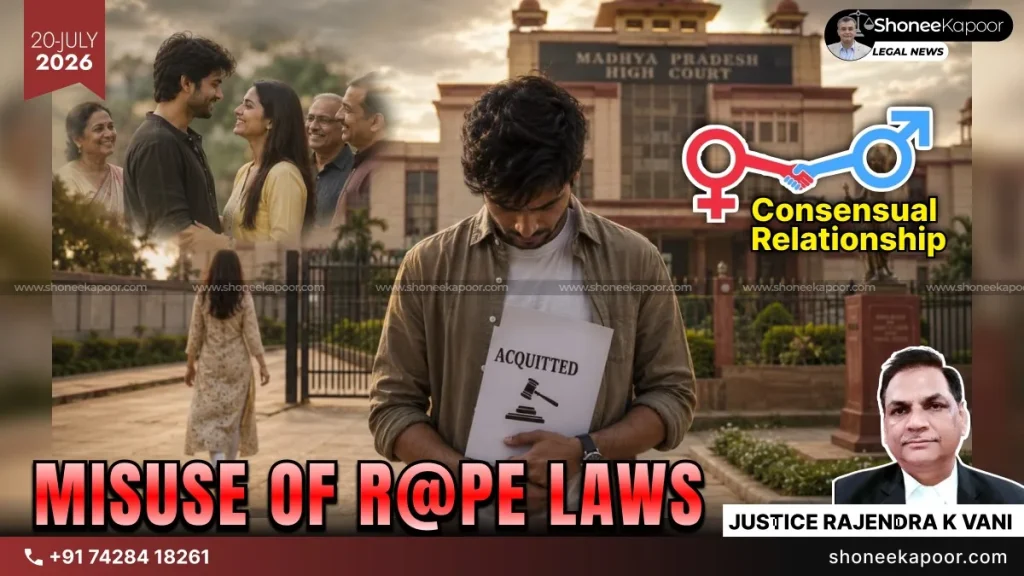
Can a man be convicted of rape and abetment of suicide simply because a consensual relationship ended without marriage? The Madhya Pradesh High Court has answered this crucial question, reaffirming that courts must distinguish between a failed relationship and a criminal offence.
MADHYA PRADESH: The Madhya Pradesh High Court has acquitted a man convicted of rape and abetment of suicide, holding that the failure of a consensual relationship cannot, by itself, be treated as a criminal offence under Sections 376 and 306 of the Indian Penal Code.
The Court held that the prosecution failed to establish that the accused had induced the deceased into a physical relationship by making a false promise of marriage with no intention of fulfilling it from the very beginning. It further ruled that even if a man subsequently refuses to marry, such refusal alone cannot amount to instigation or abetment of suicide.
Justice Rajendra Kumar Vani allowed the criminal appeal, set aside the conviction recorded by the Trial Court and directed the immediate release of the appellant.
The prosecution alleged that the deceased and the accused were in a love relationship. The deceased later became pregnant, and after the accused allegedly refused to marry her, she committed suicide by hanging. Following investigation, the accused was charged with rape on the allegation that the physical relationship had been established on a false promise to marry, and also with abetment of suicide.
The DNA report confirmed that the accused was the biological father of the deceased’s foetus. However, the defence consistently maintained that the relationship was entirely consensual and that there was no evidence of any fraudulent intent at its inception.
One of the most significant circumstances noted by the High Court was that the deceased’s parents and brother were fully aware of the relationship and had never objected to it.
The Court observed:
“There is no cogent evidence on record to establish that, from the very beginning, the accused had no intention of marrying the deceased and had entered into the relationship solely to satisfy his lust.”
The Court further observed that the family’s acceptance of the relationship substantially weakened the prosecution’s theory that the accused had deceived the deceased from the outset.
This distinction has repeatedly been recognised by the Supreme Court. A mere breach of a promise is legally different from a false promise made only to obtain consent for sexual intercourse. Criminal liability arises only when the prosecution proves that the promise was dishonest from its inception.
The High Court found no convincing evidence proving that the accused had never intended to marry the deceased when the relationship began.
The prosecution relied upon allegations that the accused later demanded a house as a condition for marriage. However, the Court found no reliable evidence substantiating this allegation.
Consequently, the Court held that the prosecution had failed to prove that the deceased’s consent for sexual intercourse had been obtained through deception or misconception of fact.
The Court reiterated the settled legal position that where a promise to marry was genuine when made but could not ultimately be fulfilled because of later circumstances, the offence of rape is not attracted.
Applying this principle, the Court concluded that the prosecution had failed to establish the essential ingredients of Section 376 IPC beyond reasonable doubt.
The High Court also dealt with the allegation under Section 306 IPC relating to abetment of suicide.
The prosecution argued that the accused’s refusal to marry the deceased ultimately drove her to take her own life.
The Court rejected this contention.
It observed:
“Even assuming, for the sake of argument, that the accused subsequently refused to marry the deceased and demanded a house from her, such an act, by itself, cannot be construed as instigation or abetment to commit suicide.”
The Court emphasised that criminal liability for abetment of suicide requires clear evidence of instigation, intentional aid or active participation as contemplated under Sections 306 and 107 IPC.
A failed relationship or refusal to marry, without more, cannot automatically satisfy these statutory requirements.
The Bench also reiterated another fundamental principle of criminal jurisprudence.Where two views are reasonably possible from the evidence on record, the one favourable to the accused must prevail.
Since the prosecution failed to establish either that the promise to marry was false from the very beginning or that the accused had instigated the deceased to commit suicide, the conviction could not legally survive.
Accordingly, the High Court allowed the appeal, set aside the conviction and acquitted the accused of all charges.
EXPLANATORY TABLE OF LAWS AND SECTIONS
| Law /Section | Legal Meaning | Application in this Case | Final Finding |
| Section 376 IPC | Punishes rape. Consent obtained through misconception of fact may constitute rape in appropriate cases. | Prosecution alleged consent was obtained on a false promise of marriage. | The Court held that the prosecution failed to prove the promise was false from the outset. Acquittal granted. |
| Section 90 IPC | Consent given under a misconception of fact is not valid consent, even where statutory requirements are satisfied. | The Court examined whether the deceased consented due to deception. | No evidence of dishonest intention at the beginning of the relationship. |
| Section 306 IPC | Punishes abetment of suicide. | Prosecution alleged refusal to marry drove the deceased to suicide. | Mere refusal to marry does not amount to abetment without evidence of instigation. |
| Section 107 IPC | Defines abetment through instigation, conspiracy or intentional aid. | Court examined whether the accused had actively instigated suicide. | Essential ingredients of abetment were not established. |
| Benefit of Doubt Principle | Where two reasonable views are possible, the one favourable to the accused must prevail. | Evidence admitted more than one possible interpretation. | Benefit of doubt extended to the accused. |
CASE DETAILS
| Particular | Details |
| Case | Ram Kailash Gupta v. State of Madhya Pradesh |
| Case Number | CRA No. 6575 of 2025 |
| Court | Madhya Pradesh High Court |
| Judge | Justice Rajendra Kumar Vani |
| Neutral Citation | 2026:MPHC-JBP:48046 |
| Counsel For Appellant | Advocate S.M. Shukla |
| Counsel For Respondent | Advocate Shikha Baghel |
KEY TAKEAWAYS
- A failed relationship alone cannot make a man a rapist. The prosecution must prove that the promise to marry was false from the very beginning.
- The families’ knowledge and acceptance of the relationship significantly strengthens the man’s defence against allegations of deception.
- A man’s refusal to marry does not automatically amount to abetment of suicide. Clear evidence of instigation is legally required.
- DNA may establish paternity, but it does not prove rape. Consent must be independently disproved by the prosecution.
- No man can be convicted on assumptions or emotions. If two views are possible, the benefit of doubt must go to the accused.
This Could Change Your Case-Get FREE Legal Advice-Click Here!
Disclaimer: The views and opinions expressed in this article are those of the Indian courts and do not necessarily reflect the official policy or position of “ShoneeKapoor.com” or its affiliates. This article is intended for informational and educational purposes only. The content provided is not legal advice, and viewers should not act upon this information without seeking professional counsel. Viewer discretion is advised.