
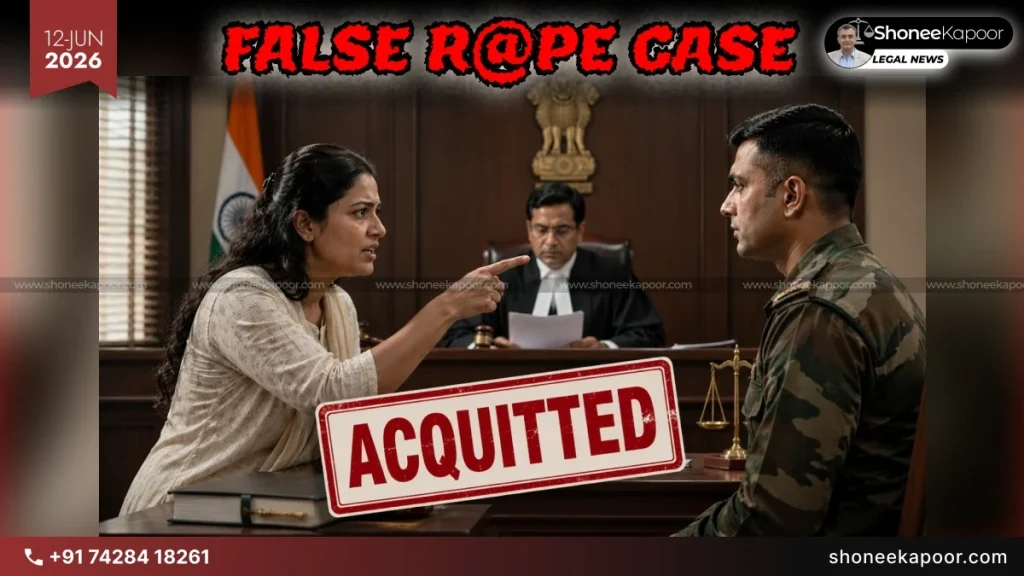
Can an unproven claim of marriage turn a consensual relationship into rape? The Dehradun Court held that without proof of the alleged temple marriage or lack of consent, a voluntary relationship between adults cannot be treated as rape.
DEHRADUN: In a judgment delivered on June 9, 2026, Additional District and Sessions Judge Manjuraj Singh Munde of the Fast Track Special Court, Dehradun, acquitted a man facing charges under Section 376 of the Indian Penal Code after finding that the prosecution had failed to establish the offence of rape beyond reasonable doubt.
The case arose from a relationship that began through a matrimonial website. The complainant, a 37-year-old widow and mother of two children, had joined the platform in search of a life partner after the death of her husband. According to her, the man introduced himself as an unmarried retired Army personnel working in Rajasthan and claimed that family circumstances had prevented his earlier marriage.
After several conversations, he allegedly invited the woman and her two children to Rajasthan, arranged train tickets and booked a hotel for their stay. The complainant alleged that while returning to Dehradun, he took her to a Kali Mata Temple near Dharamwala, applied sindoor, made her wear a mangalsutra and assured her that their marriage would later be formally registered before a court.
She further claimed that the man stayed with her at her rented accommodation in Dehradun for around fifteen days and had physical relations with her on the assurance that they were husband and wife. According to her, she later discovered through social media that he was already married and had a child. Following this discovery, she approached the police and lodged an FIR on August 19, 2023.
During the trial, the prosecution examined six witnesses, including the complainant, her daughter, the medical examiner, the landlord, a police constable and the investigating officer. However, the Court found that the evidence presented during the trial suffered from serious deficiencies.
The medical examination did not support allegations of forced sexual intercourse. The doctor found no internal or external injuries on the complainant’s body. The hymen was old and torn, the pregnancy test was negative, all laboratory reports were normal and no spermatozoa were detected. The medical examiner specifically stated:
“No definite opinion can be given regarding rape upon the victim.”
The Court also considered admissions made by the complainant during cross-examination. She acknowledged: “We had physical relations,” and further admitted, “It is correct to say that I was with the accused of my own free will.”
The Court noted that despite allegations of a temple marriage, no independent evidence was produced to prove that such a ceremony had actually taken place. No temple priest was examined as a witness. No marriage certificate was placed on record. No documentary proof of the alleged marriage was produced before the Court.
Even the photographs relied upon by the prosecution did not show the alleged application of sindoor or the tying of a mangalsutra. The Court observed that if such an important ceremony had genuinely taken place, preserving evidence through photographs or examining the priest who performed the rituals would have been natural conduct.
The Court further observed that although allegations were made that the man had falsely portrayed himself as unmarried on the matrimonial website, no documentary evidence from the website was produced to support this claim.
After examining the entire evidence, the Court concluded that the prosecution had failed to establish that the complainant’s consent had been obtained through deception or that the relationship was against her will. The Court found that both individuals were mature adults capable of understanding the nature and consequences of their actions.
The Court categorically held:
“The victim is a major woman and the mother of two children, while the accused is also a major and the father of one child. Whatever relationship existed between them was voluntary and not forced.”
Since the prosecution failed to prove the allegation of rape beyond reasonable doubt, the accused was acquitted of the charge under Section 376 IPC.
EXPLANATORY TABLE: LAWS AND SECTIONS INVOLVED
| Law / Section | Purpose | How It Applied In This Case |
| Section 376 IPC | Punishes the offence of rape. | The accused was charged under this provision but was ultimately acquitted. |
| Section 164 CrPC | Recording of statements before a Magistrate. | The complainant’s statement was recorded and relied upon during trial. |
| Section 313 CrPC | Allows the accused to explain circumstances appearing against him. | The accused denied the allegations and claimed false implication. |
| Section 65B, Indian Evidence Act | Governs admissibility of electronic evidence. | A 65B certificate was filed for photographs and electronic material produced by the complainant. |
| Section 428 CrPC | Set-off of detention period against sentence after conviction. | Mentioned in the accused details table, though no sentence followed due to acquittal. |
CASE DETAILS
- Case Title: State of Uttarakhand v. Vimal Thapa
- Sessions Trial Number: Sessions Trial No. 152 of 2023
- FIR Number: Case Crime No. 445 of 2023
- Police Station: Patelnagar, Dehradun, Uttarakhand
- Court: Court of the Additional District & Sessions Judge / Fast Track Special Court (POCSO), Dehradun
- Judge: Shri Manjuraj Singh Munde, Higher Judicial Service
- Date of Judgment: 09 June 2026
- Counsels:
- For State: Shri Kishore Kumar, Assistant District Government Counsel (Criminal).
- For Accused: Shri B.D. Jha, Advocate.
KEY TAKEAWAYS
- An allegation may trigger an investigation, but a conviction must always be based on evidence and not assumptions. Justice cannot replace proof with public sentiment.
- Not every relationship that ends in betrayal, disappointment or regret becomes a criminal offence. Consent cannot be rewritten simply because the relationship later breaks down.
- Serious allegations of deception require serious proof. Claims based on chats, matrimonial profiles or social media must be supported by credible evidence.
- The presumption of innocence is not a privilege; it is a fundamental principle of justice. Every accused person deserves a fair trial and the benefit of reasonable doubt.
- Due process protects everyone. In a society where allegations can instantly damage reputations and lives, courts must remain guided by facts, evidence and the rule of law rather than emotions.
This Could Change Your Case-Get FREE Legal Advice-Click Here!
Disclaimer: The views and opinions expressed in this article are those of the Indian courts and do not necessarily reflect the official policy or position of “ShoneeKapoor.com” or its affiliates. This article is intended for informational and educational purposes only. The content provided is not legal advice, and viewers should not act upon this information without seeking professional counsel. Viewer discretion is advised.