
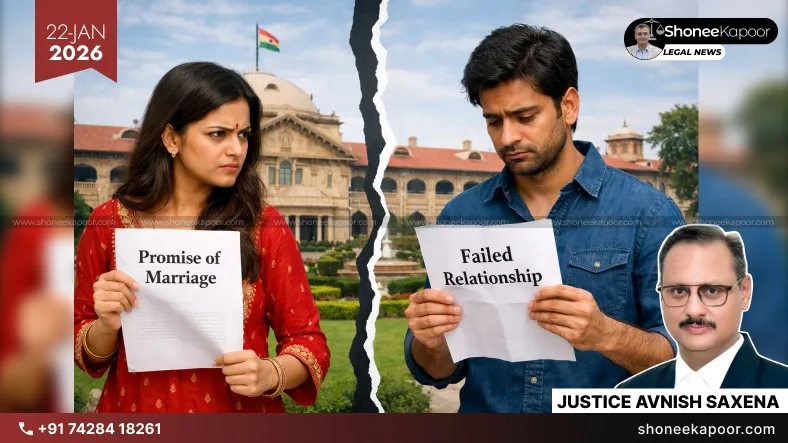
An 11-year relationship has turned into a criminal case involving Section 69 BNS and rape-related legal issues. Allahabad High Court said consent and false promise claims must be tested in trial, not quashed early. The case silently highlights how men face long legal battles and reputational damage even before guilt is proved.
Allahabad: The Allahabad High Court refused quashing the charge sheet and the criminal proceedings initiated against the accused husband, which stemmed from allegations of sexual exploitation, physical assault, and criminal intimidation.
The applicant contended that the relationship between the parties was consensual, long-standing, and within the knowledge of both sides, and argued that the criminal process was being invoked only after the relationship deteriorated, amounting to misuse of penal law.
The case started when the woman lodged an FIR alleging that she had been in a relationship with the man for around eleven years and that physical relations happened on the promise of marriage. She alleged that she was assaulted, threatened and later abandoned.
The applicant strongly relied on the Supreme Court ruling where it was clearly held that “a false promise is not a fact within the meaning of the Code” and that “there is no straitjacket formula for determining whether consent given by the prosecutrix to sexual intercourse is voluntary, or whether it is given under a misconception of fact.”
The Court noted that the complainant herself stated that the relationship continued for almost eleven years and that she lived with the accused like a wife. The defence relied on earlier complaints, compromises, medical reports, and Supreme Court judgments to argue that this was a failed relationship being converted into a criminal case, a pattern increasingly seen in matrimonial and live-in disputes involving men.
It was also highlighted before the Court that the woman was a mature, educated adult who continued the relationship for years, stayed with the man, pursued her Ph.D., and even claimed marriage through Arya Samaj documents, which according to the defence showed conscious participation rather than deception.
However, the High Court focused on the limited scope of quashing jurisdiction. It framed the core issue very clearly by observing whether-
“Prima facie the allegations levelled by the victim on the applicant accused is sufficient to proceed with the trial or continuance of the trial would amount to gross abuse of process of law?”
While acknowledging that the relationship was long and complex, the Court recorded that the allegations included claims of initial unconsciousness, repeated assurances of marriage, concealment of marital status, and abuse of trust. The Court took note that Section 69 of the Bharatiya Nyaya Sanhita is a new provision and specifically criminalises sexual intercourse obtained by deceitful means.
The Court reproduced the law itself, stating:
“Whoever, by deceitful means or by making promise to marry a woman without any intention of fulfilling the same, has sexual intercourse with her, such sexual intercourse not amounting to the offence of rape, shall be punished with imprisonment of either description for a term which may extend to ten years and shall also be liable to fine.”
The High Court also explained the legal shift after the new criminal laws, noting that earlier courts examined such cases under IPC Sections 375 and 90, but now Section 69 BNS independently deals with false promise of marriage. It clarified that the explanation of deceitful means includes situations where identity or marital status is suppressed.
Importantly, the Court acknowledged the defence argument that two versions cannot run together — false promise of marriage and marriage itself — yet held that such contradictions must be tested through evidence. The Court observed that:
“It is a matter of trial to decipher from evidence, whether the opposite party no. 2, victim was knowing the marital status of the applicant and despite that she has entered into sexual intercourse with him, which continued for eleven long years.”
The Court further relied on the Supreme Court distinction between false promise and mere breach of promise, noting that “it is former which out rightly attracts penal provision.”
In this case, the Court observed that the accused was already married when the relationship began, which raises serious questions requiring evidence. At the same time, the Court also noted strong contradictions, including earlier admissions, alleged compromise, and conflicting stands of the complainant about marriage and consent. Because of these disputed facts, the Court held that it would be improper to quash the case at the threshold.
This judgment clearly shows that the High Court did not declare the man guilty, nor did it endorse the allegations as truth. Instead, it refused to short-circuit the process at the threshold stage. The Court consciously avoided criminalising relationships automatically, but equally refused to assume consent merely due to duration.
In its concluding reasoning, the High Court made it clear that
“On the basis of prima facie facts, this Court does not find sufficient ground to quash the charge sheet and the proceedings.”
The Court firmly held that quashing jurisdiction is limited and that disputed facts, especially in long personal relationships, must be tested in trial.
Accordingly, the application was dismissed, leaving all issues — consent, knowledge, intent, and misuse of law — open to be decided during trial, where the accused will have full opportunity to defend himself with evidence and cross-examination.
This judgment is a reminder that while misuse of relationship-based criminal laws against men is a serious concern, courts will not quash cases mechanically. At the same time, it reinforces that mere allegations do not amount to guilt, and the burden of proof remains squarely on the prosecution to prove deception beyond doubt during trial.
Explanatory Table – Laws & Sections Involved
| Law & Section | Purpose | How Applied in This Case |
| BNS 2023 – Section 69 | Punishes sex obtained by deception or false promise of marriage. | Woman alleged physical relation happened on false promise while man was already married. |
| BNS 2023 – Section 115(2) | Punishment for voluntarily causing hurt. | Allegation of physical assault causing knee injury. |
| BNS 2023 – Section 352 | Punishes intentional insult leading to breach of peace. | Alleged verbal abuse and provocation during disputes. |
| BNS 2023 – Section 351(3) | Criminal intimidation and threats. | Alleged threats to defame and implicate in false cases. |
| BNSS – Section 528 | Power of High Court to quash criminal proceedings. | Accused sought quashing of charge-sheet and trial. |
| BNSS – Section 180 | Recording victim statement during investigation. | Victim narrated relationship history and allegations. |
| BNSS – Section 183 | Detailed statement before authority. | Victim claimed first sexual act was under intoxication and promise of marriage. |
| BNSS – Section 173(4) | Complaint before Magistrate for protection or grievance. | Accused earlier alleged harassment by complainant. |
| BNS 2023 – Section 63 | Defines offence of rape under new law. | Court discussed for legal interpretation though no rape charge filed. |
| BNS 2023 – Section 64(2)(f) | Rape by person in position of trust like teacher. | Court noted accused was teacher and authority figure. |
| Bharatiya Sakshya Adhiniyam 2023 – Section 120 | Presumption of absence of consent in certain rape cases. | Explained legal presumption where authority relationship exists. |
| IPC – Section 375 (Old) | Earlier definition of rape. | Used for comparison and legal interpretation. |
| IPC – Section 90 (Old) | Consent under misconception is invalid. | Referenced to understand consent principles. |
| CrPC – Sections 195 & 340 | Action against false documents or perjury. | Accused alleged marriage certificate was forged. |
Case Details
- Case Title: Kuldeep Verma vs State of U.P. and Another
- Court: High Court of Judicature at Allahabad
- Application Number: Application U/S 528 BNSS No. 35779 of 2025
- Trial Case Number: Case No. 2823 of 2025
- Crime Number: Case Crime No. 521 of 2025
- Bench: Hon’ble Avnish Saxena, J.
- Dates:
- Judgment Reserved On: 21.11.2025
- Judgment Delivered On: 13.01.2026
- Police Station: Quarsi, District Aligarh
- Counsels:
- For Applicant: Mrityunjay Dwivedi
- For Opposite Parties: Akanksha Gaur, G.A.
Key Takeaways
- Long consensual relationships should not automatically be converted into criminal cases when personal disputes arise.
- False promise allegations must be strictly proven in court; emotional disappointment cannot become criminal liability.
- Contradictory statements and delayed complaints highlight the risk of misuse of criminal laws against men.
- Courts must protect due process and prevent weaponisation of new laws to settle relationship scores.
- Men need stronger legal safeguards against false and exaggerated allegations that damage reputation, career, and family.
This Could Change Your Case-Get FREE Legal Advice-Click Here!
Disclaimer: The views and opinions expressed in this article are those of the Indian courts and do not necessarily reflect the official policy or position of “ShoneeKapoor.com” or its affiliates. This article is intended for informational and educational purposes only. The content provided is not legal advice, and viewers should not act upon this information without seeking professional counsel. Viewer discretion is advised.