
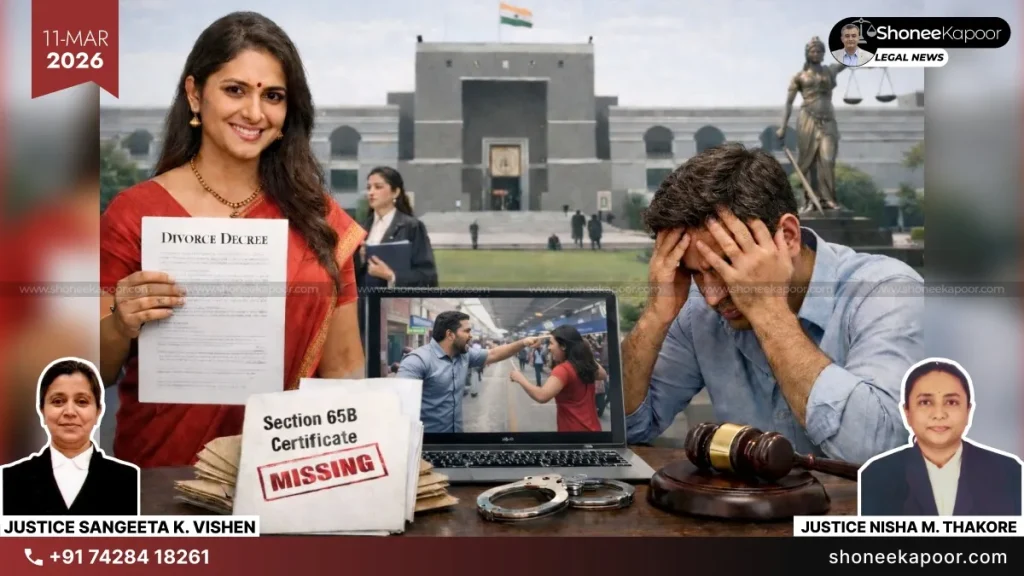
The Gujarat High Court confirmed that Family Courts can rely on CCTV footage even without the mandatory Section 65B certificate when deciding matrimonial disputes. But if strict evidentiary safeguards can be relaxed in such serious allegations, an uncomfortable question arises about how far procedural protection truly extends in marital litigation.
Divorce Upheld: The Gujarat High Court, in a judgment delivered by Justice Sangeeta K. Vishen and Justice Nisha M. Thakore, dismissed the husband’s appeal and upheld the Family Court’s decision granting divorce to the wife on the ground of cruelty.
The couple had married in 2007 and had a son in 2008. Over time, disputes developed between them and the wife began living separately in 2017. She alleged that the marriage had become unbearable because she was subjected to physical, verbal and emotional harassment.
The dispute mainly revolved around an incident in March 2018 at a railway station where the wife claimed the husband abused and assaulted her while she was waiting for a train to go to work. She also alleged another similar incident a few days later while returning from work. Medical records, witness statements and CCTV footage were relied upon before the Family Court to support her claims.
The husband challenged the divorce order, arguing that the CCTV footage was not properly proved and did not comply with Section 65B of the Evidence Act. However, the High Court rejected this argument and explained that Family Courts have wider powers to consider material while resolving family disputes.
The Court stated:
“A Family Court may receive as evidence any report, statement, documents, information or matter that may, in its opinion, assist it to deal effectually with a dispute, whether or not the same would be otherwise relevant or admissible under the Indian Evidence Act, 1872.”
It further noted that the law was designed for:
“Simplifying the rules of evidence and procedure so as to enable a family court to deal effectively with a dispute.”
After examining the record, the High Court found no error in the Family Court’s findings and dismissed the husband’s appeal.
The case also raises a broader question often discussed in family disputes — if the roles had been reversed and a husband had made similar allegations, would the outcome and approach of the courts have been the same?
Explanatory Table: Laws And Sections Involved
| Law / Section | Purpose | How Applied in This Case |
| Family Courts Act, 1984 – Section 14 | Flexible evidence rule | Court allowed CCTV and related material even though strict Evidence Act rules were questioned. |
| Family Courts Act, 1984 – Section 20 | Overriding effect | Court noted Family Courts Act prevails over conflicting procedural laws. |
| Indian Evidence Act, 1872 – Section 65B | Electronic evidence rule | Husband argued CCTV lacked proper certificate under this section. |
| Indian Divorce Act, 1869 – Section 15 | Divorce provision | Wife sought dissolution of marriage alleging cruelty. |
| Right to Information Act, 2005 | Access to records | CCTV footage of railway station incident was obtained through official request. |
Case Details
- Case Title: Nileshbhai Jonbhai Mekwan v. Pritiben D/o Arneshtbhai Christian
- Court: Gujarat High Court
- Case Number: R/First Appeal No. 2908 of 2019
- Connected Matter: Civil Application (For Stay) No. 1 of 2019
- Date of Judgment: 11 February 2026
- Bench: Justice Sangeeta K. Vishen and Justice Nisha M. Thakore
- Neutral Citation: 2026:GUJHC:16551-DB
- Counsels:
- For Appellant (Husband): Mr. A. S. Asthavadi
- For Respondent (Wife): Mr. A. A. Zabuawala
- Additional Appearance: Romesh C. Niven
Key Takeaways
- In marital disputes, even a single public altercation or allegation of misconduct can become the turning point for dissolving a marriage.
- Electronic material such as CCTV footage or recordings can strongly influence family litigation, even when technical evidentiary requirements are disputed, making it critical for husbands to respond and challenge such material immediately.
- Silence or weak rebuttal during trial can be interpreted against a husband; failing to challenge allegations, witnesses, or evidence at the right time can significantly weaken the defence.
- Family courts operate with flexible evidentiary standards, meaning material that might not strictly qualify as admissible evidence in ordinary civil courts can still be relied upon in marital disputes.
- Matrimonial litigation often turns on credibility and narrative rather than strict legal proof, which makes it essential for husbands to document events, gather independent evidence, and proactively protect their legal position from the earliest stage of conflict.
This Could Change Your Case-Get FREE Legal Advice-Click Here!
Disclaimer: The views and opinions expressed in this article are those of the Indian courts and do not necessarily reflect the official policy or position of “ShoneeKapoor.com” or its affiliates. This article is intended for informational and educational purposes only. The content provided is not legal advice, and viewers should not act upon this information without seeking professional counsel. Viewer discretion is advised.