
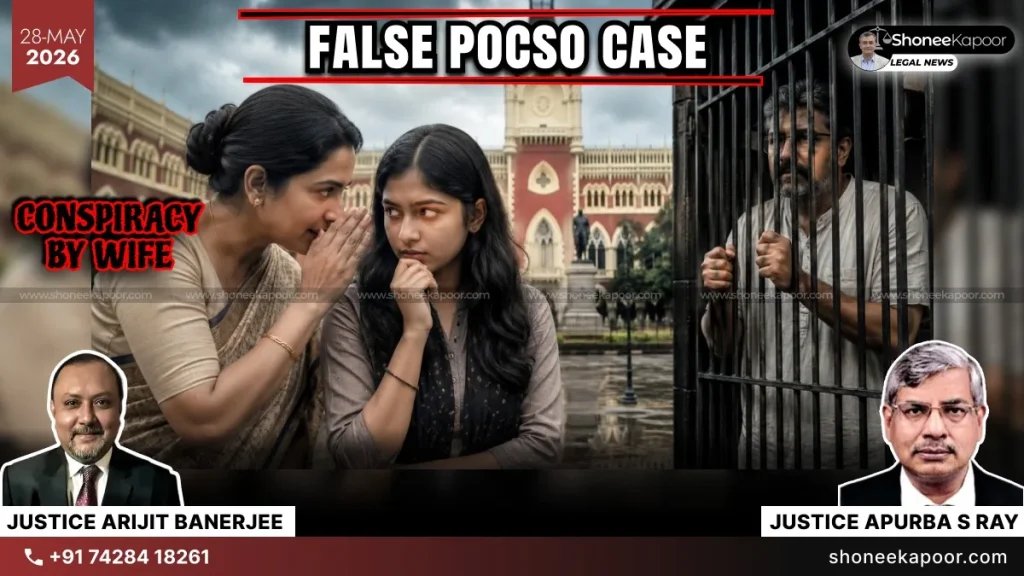
Can A Husband’s Matrimonial Dispute Become The Basis Of A POCSO Conspiracy Against Him?
The Calcutta High Court raised serious concerns over the investigation after finding excessive reliance on the estranged wife of the accused professor while independent witnesses, forensic evidence, and crucial records were ignored.
KOLKATA: In a major judgment raising concerns over misuse of criminal law against men, the Calcutta High Court acquitted a college professor who had spent years facing serious allegations under the POCSO Act. The judgment was delivered by Justice Arijit Banerjee and Justice Apurba Sinha Ray.
The Trial Court had earlier convicted the accused and sentenced him to 20 years imprisonment. However, the High Court found major contradictions, doubtful investigation, absence of independent evidence, and suspicious involvement of the accused’s estranged wife and son in the prosecution case.
The defence had argued that the accused’s wife, with whom matrimonial disputes and a Section 498A case were already pending, was behind the allegations. While examining the investigation, the High Court found it unusual that the Investigating Officer relied heavily on the estranged wife and son while ignoring neutral witnesses available inside the college campus.
The Court specifically observed:
“IO’s excessive reliance upon the estranged wife and son of the appellant.”
The Bench further questioned:
“What were the reasons for making the estranged wife and son as star witnesses for the Prosecution, particularly when the IO had sufficient opportunity to get other vital witnesses from the place of occurrence or its vicinity?”
Raising concerns about possible bias and influence, the Court also remarked:
“Was the IO influenced by anybody?”
The High Court noted that despite the alleged incident occurring inside a gated college residential campus, the police failed to examine neighbouring professors, security guards, church members, or other independent witnesses.
The Court also criticised the police for not seizing the visitor entry register, which could have verified the prosecution story.
The Bench observed:
“This document of enormous importance was not seized and brought to the notice of the court by the I.O.”
Medical evidence also failed to strongly support allegations of repeated violent sexual assault. The report recorded:
“There was no visible injury in the labia. No active injury was found in fourchette. No visible injury was found on the vaginal walls.”
The only observation was:
The Court also noted that:
“Old tear (healed) in hymen.”
Forensic examination of vaginal swab samples was never conducted despite the medical report itself recording:
“Conclusion pending for the report of vaginal swab examination/forensic examination.”
The Bench further stated:
“To hold otherwise, would compel the Court to mechanically accept the mere ipse dixit of the prosecution and give a stamp of judicial approval to every prosecution, howsoever, patently absurd or inherently improbable it may be.”
The Court ultimately held that the prosecution failed to establish foundational facts required under the POCSO Act and acquitted the accused.
Explanatory Table: Laws & Sections Involved
| Section / Law | Purpose | Relevance In This Case |
| Section 376(2)(f) IPC | Punishment for rape under aggravated circumstances | Accused was alleged to have repeatedly sexually assaulted the victim |
| Section 328 IPC | Causing hurt by poison, drugs, or intoxicating substances | Allegation that medicines were administered to victim |
| Section 506 IPC | Criminal intimidation | Allegation that victim was threatened not to disclose incidents |
| Section 6 POCSO Act | Punishment for aggravated penetrative sexual assault on a child | Main offence for which Trial Court convicted accused |
| Section 29 POCSO Act | Presumption of guilt against accused once foundational facts are proved | High Court held this presumption cannot be applied mechanically |
| Section 164 CrPC | Recording statement before Magistrate | Victim’s statement was recorded under this provision |
| Section 313 CrPC | Accused’s opportunity to explain allegations and evidence | Accused claimed false implication by estranged wife |
| Section 161 CrPC | Police examination of witnesses during investigation | Court noted important witnesses were never examined |
| Section 100 CrPC | Procedure for lawful search and seizure with independent witnesses | Court found seizure procedure doubtful and non-compliant |
| Section 498A IPC | Cruelty by husband or relatives | Pending matrimonial dispute between accused and estranged wife became important defence angle |
Case Details
- Case Title: Pratap Digal Vs. The State of West Bengal and Another
- Court: High Court at Calcutta
- Jurisdiction: Criminal Appellate Jurisdiction, Appellate Side
- Case Number: CRA (DB) No. 25 of 2025
- Bench: Justice Arijit Banerjee | Justice Apurba Sinha Ray
- Judgment Date: 22.05.2026
- Neutral Citation: 2026:CHC-AS:811-DB
- Counsels:
- For Appellant: Mr. Lord Chatterjee, Adv. & Ms. M. Chakraborty, Adv.
- For De-facto Complainant: Mr. Amit Ranjan Pati, Adv.
- For State: Mr. Joydeep Roy, Adv. & Ms. Baishali Chatterjee, Adv.
Key Takeaways
- Serious criminal allegations cannot replace proper evidence, fair investigation, and independent verification.
- Matrimonial hostility and personal vendetta can sometimes influence criminal prosecutions against men through biased investigations and interested witnesses.
- Blindly believing allegations while ignoring contradictions, missing witnesses, and forensic gaps can destroy innocent lives.
- Reverse burden laws should never become tools for automatic conviction without first proving foundational facts properly.
- Due process, neutral investigation, and objective scrutiny are essential safeguards to prevent misuse of criminal law against men.
This Could Change Your Case-Get FREE Legal Advice-Click Here!
Disclaimer: The views and opinions expressed in this article are those of the Indian courts and do not necessarily reflect the official policy or position of “ShoneeKapoor.com” or its affiliates. This article is intended for informational and educational purposes only. The content provided is not legal advice, and viewers should not act upon this information without seeking professional counsel. Viewer discretion is advised.