
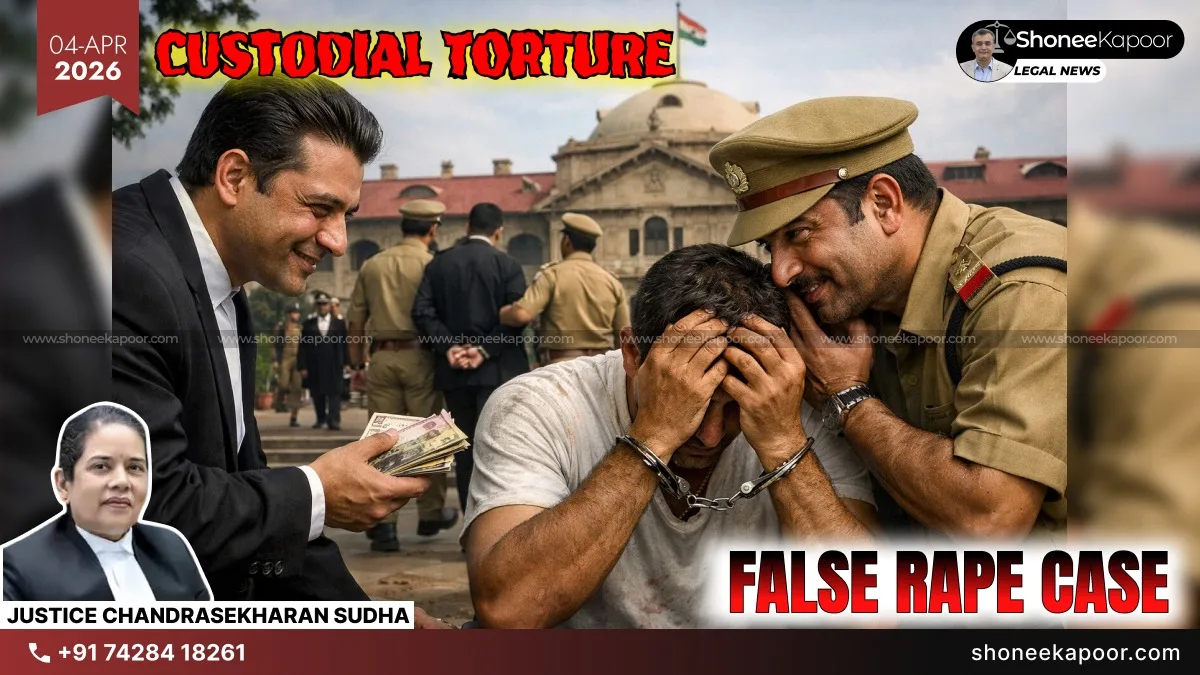
Innocent Man Framed In False Gang Rape Case: Delhi High Court Upholds Conviction Of Lawyer And Cop For Forgery, Conspiracy And Custodial Abuse

Written and analysed by Vaibhav Ojha
Head Of Legal CommunicationsIn a shocking Delhi High Court ruling, a lawyer and a cop were held guilty for orchestrating a false gang rape case against an innocent man.
What protection does an innocent man really have when the very system meant to deliver justice is used to frame him?
NEW DELHI: In a recent judgment, Justice Chandrasekharan Sudha of the Delhi High Court exposed a disturbing case where an innocent man was deliberately turned into a gang rape accused through a planned conspiracy involving a lawyer and a police officer.
The Court found that the conspiracy was executed “in furtherance of their common intention” to falsely implicate the man and extort money. It was established that false documents were created and used in judicial proceedings-
“With the knowledge and intention that such documents may appear in evidence,”
So that the case could appear genuine and result in conviction. Due to this, the man was arrested, kept in custody, and forced to face the consequences of a crime he never committed, until investigation later proved his innocence.
Even after being cleared, his suffering did not end. The Court recorded that he was repeatedly called to court but not properly examined, causing continuous harassment. Highlighting this, the Court observed:
“PW12… was not only falsely implicated in a heinous crime… but was also subjected to custodial violence and undue harassment at the hands of the police… It is a matter of great concern that the trial court also did not effectively step in to prevent the harassment.”
The Court further noted that he was made to appear in court multiple times without any effective progress in trial. It stated:
“He is seen to have been harassed to the maximum extent possible by making him appear before the court about 20 times, but sending him back without examining him,”
And emphasized that the trial court should have acted more carefully instead of granting repeated adjournments.
Rejecting the defence taken by the convicted persons, the Court also criticised the argument that they had no way of knowing future consequences, calling it an “insensitive argument.”
It clarified that timely action like proper cross-examination could have prevented the situation and termed the conduct as a clear abuse of legal process.
The High Court ultimately upheld the conviction under multiple serious offences, including criminal conspiracy, fabrication of evidence, and misuse of official position.
It stressed that a strong message must be sent that persons in positions such as lawyers and police officials cannot misuse their authority to frame innocent individuals.
The Court recognised that the man suffered wrongful arrest, custodial torture, repeated harassment, and lasting damage to his reputation due to a completely false case built against him.
The judgment stands as a clear example of how the system can be misused to destroy an innocent person’s life, while also reinforcing that such abuse of power will not be taken lightly by the courts.
Explanatory Table: Laws & Sections Involved
| Law / Section | Purpose | How Applied in This Case |
| Section 120B IPC | Punishes criminal conspiracy | Accused jointly planned false rape case and extortion |
| Section 193 IPC | Punishes false evidence in court | Fake evidence created to falsely prosecute an innocent man |
| Section 195 IPC | Punishes fabrication of evidence | Documents were fabricated to be used in judicial proceedings |
| Section 218 IPC | Punishes public servant for false records | Police officer prepared incorrect official records knowingly |
| Section 465 IPC | Punishes forgery | False documents were created to support fake allegations |
| Section 389 IPC | Punishes threat of false accusation for extortion | False rape case used as pressure to extort money |
| Section 374 CrPC | Right to appeal against conviction | Convicted persons filed appeal before High Court |
| Section 372 CrPC | Victim’s right to appeal | Appeal filed seeking enhancement of sentence and compensation |
| Section 482 CrPC | High Court’s inherent powers | Used to examine legality and prevent misuse of process |
| Section 207 CrPC | Supply of documents to accused | All case documents were provided during trial process |
| Section 209 CrPC | Transfer to Sessions Court | Case was committed to Sessions Court for trial |
| Section 313 CrPC | Statement of accused | Accused were give |
Case Details
- Case Title: Haji Mohd. Altaf vs State & Connected Matters
- Court: Delhi High Court
- Case Numbers: CRL.A. 286/2016, CRL.A. 326/2016, CRL.A. 691/2016
- Date Of Judgment: 04.04.2026
- Neutral Citation: 2026:DHC:2778
- Bench: Justice Chandrasekharan Sudha
- Counsels:
- For Appellants: Mr. S.C. Buttan, Mr. Himanshu Buttan, Mr. Ojasvi Annadi Shambhu, Mr. Nikhil, Mr. Ravin Rao, Mr. Akshit Sawal, Mr. Ayan Sharma, and Mr. Akshay Mathur
- For State: Mr. Utkarsh, APP for State
Key Takeaways
- A completely false rape case was engineered through conspiracy, showing how easily a man can be turned into an accused using fabricated evidence.
- Legal authority was misused by those in power, proving that positions like lawyer and police officer can be weaponised against innocent men.
- The man suffered arrest, custodial torture, and repeated court harassment despite being innocent, exposing systemic failure to protect him.
- Courts reaffirmed that technical loopholes cannot override truth, and fabricated cases will be punished when exposed.
- The judgment sends a strong message that misuse of criminal law to falsely implicate men will attract serious legal consequences.
This Could Change Your Case-Get FREE Legal Advice-Click Here!
Disclaimer: The views and opinions expressed in this article are those of the Indian courts and do not necessarily reflect the official policy or position of “ShoneeKapoor.com” or its affiliates. This article is intended for informational and educational purposes only. The content provided is not legal advice, and viewers should not act upon this information without seeking professional counsel. Viewer discretion is advised.
Related Articles
Delhi’s Crime Drop Didn’t Happen by Chance: How Our Men’s Rights Legal Activism Challenging Misuse, Forced Policing Reform (2024–2025)
Delhi’s improved crime metrics followed sustained legal pressure through RTIs, police engagement, and strategic litig...
Karisma Kapoor – Sunjay Kapur Case Explained: Marriage, Divorce, 498A, Death & the Delhi High Court Property War
From a celebrity wedding to IPC 498A allegations, a Supreme Court-linked divorce settlement, and now a Delhi High Cou...
498A का सच: झूठे मामलों में गिरफ्तारी नहीं, सुप्रीम कोर्ट ने पुरुषों की स्वतंत्रता पर खींची लाल रेखा
धारा 498A के नाम पर बिना जांच गिरफ्तारी ने हजारों निर्दोष पुरुषों और परिवारों की जिंदगी तबाह की है। सुप्रीम कोर्ट ने ...
Share Your Thoughts
Comments are moderated before publication.