
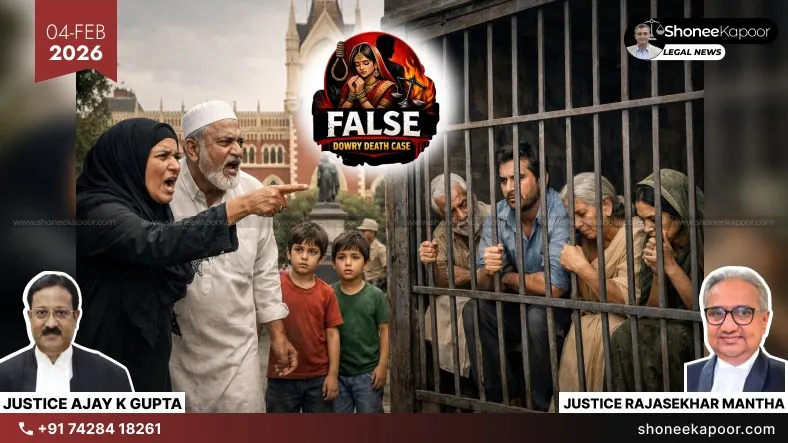
False Dowry Death Case | Life Sentence Without Proof. Child Witness Testimony Unreliable: Calcutta High Court Acquits In-Laws

Curated by NEWS DESK
Editorial DeskCalcutta High Court overturned life imprisonment in an alleged dowry death case, exposing unreliable child testimony and investigative lapses. 14 years after marriage, in-laws were jailed for life without medical certainty or credible evidence.
False Dowry Death Case: A Division Bench of the Calcutta High Court led by Justice Rajasekhar Mantha and Justice Ajay Kumar Gupta overturned the conviction of a husband and his family members who had been sentenced under Sections 498A and 302 of the IPC, holding that a criminal verdict cannot be sustained where the prosecution story is marred by doubtful evidence, material contradictions, and a flawed investigation.
The case related to the death of a married woman who suffered burn injuries nearly 14 years after marriage. The trial court had convicted the in-laws and husband for cruelty and murder, awarding life imprisonment.
However, while examining the appeal, the High Court found that the entire prosecution story was full of gaps, contradictions, and procedural violations.
At the outset, the Court noted that the statutory presumption under dowry death law did not apply because the death occurred well beyond seven years of marriage. Therefore, the prosecution was required to prove each allegation strictly and independently, which it failed to do.
The father of the deceased alleged that the in-laws demanded money and set his daughter on fire. But the Court found that he was not present at the place of incident and his version lacked independent corroboration. A crucial family member who allegedly informed him about the incident was never examined, weakening the prosecution case further.
The inquest report became a major turning point. Although it recorded that the woman was burnt in her matrimonial home, it did not name any accused or mention harassment. The Court observed that this silence was critical, especially when the prosecution later claimed a clear case of murder.
Relying on Supreme Court precedent, the Court reiterated that omission of accused names in the inquest creates serious doubt about the truthfulness of the FIR.
Medical evidence also failed to support the prosecution. The post-mortem doctor admitted that he could not determine whether the death was homicidal because the victim’s burnt clothes were not produced before him, even though the police claimed to have seized them. The Court found this lapse fatal.
Two minor children of the deceased were projected as eyewitnesses. The High Court strongly criticised the trial court for conducting a mechanical and inadequate preliminary examination of child witnesses. Citing Supreme Court rulings, the Court reminded that a judge must ensure that a child understands questions and the duty of speaking truth.
The judgment quoted the settled law that:
“It is the duty of a Trial Judge to conduct a preliminary examination before recording the evidence of the child witness to ascertain if the child is able to understand the questions put to him and that he is able to give rational answers to the questions put to him.”
The Court further noted contradictions between the children’s statements. One child claimed the victim’s hands were tied with a saree, while another said a rope was used. There were no injury marks to support this claim, and neither the inquest nor post-mortem report mentioned tied hands.
The Court observed that these inconsistencies made the alleged eyewitness account unreliable and suggested possible tutoring.
Another important factor was the conduct of the husband after the incident. Evidence showed that he tried to extinguish the fire, took the victim to hospitals, and sought medical help. The Court reasoned that such conduct was inconsistent with a planned murder.
The prosecution also failed to examine treating doctors from two hospitals where the victim was taken while alive and conscious. Hospital records, bed-head tickets, and medical histories were never produced. According to the Court, these documents could have clarified whether the burns were accidental, suicidal, or homicidal.
The Court expressed serious concern over procedural irregularities, especially the three-day delay in forwarding the FIR to the Magistrate, observing that such delay casts doubt on whether the case narrative was developed later as an afterthought.
Summing up, the High Court held that:
“The prosecution has not been able to establish the culpability or participation of the appellants in the death of the victim, even remotely, much less beyond reasonable doubt.”
It further observed that “the chain of circumstances is not even remotely complete” and that material witnesses were deliberately withheld.
As a result, the conviction and sentences were set aside, and all accused were ordered to be released, subject to statutory bonds. The judgment stands as a strong reminder that criminal law demands strict proof, fair investigation, and reliable evidence, not assumptions driven by emotion or pressure.
Explanatory Table: Laws & Sections Involved
| Law / Section | Simple Explanation for Layman | How Court Viewed It |
| Section 498A IPC | Deals with cruelty by husband or his relatives towards a married woman | Allegations not proved; evidence unreliable |
| Section 302 IPC | Punishment for murder | Prosecution failed to prove homicidal death |
| Section 34 IPC | Criminal act done with common intention | Common intention not established |
| Section 304B IPC | Dowry death (death within 7 years of marriage) | Not applicable as death occurred after 14 years |
| Section 118 Evidence Act | Who is competent to testify, including child witnesses | Trial court failed to properly test child witnesses |
| Section 164 CrPC | Statement recorded before Magistrate | Even 164 statements could not cure contradictions |
| Section 437A CrPC | Bond after acquittal | Applied while releasing accused |
| Inquest Proceedings (CrPC) | Preliminary inquiry into cause of death | Inquest silent on accused involvement, fatal to prosecution |
Case Details
- Case Title: Sk. Morsed Ali & Ors. vs The State of West Bengal, C.R.A. 130 of 2016
- Court: High Court at Calcutta, Criminal Appellate Jurisdiction
- Bench: Justice Rajasekhar Mantha & Justice Ajay Kumar Gupta
- Date of Judgment: 20 January 2026
- Neutral Citation: 2026:CHC-AS:92-DB
- Trial Court Case:
- Sessions Trial No. 01(02)/2014
- Sessions Case No. 252(April)/2013
- Counsels
- For Appellants: Mr. Sudipto Maitra, Senior Advocate, Mr. Vijay Verma, Mr. Dwaipayan Biswas, and Mr. Anik Bhattacharya
- For State: Mr. Debasish Roy, Public Prosecutor, Ms. Amita Gaur
Key Takeaways
- Allegations alone are not evidence; liberty cannot be taken away unless the prosecution proves guilt with clear, consistent, and reliable material.
- Child witnesses in family disputes must be examined with extreme caution, as improper questioning and tutoring can seriously distort the truth.
- Delay in FIR procedures and silence in early records like inquest reports strongly indicate afterthought and weaken the credibility of accusations.
- Medical records, treating doctors, and scientific evidence are crucial; their absence exposes how easily serious charges can be built on assumptions.
- Gender-based laws lose moral and legal legitimacy when misused, reinforcing the urgent need for fairness, accountability, and gender-neutral safeguards in criminal law.
This Could Change Your Case-Get FREE Legal Advice-Click Here!
Disclaimer: The views and opinions expressed in this article are those of the Indian courts and do not necessarily reflect the official policy or position of “ShoneeKapoor.com” or its affiliates. This article is intended for informational and educational purposes only. The content provided is not legal advice, and viewers should not act upon this information without seeking professional counsel. Viewer discretion is advised.
Related Articles
Can a ‘girlfriend’ of the husband be implicated under Section 498A?
From landmark Supreme Court rulings to ground-level misuse, this article unpacks how Section 498A defines ‘husband’ a...
Real Court Cases Where False Allegations Backfired On Wife
Real Indian court cases where false 498A, dowry, cruelty and defamatory allegations against husbands backfired, leadi...
False 498A – 85 BNS Fear And Need Legal Help? The Law Changed, The Risk Remains, The Defence Must Change Too
If arrest is “not automatic” now, why are families still rushing for bail and protection? Is Section 85 BNS just a ne...
Share Your Thoughts
Comments are moderated before publication.