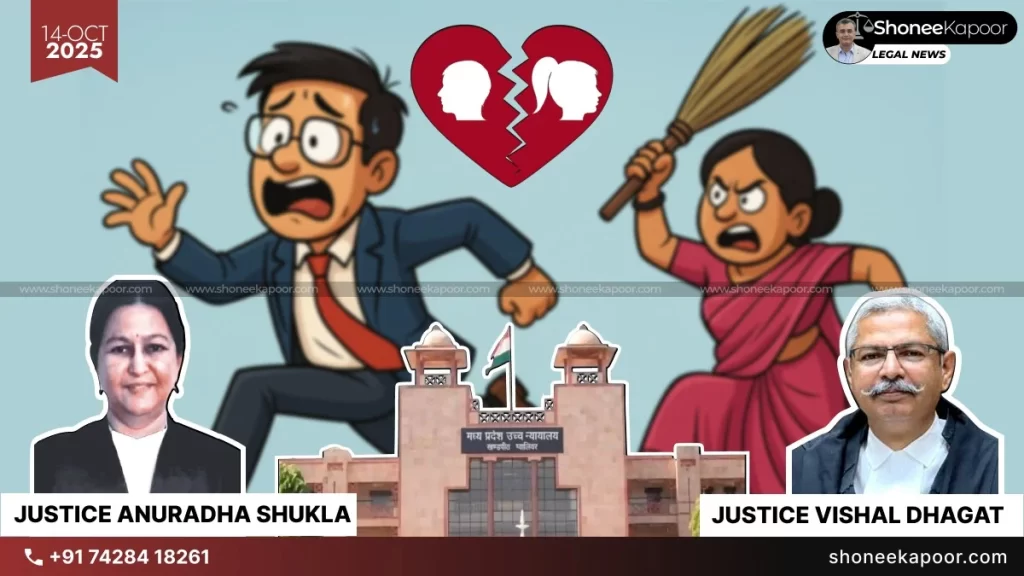
Wife’s Anger No Excuse For False Affair Allegations Against Husband: Madhya Pradesh High Court Grants Divorce
Vaibhav Ojha
False Affair Allegations Against Husband
The Madhya Pradesh High Court granted divorce to a husband falsely accused of infidelity, ruling that anger cannot justify false allegations. The Court held that such baseless claims amount to cruelty in marriage.
Jabalpur: The Madhya Pradesh High Court has made it clear that a wife cannot use anger as an excuse for making false affair allegations of infidelity against her husband. The Court ruled that such baseless and defamatory accusations cause mental cruelty and can be valid grounds for divorce.
A Division Bench comprising Justice Vishal Dhagat and Justice Anuradha Shukla was hearing an appeal filed by a husband whose wife had accused him of having illicit relations with other women. The Court refused to accept the wife’s claim that she made the allegations “in anger”.
“The other aspect of cruelty relates to aspersions cast about the immoral character of appellant/husband and for this aspect we do not have to check merely the oral testimony of the parties as these allegations have documentation and were prominently made in Exs.-P/13 and P/14 which are the petitions filed by respondent/wife under Section 125 of Cr.P.C. and under Section 12 of the Act of 2005. It is claimed in cross-objection that wife initiated the proceeding of Section 12 of the Act of 2005 in anger but this explanation would not absolve her of the liability incurred by making baseless allegations against husband regarding his moral character.”
The couple was married in 2002 and had one child. They had been living separately for the past few years. In 2021, the husband approached the family court seeking divorce, but was only granted judicial separation in 2024. Dissatisfied, he appealed to the High Court. The wife also challenged the order, saying she wanted to resume marital life.
In its judgment dated September 25, the High Court noted that the lower court had avoided giving a definite finding on whether the husband was cruel, but had accepted that the wife had treated the husband cruelly.
“Appellant/husband had raised the ground of desertion by claiming that he was deserted by wife since 04.02.2019 but the impugned judgment reflects that the trial Court was not convinced with the aforesaid date of desertion, as for it parties continued their relationship in 2020-2021 and even thereafter and, thus, minimum two years period of desertion was not complete when the divorce petition was filed in the year 2021.”
The Court found no strong proof that the wife was rude to her husband or mother-in-law, or that she wasted money excessively. However, it found that she had made serious and false allegations about her husband’s character.
“Making baseless and false allegations of the nature of moral turpitude not only cause mental agony to the other party of marriage but it brings the marital relationship to its doom. We accede that if allegations were true then nothing should have been spared by wife to establish what was being claimed by her repeatedly or we may say that the burden to prove these grave allegations was heavily on her. As nothing worth credence has been proved by her, we find no exaggeration in the complaint of husband that he has suffered great agony on account of these allegations and has therefore been subjected to cruelty.”
The Court further noted that the wife went to the extent of claiming that she had “clicked some photographs regarding vulgar chatting of her husband, his intimacy with other women and also of carrying condoms on his solo foreign visits.”
However, the High Court rejected this so-called evidence, stating that it was inadmissible:
“The documents relating to chatting and photographs were not considered as admissible evidence by trial Court and we do not find any reason to differ with that finding as the alleged chatting marked as Ex.-D/3 are photo copies produced in evidence without any certificate about the sources and the process through which they were generated. Photographs showing condom lying over a bag do not connect with appellant/husband nor establish any fact regarding his alleged sin. Even the other photographs do not have any vulgar contents or show any intimate relationship.”
Holding that the family court had erred in denying divorce, the Bench observed:
“We are aware that relationship between the parties had gone so bitter that neither of them was having any empathy for the other, but even this kind of relationship cannot be an excuse to make false allegations regarding the moral character of the other party. Thus, on this ground of cruelty, husband deserves a decree of divorce and there is no reasoned justification in the impugned judgment for not allowing the decree of divorcee despite holding that husband was being subjected to cruelty.”
On the issue of desertion, the Court agreed with the trial court that since the couple had met several times and spent time with their daughter, there was no intention of permanent separation:
“This behaviour of the parties is not in coherence with any intention to permanently withdraw from the company of other spouse. The trial Court was therefore justified in dismissing the divorce petition on the ground of desertion.”
Finally, the Court allowed the husband’s appeal and issued a clear ruling:
“In the result, the appeal filed by appellant/husband is allowed on the ground of cruelty and the cross-objection filed by respondent/wife is dismissed. Consequently, the marriage solemnized between the parties on 08.12.2002 is declared to be dissolved on the ground of cruelty.”
Wife’s Anger No Excuse For False Affair Allegations Against Husband: Madhya Pradesh High Court Grants Divorce
Explanatory Table of Laws & Sections Mentioned
Law / Section
Statute
Purpose / Context in Case
Court’s Observation / Relevance
Section 125 CrPC
Code of Criminal Procedure, 1973
Provides for maintenance to wife, child, or parents.
Wife had filed a petition under this section making allegations about husband’s immoral character.
Section 12
Protection of Women from Domestic Violence Act, 2005
Allows an aggrieved woman to seek relief from domestic violence.
Wife filed this petition alleging cruelty and infidelity by husband; Court found her claims false.
Section 19
Family Courts Act, 1984
Provides appeal provisions from judgments of Family Courts.
Husband’s appeal was filed under this section challenging family court’s refusal of divorce.
Digital evidence admissibility (requires certificate).
Court held photos and chats inadmissible as they lacked certification and credibility.
Case Title: A v. B, First Appeal No. 642 of 2024, decided on 25 September 2024
Court: High Court of Madhya Pradesh, Jabalpur Bench
Bench Composition: Justice Vishal Dhagat and Justice Anuradha Shukla
Date of Judgment: 25 September 2024
Case Type: First Appeal under Section 19 of the Family Courts Act, 1984
Parties:
Appellant: Husband (A)
Respondent: Wife (B)
Counsels Appearing:
For Appellant: Mr. Ashish Rawat, Advocate
For Respondent: Mr. Manish Tiwari, Advocate
Result:
Appeal allowed on the ground of cruelty
Marriage dissolved (solemnized on 08.12.2002)
Cross-objection dismissed
Key Issue: Whether false allegations of infidelity made by a wife, even if done “in anger,” amount to cruelty and justify divorce.
Summary of the Verdict:
Wife’s anger cannot justify false allegations of adultery.
Baseless charges of infidelity amount to cruelty under matrimonial law.
Divorce granted to husband; wife’s cross-objection dismissed.
This ruling reinforces that false accusations of immoral conduct or infidelity can deeply harm one’s reputation and mental peace — and therefore, constitute valid grounds for divorce under Indian matrimonial law.
Disclaimer: The views and opinions expressed in this article are those of the Indian courts and do not necessarily reflect the official policy or position of “ShoneeKapoor.com” or its affiliates. This article is intended for informational and educational purposes only. The content provided is not legal advice, and viewers should not act upon this information without seeking professional counsel. Viewer discretion is advised