
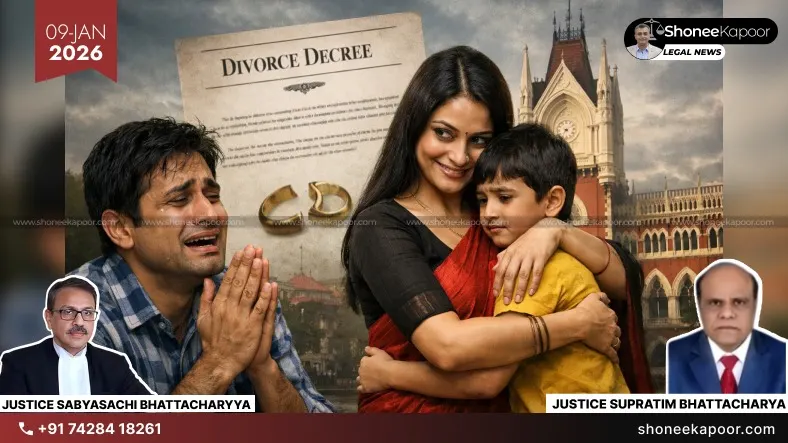
The Calcutta High Court has allowed divorce by holding that long separation, cruelty, and a completely broken marriage cannot be kept alive only in law. The Court ruled that irretrievable breakdown is part of cruelty even under the Special Marriage Act.
Kolkata: The Calcutta High Court allowed a wife’s appeal and grants divorce by setting aside the trial court’s refusal. A Division Bench of Justices Sabyasachi Bhattacharyya and Supratim Bhattacharya clearly acknowledged that a marriage which has lost its substance cannot be kept alive only on paper. The Bench made it clear that law cannot compel parties to suffer indefinitely in a relationship that has completely failed.
The case arose from a marriage solemnised under the Special Marriage Act, 1954. The wife, a government doctor, approached the court alleging long separation, financial burden, mental cruelty, and desertion. The husband opposed divorce and claimed that he wanted to continue the marriage, despite years of separation and lack of real cohabitation.
The wife alleged mental cruelty, desertion, financial exploitation, and character assassination. She claimed that the husband siphoned off loan money, depended entirely on her income, and deserted her after 2015. She also alleged that he abused her at her workplace and spread rumours about her chastity. In the plaint, she alleged that the husband used to “chat intimately” with another married woman, creating fear and mental stress.
On the other hand, the husband denied the allegations and clearly stated that he did not want divorce. He claimed that he tried to live with his wife, that he loved his son, and that he was prevented from meeting the child. He also stated that he worked as a daily labourer earning about ₹300 per day and had earlier run a business.
One striking aspect of the judgment is how the court treated pleadings and denials. The High Court repeatedly held that the husband’s replies were vague and evasive. Several allegations were treated as proved by applying the doctrine of non-traverse, meaning silence or general denial worked against the husband. This standard, when applied selectively, becomes risky for men who often lack legal sophistication and professional drafting support.
The judgment criticises the trial court for rejecting the wife’s application to record evidence of her colleagues through video conferencing on the ground that the court was not equipped. The High Court found this unacceptable and held that the wife was deprived of an opportunity to adduce evidence. However, it reflects how procedural limitations are often interpreted only in favour of wives, while men rarely receive similar latitude when procedural hurdles affect their defence.
The court relied heavily on the long period of separation and repeatedly stated that stray or occasional visits by the husband could not amount to a genuine conjugal relationship. This approach reflects a mindset where reconciliation, mediation, or rehabilitation of the husband’s role is not seriously explored once separation is established.
The High Court examined the entire record and noted that the parties had been living separately for many years, with only “stray visits” by the husband, which the Court held cannot be treated as a real marital life. The judges categorically observed that:
“Mere stray visits, once in a blue moon, cannot be equated with living a conjugal life together as husband and wife”
An important portion of the judgment discusses the husband’s financial status. The court noted contradictions in his claim of being a businessman and relied on his admission that he earned ₹300 per day as a labourer. It further observed that the wife bore the child’s education expenses and loan liabilities. What remains unaddressed is how a financially weak man is expected to survive post-divorce in a legal system where maintenance obligations, litigation costs, and compliance pressures often continue to fall heavily on men.
While granting divorce, the court repeatedly stated that poverty alone should not be a ground to penalise a husband. Yet, in practical reasoning, the discussion consistently revolves around his lack of income, dependence on the wife, and inability to match her status. This internal contradiction highlights the silent bias that often permeates matrimonial adjudication.
On irretrievable breakdown, the High Court held that although it is not a standalone statutory ground, it can be treated as part of cruelty. The court observed that forcing a dead marriage to survive would only cause further agony and that a marriage surviving “in name” serves no meaningful purpose. While this reasoning appears progressive, it disproportionately impacts men because similar judicial sympathy is rarely extended when husbands seek exit from long-dead or emotionally abusive marriages.
While referring to Supreme Court decisions such as Rakesh Raman v. Kavita and V. Bhagat v. D. Bhagat, the High Court did not reproduce their text but applied their settled principles. The essence drawn from these rulings is that cruelty is not confined to physical abuse alone and that prolonged separation, emotional bitterness, and erosion of marital bond may constitute mental cruelty.
Ultimately, the High Court dissolved the marriage, set aside the trial court judgment, and granted the husband only limited visitation rights. He was permitted to meet his son once a month for two hours in a public place. This again reflects the harsh reality faced by Indian fathers, where even after years of litigation, emotional investment, and financial contribution, they are reduced to regulated visitors in their child’s life.
This judgment, while framed as balanced and pragmatic, reinforces a larger systemic concern: Indian matrimonial law continues to operate on narratives and presumptions that disproportionately disadvantage men. Financial weakness, imperfect pleadings, or emotional withdrawal by a husband are easily converted into findings of cruelty, while men’s vulnerability, poverty, dignity, and parental rights remain secondary. For men navigating marital breakdown, this ruling is not a reassurance of fairness — it is a reminder of how unequal the system still remains.
Explanatory Table – Laws & Sections Involved
| Laws and Sections | Purpose | Why It Mattered in This Case |
| Special Marriage Act, 1954 – Section 27(1)(d) | Divorce can be granted on ground of cruelty. | Court held that long separation and dead marriage amount to cruelty and granted divorce under this section. |
| Hindu Marriage Act, 1955 – Section 13(1)(i-a) | Cruelty as ground for divorce. | Used for interpretation because wording is similar to Special Marriage Act; Supreme Court principles applied. |
| Code of Civil Procedure – Order XLI Rule 27 | Allows additional evidence in appeal. | Wife sought to bring workplace witnesses; trial court wrongly blocked evidence earlier. |
| Code of Civil Procedure – Section 25 | Power to transfer cases. | Referred while discussing Supreme Court powers in matrimonial matters. |
| Constitution of India – Article 141 | Supreme Court law is binding on all courts. | High Court applied Supreme Court ruling that breakdown of marriage is part of cruelty. |
| Constitution of India – Article 142 | Supreme Court power to do complete justice. | Discussed while distinguishing limits of High Court and Supreme Court powers. |
| Indian Penal Code – Sections 498A, 406, 34 | Matrimonial cruelty, breach of trust, common intention. | Husband claimed criminal cases were filed, affecting cohabitation narrative. |
| Doctrine of Non-Traverse (Evidence Law) | If allegations are not clearly denied, they are treated as admitted. | Husband’s vague denials strengthened cruelty and desertion findings. |
Case Summary
- Case Title: Dr. Soma Mandal Debnath Vs. Sri Tanmoy Debnath, F.A. No. 190 of 2022, IA No: CAN 2 of 2022 and CAN 3 of 2024
- Court: High Court at Calcutta – Civil Appellate Jurisdiction
- Bench: Hon’ble Mr. Justice Sabyasachi Bhattacharyya and Hon’ble Mr. Justice Supratim Bhattacharya
- Dates:
- Judgment Reserved on: 18.12.2025
- Judgment Delivered on: 08.01.2026
Counsels:
- For the Appellant (Wife):
- Mr. Pappu Adhikary
- Mr. Somnath Banerjee
- Mr. Pradip Pal
- For the Respondent (Husband):
- Mr. Ayan Mitra
- Ms. Moumita Dhar
Key Takeaways
- Long separation now dissolves marriages easily when wives seek divorce, leaving men little scope to reconcile or defend.
- Weak or vague replies by husbands are treated as admissions, putting men at legal risk due to poor drafting or resources.
- A husband’s financial weakness is silently used against him, despite claims that poverty should not be punished.
- Procedural gaps favour wives, while men rarely receive similar judicial flexibility.
- Fathers are reduced to limited visitation, keeping men’s parental rights secondary.
This Could Change Your Case-Get FREE Legal Advice-Click Here!
Disclaimer: The views and opinions expressed in this article are those of the Indian courts and do not necessarily reflect the official policy or position of “ShoneeKapoor.com” or its affiliates. This article is intended for informational and educational purposes only. The content provided is not legal advice, and viewers should not act upon this information without seeking professional counsel. Viewer discretion is advised.