
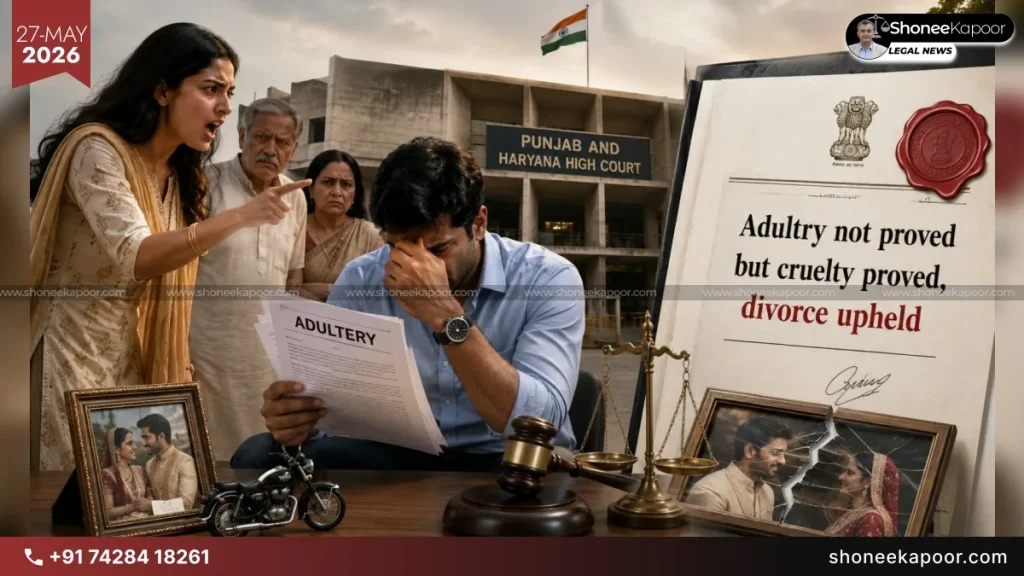
A husband finding his wife with her alleged Ex still not enough to prove adultery? Punjab & Haryana High Court held that one isolated meeting with an alleged ex-partner is not enough to legally prove an adulterous relationship.
CHANDIGARH DIVORCE: The Punjab & Haryana High Court recently delivered a judgment clarifying that suspicion alone cannot be treated as proof of adultery in matrimonial disputes.
The Court made it clear that simply meeting an ex-partner once does not mean that a married person is involved in an adulterous relationship. The Bench also observed that a relationship before marriage cannot automatically become evidence of adultery after marriage.
“The conduct of respondent-wife in meeting the person (with whom she was allegedly in a relationship much prior to marriage) alone on January 11, 2023, being a single incident, cannot be said to mean that she was living in adultery with him. Nor can her previous relationship with him before marriage tantamount to an offence of adultery for the respondent-husband.”
Read Also: How to Send a Legal Notice for Divorce in India: Format, Process, Grounds & Legal Tips 2026The Bench ruled
The case arose from a matrimonial dispute involving a marriage solemnised on November 16, 2021. No child was born from the marriage. The husband, who was serving in the Indian Navy, accused his wife of continuing a relationship with another man even after marriage.
According to the husband, his wife was “quarrelsome and short-tempered”, often came home late, refused to sleep with him and spent long hours talking to strangers on her mobile phone. He later claimed that he discovered that she had allegedly been in a relationship with another man even before the marriage.
The husband further alleged that on January 11, 2023, he found his wife at the residence of that man. He stated that he called her father and brother to the spot, where she was allegedly found “in compromising position” before she was taken back to her parental home.
The wife denied all allegations made by the husband. She instead accused the husband and his family of dowry harassment. She also alleged that her father-in-law had “bad eyes” on her and claimed that despite informing her husband about this conduct, he supported his father instead of supporting her.
However, the Family Court found major contradictions in her statements. The High Court referred to the Family Court’s observations and reproduced the findings in detail.
“It is highly improbable to believe that the wife would commute with the same person i.e. her father-in-law, who is having bad eyes on her. Meaning thereby, her allegations that her father-in-law, who is admittedly old aged person, had bad eyes on her, are false. Making such like reckless, irresponsible and false allegations on the character of father of petitioner and defaming him in the pleadings before the Court in present petition, is apparently a serious cruelty against the petitioner…”
The Court also noted that the wife’s dowry allegations did not stand during cross-examination. She admitted that the Bullet motorcycle, which she had earlier claimed was given in dowry, was actually never given.
“Meaning thereby the claim made by the respondent in her reply is found false and an apparent attempt to defame the petitioner by levelling false allegations of dowry,”
The Family Court observed
The trial court had already concluded that repeatedly making false allegations against the husband and his family without evidence amounted to cruelty under matrimonial law. While the allegation of adultery was not legally proved, the Court found that the conduct of the wife and the false accusations caused serious mental cruelty to the husband.
The High Court agreed with the findings of the Family Court and held that the marriage was rightly dissolved, not because adultery was proved, but because false allegations and reckless accusations had damaged the marriage completely.
Referring to the final conclusion, the High Court stated that the Family Court judgment did not require any interference.
The High Court ultimately upheld the divorce granted in favour of the husband and dismissed the wife’s appeal after finding that the marriage had irretrievably broken down due to false allegations, character attacks and mental cruelty caused to the husband and his family.
Explanatory Table: Laws And Provisions Involved
| Law / Provision | Purpose | How Applied In This Case |
| Mental Cruelty Under Hindu Marriage Law | To protect a spouse from conduct causing serious emotional, mental or reputational harm within marriage | The Court held that repeated false allegations against the husband and his family amounted to mental cruelty sufficient for divorce |
| Adultery As Ground For Divorce | To determine whether a spouse maintained a voluntary sexual relationship outside marriage | The Court clarified that one isolated meeting with an ex-partner was not enough to legally prove adultery |
| Burden of Proof | To ensure serious allegations are supported by proper evidence before courts accept them | The husband’s suspicion alone was not treated as conclusive proof of adultery by the High Court |
| Evidence Through Cross-Examination | To test truthfulness and reliability of statements made before the Court | During cross-examination, the wife admitted that the alleged Bullet motorcycle dowry was never actually given |
| False Dowry Allegations | Courts examine whether dowry accusations are genuine or made to defame the opposite party | The Court observed that the dowry allegations appeared false and were made to defame the husband and his family |
| Reputation And Defamation Within Matrimonial Litigation | To protect parties from reckless and unsupported character attacks in court proceedings | Allegations that the father-in-law had “bad eyes” on the wife were found unreliable and defamatory |
| Appreciation Of Conduct Of Parties | Courts assess overall behaviour and conduct of spouses during marriage and litigation | The Court analysed the conduct, contradictions and allegations of both parties before sustaining divorce |
| Appellate Review By High Court | To examine whether the Family Court judgment suffered from legal error requiring interference | The High Court found no error in the Family Court judgment and dismissed the wife’s appeal |
| Dissolution Of Marriage | To legally end a marriage where continuation becomes impossible due to cruelty or breakdown of trust | The marriage was dissolved because the Court found the husband suffered mental cruelty from false allegations |
Case Details
- Case Title: Wife Vs Husband
- Court: Punjab and Haryana High Court
- Case Type: Matrimonial Appeal arising from a divorce decree passed by the Family Court
- Marriage Date: 16 November 2021
- Husband’s Profession: The husband was serving in the Indian Navy
- Ground For Divorce: Mental Cruelty
Key Takeaways
- A man’s life and reputation cannot be destroyed merely on suspicion without proper proof.
- Meeting an ex-partner once does not automatically make someone adulterous.
- False dowry allegations and reckless accusations can mentally destroy husbands and their families.
- Men also suffer emotional harassment, social humiliation and character assassination in matrimonial disputes.
- Allegations should be backed by evidence because assumptions and emotional narratives can ruin innocent families.
This Could Change Your Case-Get FREE Legal Advice-Click Here!
Disclaimer: The views and opinions expressed in this article are those of the Indian courts and do not necessarily reflect the official policy or position of “ShoneeKapoor.com” or its affiliates. This article is intended for informational and educational purposes only. The content provided is not legal advice, and viewers should not act upon this information without seeking professional counsel. Viewer discretion is advised.